Delhi High Court Rejects "Agony of the Moment" Defense: Drivers Must Anticipate Road Hazards and Stray Animals
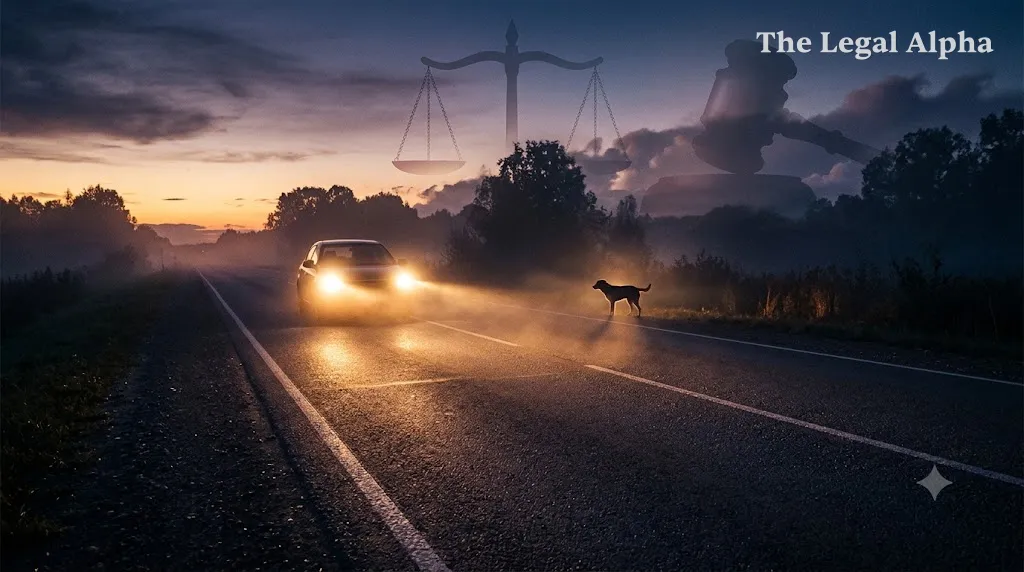
The Delhi High Court dismissed an appeal filed by an insurance company challenging an award of approximately ₹1.7 crore plus interest granted to the legal heirs of a road accident victim, Satish Chandra Gupta. The accident occurred when a car swerved at high speed to avoid a stray dog suddenly appearing on the road, causing the vehicle to overturn. The passenger sustained severe injuries resulting in quadriplegia and subsequently passed away. The insurer attempted to avoid liability by invoking the "agony of the moment" doctrine, but the High Court held that road users in India frequently disregard regulations, placing a duty on every driver to anticipate such hazards and maintain strict control over vehicle speed.
Legal Topic
Area of Law: Tort Law & Motor Vehicles Law
Sub-topic: Motor Accident Claims / Negligence / Doctrine of Agony of the Moment
Core Legal Issue
The central legal question was whether a driver swerving sharply at high speed to evade an animal (a stray dog) qualifies as a legitimate defense under the "agony of the moment" doctrine to negate negligence, or whether stray animals and irregular traffic patterns on Indian roads are foreseeable conditions requiring drivers to exercise a higher standard of care and maintain complete vehicle control.
What Did the Court Decide?
The High Court dismissed the insurer's appeal and upheld the Motor Accidents Claims Tribunal (MACT) award of ₹1.7 crore with accrued interest. The court directed the insurer to deposit the remaining 50% of the award amount, along with interest, with the Registrar General for immediate disbursement to the legal heirs of the deceased. The bench clarified that determining negligence depends on the totality of circumstances and whether the driver exercised the degree of reasonable care expected under ordinary Indian road conditions.
Key Legal Points
-
Duty of Foreseeability: A driver cannot escape liability simply because a stray animal stepped onto the road, as such occurrences are foreseeable conditions that require calibrated speed and vigilance.
-
Limited Scope of the "Agony of the Moment" Doctrine: This defense primarily applies to sudden, unavoidable emergencies triggered by third-party wrongdoing, not typical, anticipateable road hazards like stray animals.
-
Contextual Standard of Driving: Given the tendency of road users to ignore traffic rules and the frequent presence of hazards, drivers are required to operate within limits that allow for safe deceleration and stopping.
-
Standard of Proof in Accident Claims: Negligence under motor vehicle claims is adjudicated on the balance and preponderance of probabilities rather than proof beyond reasonable doubt.
Relevant Law
-
Motor Vehicles Act, 1988: Provisions governing compensation claims before the Motor Accidents Claims Tribunal (MACT) and statutory insurer liabilities.
-
Law of Torts: Core principles of actionable negligence, reasonable care, duty to other road users, and the doctrine of "agony of the moment."
Arguments of the Parties
Insurer (Appellant)
-
Argued that the driver faced a sudden, unforeseen emergency caused by a stray dog crossing unexpectedly into the car's path.
-
Contended that swerving was an instinctive reaction during a moment of crisis ("agony of the moment"), which should exonerate the driver from a finding of actionable negligence.
Claimants / Legal Heirs (Respondents)
-
Argued that the driver was operating the vehicle at excessive speed and failed to account for prevailing road and traffic conditions.
-
Emphasized the extensive medical documentation and catastrophic expenses incurred while managing the victim's quadriplegia prior to his demise.
Why Does It Matter?
This ruling sets a strict standard for both drivers and motor insurance companies across India. It reinforces that stray animals and unexpected obstacles cannot serve as automatic shields to bypass liability or claim sudden emergency. The decision prevents insurers from leaning on reflexive-action defenses when vehicle speed and inadequate care are the proximate causes of an accident, establishing clear guidance that the duty to anticipate common Indian road hazards rests squarely with the driver.
Legal Takeaway
The presence of stray animals or disorderly traffic is an ordinary, foreseeable condition on Indian roads that does not negate driver negligence. Motorists bear an affirmative duty to regulate their speed and drive with sufficient care to handle sudden, routine obstacles safely without causing harm to passengers or third parties.
Sources
Primary Source:
Delhi High Court judgment in ICICI Lombard General Insurance Co. Ltd. v. Satish Chandra Gupta & Ors. [MAC.APP. 585/2016], presided over by Justice Anish Dayal.
Additional Sources:
Case reports and coverage by Hindustan Times and Press Trust of India (PTI).