Supreme Court Pivots to Vehicular Emissions in Delhi-NCR, Demands Inter-State Enforcement Blueprint
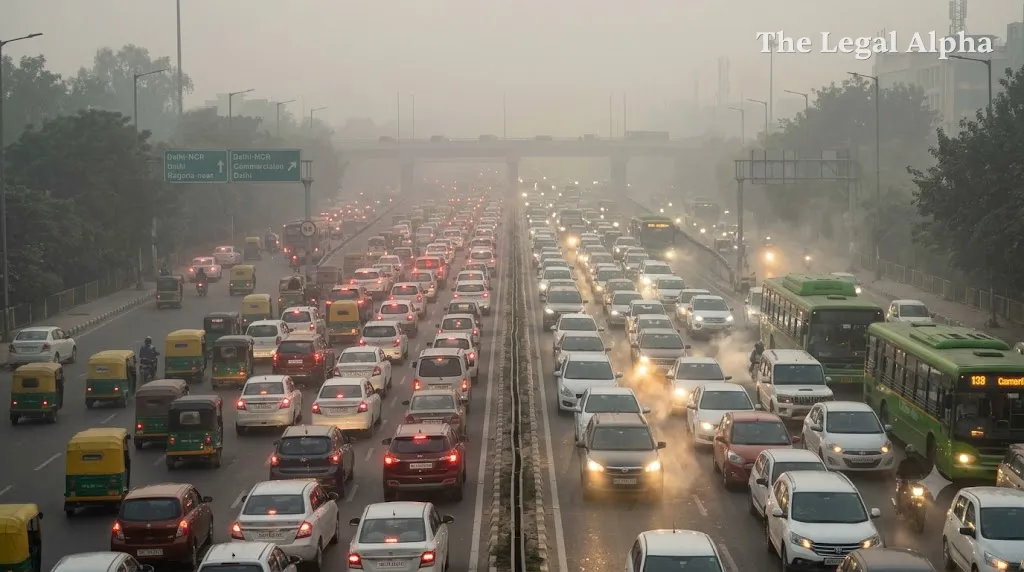
The Supreme Court of India has shifted its scrutiny directly toward vehicular pollution as air quality across the National Capital Region (NCR) dropped into hazardous territory. Noting that seasonal farm fires showed a decline while regional transit emissions escalated, a three-judge bench issued a stern order directing the Delhi government, the Municipal Corporation of Delhi (MCD), Delhi Police, and the neighbouring states of Haryana, Rajasthan, and Uttar Pradesh to submit comprehensive action plans on how they police polluting vehicles.
The court intervened after data highlighted that vehicle exhaust constitutes the single largest component of Delhi’s local atmospheric toxicity, prompting the bench to demand empirical proof of border checks, emission standard audits, and measures to remove end-of-life automobiles from arterial roads.
Legal Topic
Area of Law: Environmental Law & Public Health Jurisprudence
Sub-topic: Air Quality Management / Judicial Enforcement of Environmental Standards
Core Legal Issue
The fundamental legal question before the apex court centers on whether regional authorities and state administrations are fulfilling their statutory mandates under clean air legislation to monitor, restrict, and penalise non-compliant vehicular sources.
Beyond individual municipal enforcement, the court is addressing systemic governance failures: how effectively inter-state regulatory frameworks coordinate across state borders to enforce vehicular emission thresholds, phase out non-compliant engines, and uphold citizens' fundamental rights to a clean, non-toxic environment.
What Did the Court Decide?
A bench comprising Chief Justice of India Surya Kant, Justice Joymalya Bagchi, and Justice V. Mohana held that vehicular exhaust across the economically interconnected NCR requires "urgent and immediate intervention". Rather than issuing blanket prohibitions, the court directed the concerned state governments and municipal agencies to file exhaustive affidavits detailing their administrative machinery within two weeks.
Specifically, the court required the authorities to disclose:
-
Verification procedures for Pollution Under Control (PUC) certifications.
-
Concrete data showing the number of vehicles inspected, penalised, impounded, or turned away at borders for non-compliance.
-
Concrete steps taken to detect and remove overage or end-of-life vehicles from roads.
-
Inter-state coordination protocols governing vehicles that traverse state boundaries daily.
The court structured its calendar into focused thematic tracks, scheduling the dedicated hearing on vehicular emissions for November 23, while listing companion matters concerning solid waste management, crop burning, construction dust, and urban tree canopy across late November.
Key Legal Points
-
Shift in Evidentiary Scrutiny: Relying on compliance figures regarding the Graded Response Action Plan (GRAP) and findings from the Commission for Air Quality Management (CAQM), the bench formally pivoted from agricultural residue burning to metropolitan transport emissions as the prime driver of toxic spikes.
-
Demand for Verifiable Administrative Output: The court moved past policy declarations, requiring empirical enforcement metrics, including audit logs, border inspections, and prosecution figures.
-
Inter-State Accountability: The bench underlined the geographic interconnectedness of Delhi and surrounding industrial hubs, indicating that isolated municipal crackdowns are legally insufficient without reciprocal compliance from contiguous states.
-
Procedural Segmentation: In a novel case-management step, the bench divided the broad air pollution suo motu proceedings into distinct operational subject areas to ensure accountability on specific pollution drivers.
Relevant Law
-
Constitution of India: Article 21 (Right to life and clean environment) and Article 32 (Supreme Court’s writ jurisdiction for public interest enforcement).
-
Commission for Air Quality Management in National Capital Region and Adjoining Areas Act, 2021: Statutory mechanisms governing coordinating guidelines, regional emissions monitoring, and enforcement powers.
-
The Motor Vehicles Act, 1988 (read with the Central Motor Vehicles Rules, 1989): Provisions regulating vehicular roadworthiness, vehicular emission certifications, and deregistration of overage vehicles.
-
Air (Prevention and Control of Pollution) Act, 1981: Statutory mandate directing state pollution control boards to monitor ambient air quality and curb vehicular contaminants.
Arguments of the Parties
-
The Amicus Curiae and Union Submissions: Senior Advocate Aparajita Singh, serving as amicus curiae, along with Additional Solicitor General Aishwarya Bhati, presented data illustrating that while stubble burning had significantly declined between late October and early November, overall air pollution levels remained severe. They argued that vehicular emissions now constitute the acute driver of toxic air spikes and highlighted that state administrations had failed to fully demonstrate compliance with earlier judicial directions issued earlier in the year.
-
The State and Municipal Authorities: While the state administrations acknowledged the application of emergency measures under GRAP Stage III, the bench noted that routine mechanisms—such as localized traffic diversions and water sprinkling—appeared inadequate against sustained bumper-to-bumper congestion, prompting the court to demand formal affidavits outlining actionable solutions.
Why Does It Matter?
This development signals a transition from seasonal firefighting to structural regulatory audits. For years, regional discourse prioritized stubble burning as the primary autumn villain. By holding up CAQM findings that pin nearly a quarter of winter pollutants on vehicle pipes, the Supreme Court has set a legal precedent that will likely tighten emissions surveillance across commercial transit and private transport.
For interstate commercial transport operators and private motorists, this judicial focus could soon translate into tighter vehicle age bans, rigorous digital PUC audits, and increased border-point checks. Furthermore, by breaking the proceedings into thematic hearing tracks, the apex court is building a framework to enforce administrative compliance on specific municipal and state agencies.
Legal Takeaway
The Supreme Court has clarified that regional air-pollution remedies cannot focus exclusively on seasonal crop burning while vehicular compliance remains under-enforced. Going forward, state administrations in the National Capital Region must justify their regulatory oversight with verifiable enforcement metrics or risk judicial coercion under environmental protection jurisprudence.
Sources
-
Primary Source: Supreme Court of India, Order dated November 8, 2026, in In Re: Air Pollution in Delhi-NCR and Adjoining Areas (Suo Motu / Companion Petitions), coram Surya Kant, CJI, Joymalya Bagchi, J., and V. Mohana, J.
-
Additional Sources: Commission for Air Quality Management (CAQM) Assessment Reports on Delhi-NCR Emission Inflow; Central Pollution Control Board (CPCB) Daily Air Quality Index Reports for Delhi-NCR.