Supreme Court Mandates Dedicated Bar Rooms and Sanitation for Women Advocates Across District Courts, Bars Fiscal Constraints as Excuse
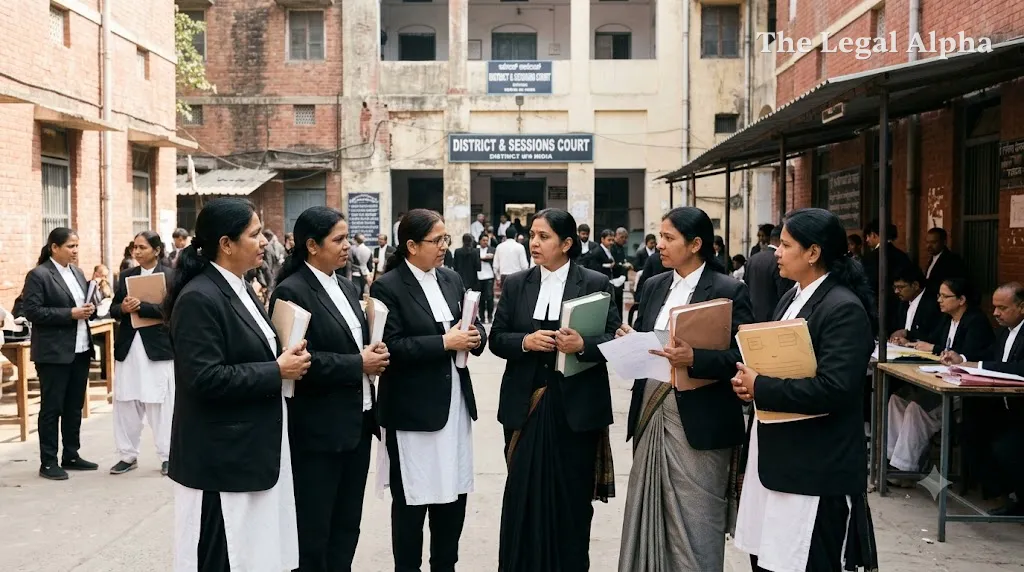
The Supreme Court of India directed all State governments, Union Territories, and High Courts to sanction necessary funds and allocate land to construct dedicated bar rooms, hygienic washrooms, and essential amenities for women legal practitioners across district, sub-divisional, and taluka courts.
A three-judge Bench led by the Chief Justice of India disapproved of the systemic neglect of women's working spaces across lower court complexes. The Court made it clear that basic infrastructural amenities must be provided in every court complex where women advocates practice, irrespective of how few they may be in number. Emphasising that these requirements are non-negotiable, the Bench directed administrative authorities to overcome budgetary and spatial hurdles immediately and scheduled compliance reviews for December 2, 2026.
Legal Topic
Area of Law: Constitutional Law / Judicial Administration
Sub-topic: Gender Justice, Dignity in the Legal Profession, and Court Infrastructure
Core Legal Issue
The core legal question before the Supreme Court is whether the failure of State governments and judicial administrations to provide basic workplace sanitation and designated facilities for women advocates violates their constitutional rights to equality, non-discrimination, and the right to practice a profession with dignity.
Specifically, the Court examined whether administrative and fiscal constraints—such as budgetary deficits or spatial shortages in sub-district courts—can legally justify denying female advocates access to essential working facilities guaranteed under the Constitution.
What Did the Court Decide?
The Supreme Court held that the provision of basic amenities, including dedicated women’s bar rooms and clean toilets, is a mandatory obligation binding on High Courts and executive governments alike.
Key directives and observations include:
-
Mandatory Provision: High Courts and State administrations must guarantee exclusive bar rooms equipped with adequate amenities wherever women advocates practice, without conditioning the infrastructure on minimum headcount thresholds.
-
Rejection of Financial and Spatial Defenses: The Bench held that neither a lack of dedicated funds nor land constraints can justify non-compliance, directing authorities to requisition land and allocate supplemental budgets where needed.
-
Next Steps: The Supreme Court posted the matter for further monitoring on December 2, 2026, directing authorities to report tangible progress on fund allocations and physical execution. While the legal requirement has been made absolute, the implementation mechanics across individual states remain under judicial monitoring.
Key Legal Points
-
Workplace Dignity as a Fundamental Right: Safe working environments, privacy, and sanitation for legal practitioners form an intrinsic part of the guarantee to practice a profession with human dignity under Articles 19(1)(g) and 21 of the Constitution.
-
Institutional Obligation Over Headcount: The presence of even a single female practitioner requires equal institutional access; fundamental facilities cannot be deferred pending higher female enrollment.
-
Fiscal Inability Is No Defense: The State cannot cite resource scarcity or land acquisition bottlenecks to avoid fulfilling core constitutional duties tied to judicial infrastructure.
-
Equal Opportunity in the Bar: Structural neglect of sanitation and professional spaces acts as an institutional barrier that disproportionately pushes women out of active courtroom litigation.
Relevant Law
-
Article 14 of the Constitution of India: Equality before the law and equal protection of the laws, barring institutional arbitrariness in court administration.
-
Article 15(1) & 15(3) of the Constitution of India: Prohibition of sex-based discrimination and positive mandate for special provisions benefiting women.
-
Article 19(1)(g) of the Constitution of India: Fundamental freedom to practice any profession, carry on any occupation, trade, or business unhindered by hostile working conditions.
-
Article 21 of the Constitution of India: Right to life and personal dignity, encompassing basic health, hygiene, and privacy in public workplaces.
-
Advocates Act, 1961: Governance of legal practitioners and bar associations in maintaining professional standards and welfare.
Arguments of the Parties
Petitioner / Applicant
The petitioners highlighted that women lawyers in district, sub-divisional, and taluka complexes face acute physical hardship due to absent or unhygienic washrooms and lack of separate resting and preparation spaces. It was contended that the absence of basic infrastructure severely impedes female retention in trial court litigation, violating their fundamental rights to equality and professional dignity.
Respondent / State Authorities
State authorities and administrative respondents submitted that older court complexes frequently face extreme physical space limitations, land availability bottlenecks, and municipal budgetary shortages. They contended that infrastructure overhauls require staggered administrative approvals, public works coordination, and progressive budgetary allocations.
Why Does It Matter?
While national discourse frequently addresses gender parity in the higher judiciary, the daily obstacles encountered by women practitioners in lower courts remain one of the steepest barriers to career longevity in litigation. By stripping States of the defense of budgetary shortfalls, the Supreme Court has re-characterized basic court sanitation from a discretionary amenity into an actionable constitutional requirement.
If enforced effectively across taluk and district courts, this ruling directly addresses the retention leak in the legal pipeline, ensuring junior and rural women lawyers are not forced out of trial advocacy by unlivable court environments.
Legal Takeaway
The Supreme Court has confirmed that basic professional infrastructure—including exclusive bar rooms and clean sanitation—is a non-negotiable prerequisite for women practicing at all levels of the judiciary. Administrative and financial constraints cannot excuse an institution's failure to provide equal, dignified working conditions guaranteed by the Constitution.
Sources
Primary Source:
Supreme Court of India, Order dated October 26, 2026, in Sarika Tyagi v. Union of India (Bench of CJI Surya Kant, Justice Joymalya Bagchi, and Justice V. Mohana).
Additional Sources:
Reports and proceedings compiled by Press Trust of India, India Today, and The Hindu.