Supreme Court Fireworks Timings Flouted in Noida and Ghaziabad as Post-Diwali Enforcement Stalls
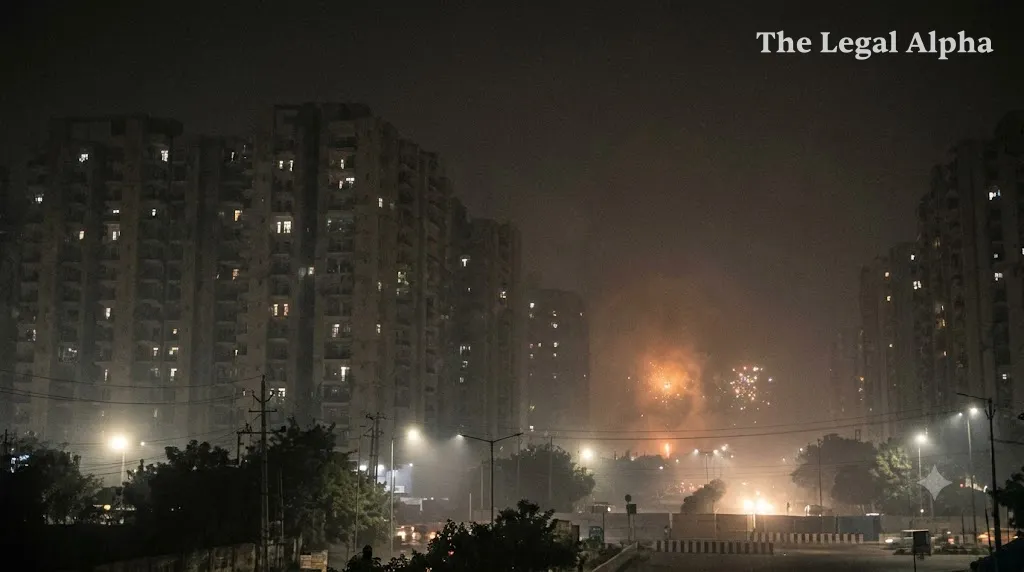
Residents across Noida and Ghaziabad openly flouted the Supreme Court’s designated festive time slots during Diwali celebrations, setting off high-decibel firecrackers into the early morning hours. Despite targeted judicial directives limiting cracker use to specific two-hour windows and permitting solely certified green fireworks, roadside sales persisted near residential complexes, and fireworks continued until sunrise. The widespread defiance has reignited concerns regarding the administrative failure of local police and municipal authorities to enforce apex court mandates on air pollution in the National Capital Region (NCR).
Legal Topic
Area of Law: Environmental Law Sub-topic: Judicial Enforcement / Air Pollution Control Regulations
Core Legal Issue
The controversy centres on the enforceability of judicial directions under Article 142 of the Constitution of India when balancing religious and cultural festivities against the fundamental right to clean air under Article 21.
Specifically, the issue involves whether executive machinery and law enforcement agencies are incurring liability for civil contempt by failing to implement court-mandated restrictions on the sale, distribution, and temporal regulation of firecrackers in non-attainment and pollution-critical areas.
What Did the Court / Authority Decide?
In the run-up to the festive period, the Supreme Court issued a calibrated order relaxing the complete blanket prohibition by permitting only Council of Scientific and Industrial Research–National Environmental Engineering Research Institute (CSIR-NEERI)-certified green crackers bearing verified QR codes.
The Court restricted bursting strictly to specified slots—6:00 AM to 7:00 AM and 8:00 PM to 10:00 PM—and prohibited conventional fireworks, joined crackers (laris), and formulations containing banned chemicals such as barium salts. The bench directed state administrative machinery and police patrolling teams to confiscate non-compliant items, book violators, and file compliance affidavits detailing prosecutions and hospital admissions, warning that administrative failure would invite contempt proceedings. The Court has scheduled follow-up compliance reviews to assess ground-level adherence and air quality monitoring data.
Key Legal Points
-
Right to Health vs. Freedom of Celebration: The Supreme Court reaffirmed that no cultural or commercial freedom under Article 19 can override the non-negotiable right to life and public health guaranteed under Article 21.
-
Absolute Ban on Barium Salts: Reaffirming earlier precedents, the use of toxic formulations and non-certified fireworks remains an offence under environmental control legislation.
-
Vicarious Accountability of Law Enforcement: The apex court reiterated that district magistrates and police chiefs bear personal responsibility for ensuring compliance with judicial prohibitions within their jurisdictions.
-
Polluter Pays Principle: Commercial entities and unauthorized roadside vendors operating outside designated zones face immediate licence revocation and confiscation of goods.
Relevant Law
-
Constitution of India: Article 21 (Protection of life and personal liberty, interpreting the right to clean air) and Article 142 (Enforcement of decrees and orders of Supreme Court).
-
Air (Prevention and Control of Pollution) Act, 1981: Sections 19, 21, and 31A regarding control areas, emission standards, and statutory directions.
-
Environment (Protection) Act, 1986: Section 5 (Power to issue directions) and Section 15 (Penalties for non-compliance).
-
Judicial Precedent: Arjun Gopal and Others v. Union of India (2018), laying down framework rules on green crackers and festival time limits.
Arguments of the Parties
Petitioners & Public Interest Intervenors The petitioners contended that toxic particulate spikes during winter meteorological inversion cause irreversible respiratory harm to children, senior citizens, and patients with pre-existing ailments. They submitted that weak policing renders judicial directives ineffective on the ground and argued that local administrations must face strict accountability for contempt when unauthorized sales and round-the-clock bursting go unchecked.
State Authorities & Administrative Bodies The State submitted that extensive public advisories and patrolling guidelines were issued across Noida, Ghaziabad, and the wider NCR. Counsel argued that policing high-density gated societies, public parks, and sprawling suburban sectors poses significant operational friction during festive hours, while maintaining that inspections, unauthorized stock seizures, and compliance reporting are being actively pursued.
Why Does It Matter?
The recurrent flouting of fireworks deadlines in major NCR satellite cities exposes a persistent gap between judicial rule-making and street-level execution. Delegating compliance management to informal advisories or private resident welfare associations has proven structurally ineffective.
This systematic breakdown raises the likelihood of intensified judicial scrutiny, where higher courts may resort to summoning top bureaucratic officials and ordering institutional audits of district monitoring squads. It also casts doubt on whether future regulatory compromises—such as green-cracker allowances—will survive if regulatory bodies cannot enforce basic temporal limits.
Legal Takeaway
Judicial declarations of fundamental rights remain abstract without strict administrative and penal deterrence at the street level. Until state enforcement agencies are held systematically accountable for omissions, temporal and environmental limits set by the Supreme Court risk becoming paper orders during regional pollution peaks.
Sources
Primary Source: Supreme Court of India, Arjun Gopal and Others v. Union of India & Ors. (Writ Petition (Civil) No. 728 of 2015), Directives and Orders regulating firecracker usage, certifications, and compliance mandates in Delhi-NCR.
Additional Sources: Central Pollution Control Board (CPCB) monitoring frameworks; Commission for Air Quality Management (CAQM) notifications; Uttar Pradesh Pollution Control Board regional enforcement reports.