Supreme Court Directs Faster Hearings for 22 Lakh Deleted Voters in West Bengal
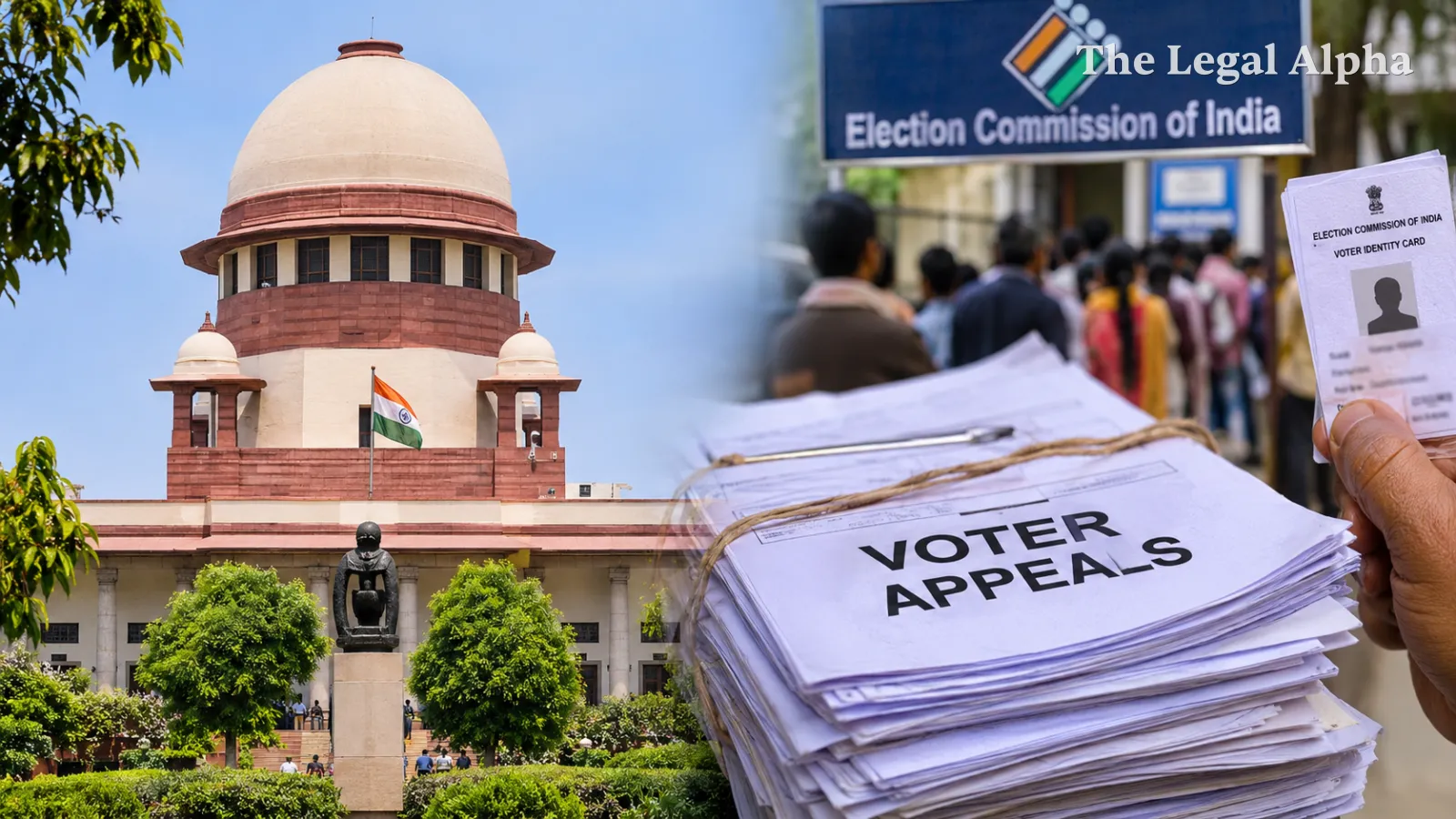
The Supreme Court of India has directed appellate tribunals dealing with West Bengal's voter-list disputes to prioritise appeals filed by people whose names were removed from electoral rolls during the Special Intensive Revision (SIR) exercise. The direction seeks to address the growing backlog of voter appeals and ensure that people challenging their exclusion receive timely decisions.
The Court has also asked the Election Commission of India (ECI) to strengthen the appellate mechanism and improve access to tribunals, particularly in Kolkata, where municipal elections are approaching.
What Happened?
On November 23, 2026, a three-judge Bench comprising Chief Justice of India Surya Kant, Justice Joymalya Bagchi and Justice V. Mohana issued directions concerning the disposal of appeals arising from the Special Intensive Revision of electoral rolls in West Bengal.
The Court was informed that approximately 38.31 lakh appeals had been filed before the appellate tribunals. Of these, 22.21 lakh appeals were submitted by voters seeking restoration of their deleted names, while another 16.10 lakh challenged the inclusion of certain individuals in the electoral rolls.
Considering the substantial number of pending matters, the Supreme Court directed the tribunals to give preference to appeals filed by excluded voters rather than treating both categories of disputes equally.
Legal Topic
Area of Law: Constitutional Law and Election Law
Sub-topic: Electoral Rolls, Right to Vote and Appellate Remedies under the Representation of the People Act, 1950.
Core Legal Issue
The central legal issue concerns the timely adjudication of appeals filed by individuals whose names have been removed from electoral rolls during the SIR exercise. The Court was required to consider how the appellate mechanism could deal with a substantial number of pending disputes, particularly where delays could affect an individual's opportunity to participate in forthcoming elections.
Another important question concerns the handling of appeals challenging the inclusion of voters. The proceedings also raised concerns about the legal authority under which certain appeals seeking deletion of names had been filed by officials associated with the Chief Electoral Officer's office.
What Did the Supreme Court Decide?
The Supreme Court directed the appellate tribunals to divide the pending matters into two separate categories:
-
Appeals by excluded voters: Cases filed by individuals whose names were deleted from electoral rolls must receive priority in final disposal.
-
Appeals challenging voter inclusion: These matters may be deferred for the time being because the Court considered them less urgent.
-
Kolkata Municipal Corporation area: Appeals involving voters from constituencies falling within the municipal corporation's limits must receive additional priority because of the forthcoming civic elections.
-
Additional tribunals: The Election Commission must consult the Chief Justice of the Calcutta High Court and increase the strength of the appellate tribunals.
-
Better tribunal facilities: The Election Commission must identify alternative premises at different locations in Kolkata to make the appellate process more accessible.
The Court's directions are interim procedural measures intended to accelerate the disposal of pending appeals. They do not automatically restore the names of all excluded voters or finally determine the validity of the SIR exercise.
Key Legal Points
-
The right to participate in elections depends on a person's eligibility and inclusion in the electoral rolls under the applicable election laws.
-
Appeals against deletion of names and objections to the inclusion of voters involve different categories of electoral disputes.
-
The Supreme Court has recognised the urgency of resolving exclusion-related appeals before forthcoming elections.
-
The Election Commission has been directed to strengthen the institutional capacity of appellate tribunals.
-
The legal authority for appeals challenging voter inclusion remains a separate issue raised during the proceedings and has not been finally resolved by these interim directions.
Relevant Law
Representation of the People Act, 1950
-
Section 21: Preparation and revision of electoral rolls.
-
Section 22: Correction of entries in electoral rolls.
-
Section 23: Inclusion of names in electoral rolls.
-
Section 24: Appeals against orders concerning electoral roll matters.
Registration of Electors Rules, 1960
- Rule 23: Provides the appellate mechanism against specified decisions of Electoral Registration Officers.
Constitution of India
-
Article 324: Vests the superintendence, direction and control of elections in the Election Commission of India.
-
Article 326: Provides for elections to the House of the People and State Legislative Assemblies on the basis of adult suffrage, subject to constitutional and statutory qualifications.
These provisions provide the statutory and constitutional framework for electoral roll preparation, correction, inclusion and election administration.
Arguments of the Parties
Petitioners
Advocate Prashant Bhushan, appearing for the petitioners, highlighted the substantial backlog before the appellate tribunals. He submitted that approximately 38 lakh appeals had been filed but only a relatively small number had been decided.
He further pointed out that a significant proportion of decided appeals had resulted in relief for voters whose names were deleted. He urged the Court to ensure that excluded voters received timely decisions, particularly those from Kolkata who could be affected by forthcoming municipal elections.
Senior Advocate Gopal Sankaranarayanan also questioned the legal basis of appeals filed by officials from the West Bengal Chief Electoral Officer's office against the inclusion of certain voters. He argued that the statutory framework did not support the manner in which those appeals had been instituted.
Election Commission and Respondents
The Election Commission's position, as reflected in its earlier submissions, was that the appeals had been filed by officials exercising statutory authority under the electoral law framework.
The respondents also contested allegations concerning the consequences of voter deletions for access to public welfare benefits. The State's response to these allegations was sought separately by the Court.
Why Does It Matter?
The Supreme Court's directions have important implications for electoral participation and the administration of elections in West Bengal.
The large number of pending appeals raises concerns about whether voters whose names were removed will receive an effective opportunity to challenge their exclusion before upcoming elections.
Prioritising these cases could help prevent procedural delays from undermining eligible voters' ability to participate in the electoral process. The special preference given to Kolkata Municipal Corporation constituencies reflects the importance of resolving electoral disputes before local elections take place.
The direction to increase the number of tribunals is also significant. A larger appellate mechanism, supported by more accessible hearing locations, could improve the speed and convenience of resolving electoral disputes.
However, the order should not be interpreted as a final judicial finding that all deletions were unlawful. Each appeal will still require consideration under the applicable legal framework.
Legal Takeaway
The Supreme Court has emphasised that appeals filed by voters excluded from electoral rolls must receive priority, particularly when forthcoming elections could affect their opportunity to vote. The directions reinforce the importance of timely appellate remedies and an accessible electoral dispute-resolution mechanism. The underlying disputes concerning voter inclusion and exclusion remain subject to adjudication.
Sources
Primary Source:
- Supreme Court of India, daily cause list dated November 23, 2026, identifying Mostari Banu v. Election Commission of India, W.P. (C) No. 1089/2025 and connected SIR matters.
Additional Sources: