Supreme Court Backs Stricter BS-VI Vehicle Restrictions in Delhi to Tackle Air Pollution
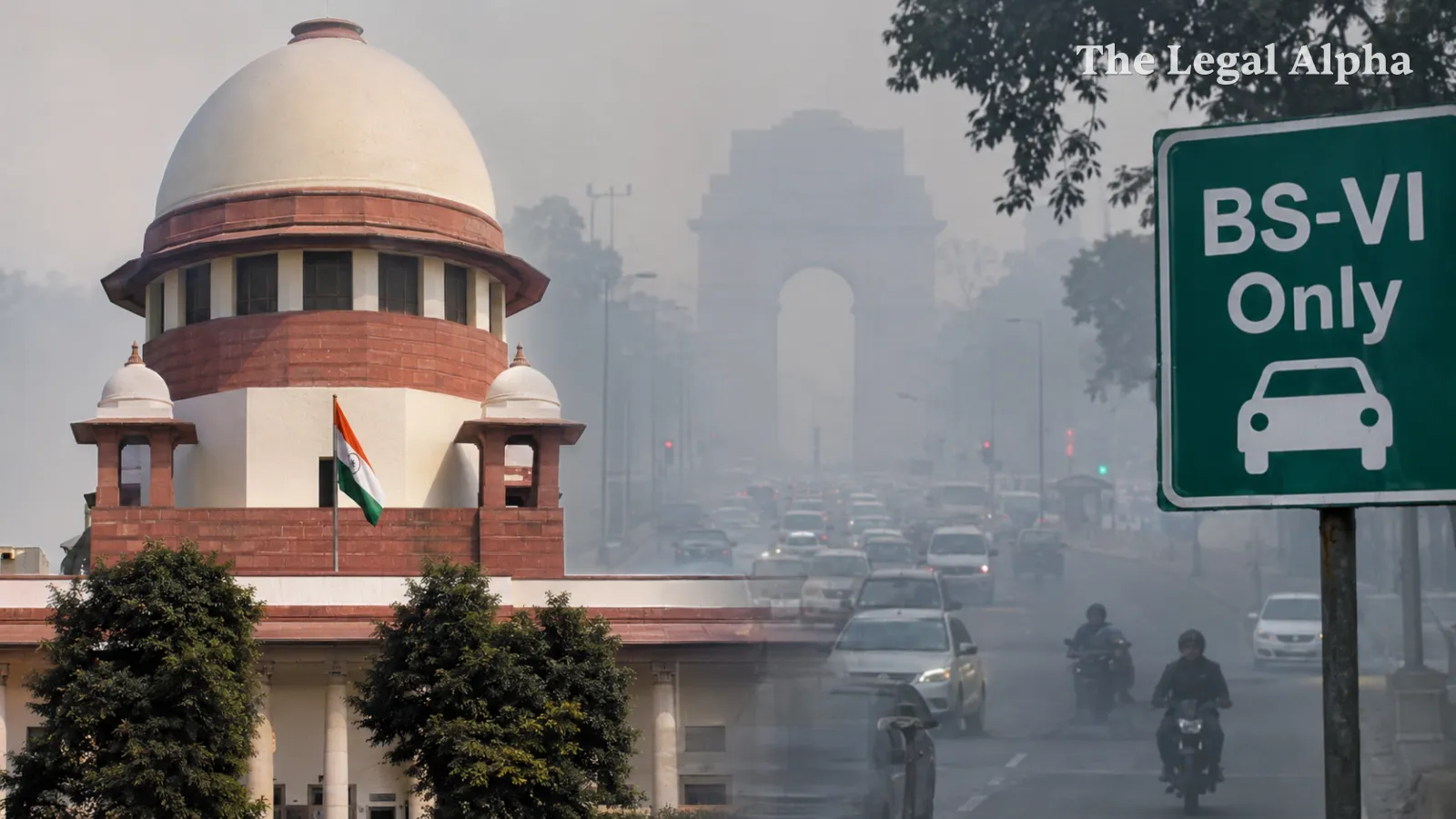
The Supreme Court has indicated its support for restricting vehicles operating in Delhi to those complying with Bharat Stage-VI (BS-VI) emission standards, as it examines stronger measures to address the national capital's recurring air pollution crisis.
During a hearing on November 23, 2026, a three-judge Bench headed by Chief Justice of India Surya Kant, along with Justice Joymalya Bagchi and Justice V. Mohana, expressed its inclination towards allowing only BS-VI-compliant vehicles in Delhi, potentially extending the restriction to the wider National Capital Region (NCR).
The Court's observations came during ongoing proceedings concerning vehicular pollution and the effectiveness of existing regulatory measures. However, its remarks should not be treated as a final judicial direction imposing a new blanket restriction.
What Happened?
The Supreme Court is examining whether stricter restrictions on older and more polluting vehicles are necessary to improve air quality in Delhi and neighbouring areas.
During the November 23 hearing, the Bench indicated that limiting vehicles to those meeting BS-VI emission standards could be an effective step. It also discussed the possibility of reducing the movement of heavy commercial vehicles within Delhi and developing alternative arrangements for transporting essential goods.
The proceedings form part of the Court's broader examination of air pollution, including vehicle emissions, enforcement of pollution-control requirements and coordination between Delhi and neighbouring states.
Legal Topic
Area of Law: Environmental Law
Sub-topic: Air Pollution Control, Vehicular Emission Standards and Environmental Regulation
Core Legal Issue
The central legal question is whether the Supreme Court can require stricter restrictions on vehicles that do not comply with BS-VI emission standards to reduce vehicular pollution in Delhi and the National Capital Region.
The matter also raises questions about the responsibility of neighbouring states to control vehicle emissions, enforce Pollution Under Control (PUC) requirements and coordinate with Delhi authorities to address pollution that crosses state boundaries.
What Did the Supreme Court Observe?
The Bench expressed a clear preference for allowing only BS-VI-compliant vehicles in Delhi, potentially extending the requirement to the entire NCR.
During the hearing, the Court also addressed concerns raised regarding BS-IV vehicles. A lawyer pointed out that owners of such vehicles were facing difficulties obtaining PUC certificates, affecting their ability to obtain fuel.
The Chief Justice indicated that the existing position should continue for approximately another month while the matter was considered.
The Court also explored longer-term alternatives to reduce commercial vehicle traffic in Delhi. These included establishing warehouses near the city's borders, where goods could be transferred to battery-operated vehicles for transportation within the capital.
The Bench suggested that such arrangements could be developed over the next five years, even if immediate implementation was not practical.
Importantly, the November 23 hearing did not result in a final blanket judicial order imposing a new BS-VI-only restriction across Delhi-NCR. The proposal remains under consideration.
The Court also sought affidavits from the concerned states explaining their pollution-control measures and asked their respective Advocate Generals to appear at the next hearing.
Key Legal Points
-
BS-VI emission compliance: The Supreme Court favours stricter vehicle emission standards as an important measure to address vehicular pollution.
-
Interstate coordination: Pollution-control efforts require cooperation between Delhi and neighbouring states, particularly Haryana, Uttar Pradesh and Rajasthan.
-
PUC certification: The availability and enforcement of Pollution Under Control certificates for vehicles remain an important issue.
-
Commercial vehicle restrictions: The Court is exploring alternatives to reduce the entry of heavy commercial vehicles into Delhi.
-
Long-term environmental planning: Border warehouses and battery-operated transport have emerged as possible solutions for reducing emissions within the capital.
Relevant Law
Bharat Stage-VI Emission Standards
BS-VI standards prescribe stricter emission limits for motor vehicles. They became mandatory across India for manufacturing, sale and registration of new vehicles from April 1, 2020.
Air (Prevention and Control of Pollution) Act, 1981
The legislation provides the broader statutory framework for preventing, controlling and reducing air pollution in India.
Environment (Protection) Act, 1986
The Act empowers the Central Government to take measures for protecting and improving environmental quality and regulating pollution.
Commission for Air Quality Management in National Capital Region and Adjoining Areas Act, 2021
This legislation establishes the Commission for Air Quality Management (CAQM), which coordinates and oversees air-quality management measures in the NCR and adjoining areas.
Graded Response Action Plan (GRAP)
GRAP provides a framework of progressively stricter emergency measures to address deteriorating air quality in Delhi-NCR.
Arguments of the Parties
Concerns Raised Before the Court
A lawyer representing the concerns of BS-IV vehicle owners pointed out that these vehicles were facing difficulties obtaining PUC certificates and, consequently, accessing fuel.
The concern was that restrictions affecting older vehicles could create practical difficulties for owners who rely on them for their daily activities.
Position of the Authorities
Additional Solicitor General Aishwarya Bhati, appearing for the Commission for Air Quality Management, referred to the measures already undertaken by authorities to control pollution.
The authorities also highlighted the contribution of existing restrictions and enforcement measures towards reducing vehicular emissions.
Observations of the Court
The Bench questioned the limited involvement of neighbouring states and emphasised that controlling pollution in Delhi requires coordinated efforts across the NCR.
It also examined whether commercial vehicle movement could be reduced through alternative transportation arrangements without disrupting essential supplies.
Why Does It Matter?
The Supreme Court's observations could have significant implications for vehicle owners, transport operators, businesses and commuters across Delhi-NCR.
A stricter BS-VI requirement, if eventually implemented through appropriate directions, could affect owners of older petrol and diesel vehicles, particularly those travelling into Delhi from neighbouring states.
Commercial transport operators may also face changes in how goods are delivered to the capital. The proposed use of border warehouses and battery-operated vehicles could require investment in new transportation infrastructure.
The proceedings also highlight an important environmental governance issue: air pollution cannot be addressed effectively through isolated action by one state. Vehicle movement, emission standards and enforcement mechanisms require coordination between multiple jurisdictions.
At the same time, any new restrictions will need to consider practical concerns involving livelihoods, public transportation and the uninterrupted movement of essential commodities.
Legal Takeaway
The Supreme Court has signalled its support for stronger BS-VI vehicle restrictions as part of a wider effort to tackle Delhi-NCR's air pollution problem. However, its November 23 observations are not equivalent to a final blanket ban. The next stage of the proceedings will be important in determining what additional restrictions and coordinated measures may be introduced.
Sources
Primary Source:
- Supreme Court of India – Order dated November 6, 2026, in Suo Motu Writ Petition (Civil) No. 11/2026.
Additional Sources: