State Held Accountable: Supreme Court Directs ₹6 Lakh Payout After Shoddy Police Probe Jails Man for Six Years
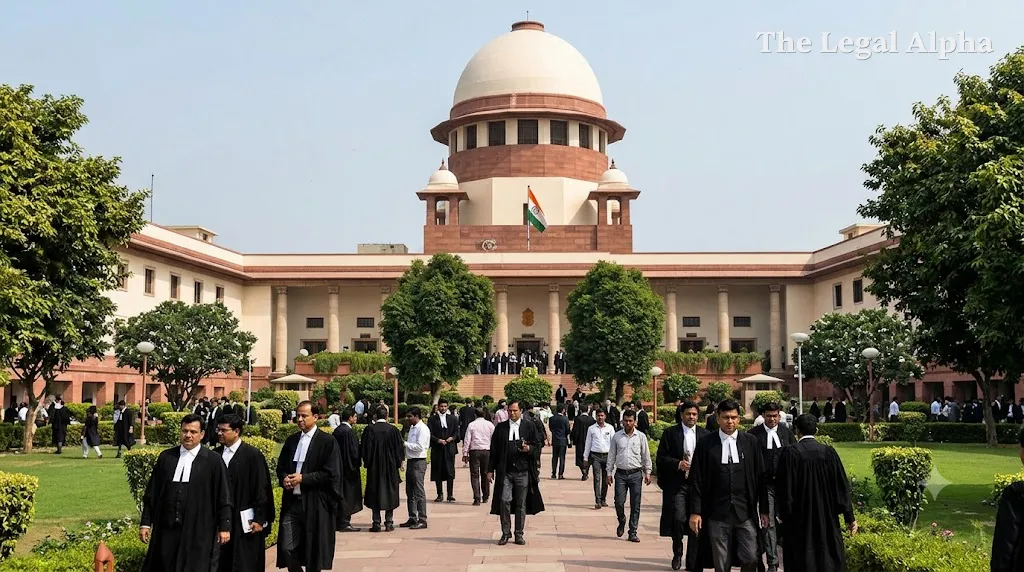
The Supreme Court of India directed the State of Uttar Pradesh to pay ₹6,00,000 in compensation to an acquitted individual, Arun alias Deepak, who spent six years incarcerated as an undertrial. The case arose from an FIR registered in 2019 at Achhnera Police Station in Agra concerning charges of abduction and murder.
A Division Bench comprising Justice J.B. Pardiwala and Justice K. Vinod Chandran observed that the individual's prolonged incarceration stemmed from a botched and superficial police investigation. The Court emphasized that six critical years of a person's life were stripped away based entirely on conjectures and an unverified narrative concocted by investigators.
Legal Topic
-
Area of Law: Criminal Jurisprudence / Constitutional Law
-
Sub-topic: Compensation for Unlawful Incarceration / Police Negligence & Article 21 Rights
Core Legal Issue
The matter addressed whether an individual whose constitutional right to personal liberty under Article 21 is compromised by a grossly negligent, slipshod, and baseless police investigation is entitled to monetary restitution from the State, even after securing an acquittal at trial.
What Did the Court Decide?
The Supreme Court ruled that the petitioner was a victim of systemic investigative failure and warranted direct public law reparation.
-
Compensation Awarded: Ordered the State of Uttar Pradesh to deposit ₹6,00,000 to the petitioner to partially compensate for the unrecoverable loss of six years of personal freedom.
-
Censure of State Machinery: Characterized the probe as a textbook example of "how an investigation should not be proceeded with" and noted that the State's machinery acted without conducting even a rudimentary inquiry before depriving a citizen of liberty.
-
Institutional Directives: Emphasized the urgent necessity for the State administration to properly train and educate investigating officers in lawful, forensic, and objective criminal investigation techniques to prevent similar miscarriages of justice.
Key Legal Points
-
Public Law Restitution for Article 21 Violations: The judiciary can award monetary compensation under public law remedies when gross negligence by investigative agencies results in prolonged and unjustified deprivation of liberty.
-
Flawed Circumstantial Evidence: The prosecution's case rested purely on speculative links—namely unverified CCTV footage and the statement of a co-accused—none of which formed an unbroken chain of circumstantial evidence.
-
Investigative Accountability: State authorities cannot plead immunity or treat prolonged undertrial incarceration casually when the underlying charge sheet is demonstrably devoid of basic evidentiary support.
Relevant Law
-
Constitution of India: Article 21 (Protection of life and personal liberty) and Article 32 / 142 (Constitutional remedies and power to ensure complete justice).
-
Indian Penal Code, 1860 (now Bharatiya Nyaya Sanhita, 2023): Sections 364 (Kidnapping/abduction in order to murder), 302 (Murder), and 201 (Causing disappearance of evidence).
-
Judicial Precedents: Rudul Sah v. State of Bihar and Nilabati Behera v. State of Orissa (Establishing state liability and compensation under public law for violations of fundamental rights).
Arguments of the Parties
-
The Petitioner: Submitted that he had been behind bars since November 2019 without any cogent material tying him to the crime. The defense highlighted that the trial court found none of the prosecution's projected circumstances proved, proving his detention was an egregious miscarriage of justice.
-
The State: Contended that the initial detention and charges were based on contemporaneous evidentiary materials collected during the early probe, including purported surveillance footage and statements implicating the accused.
Why Does It Matter?
This decision reinforces strict judicial scrutiny over investigative laxity in India's criminal justice system. In a system where undertrials comprise the vast majority of prison populations, acquittals often arrive too late to restore lost livelihoods, reputations, and years of life. By imposing direct financial liability on the State for slipshod police inquiries, the Supreme Court signals that procedural delinquency and baseless framing carry tangible institutional consequences.
Legal Takeaway
Prolonged imprisonment resulting from reckless or incompetent police inquiries is an actionable violation of Article 21 that warrants financial compensation from the State. An acquittal alone does not automatically cure systemic state failures when an individual has been unjustly deprived of their fundamental liberty.
Sources
-
Primary Source: Supreme Court of India, Arun @ Deepak v. State of U.P., Bench of Justice J.B. Pardiwala and Justice K. Vinod Chandran (Order dated October 26, 2026; Arising out of FIR No. 367/2019, P.S. Achhnera, District Agra).
-
Additional Sources: Supreme Court proceedings and reporting verified via Law Trend and LawChakra.