Sikkim High Court Directs Urgent Installation of Early Warning Systems Across 40 High-Risk Glacial Lakes to Avert GLOF Disasters
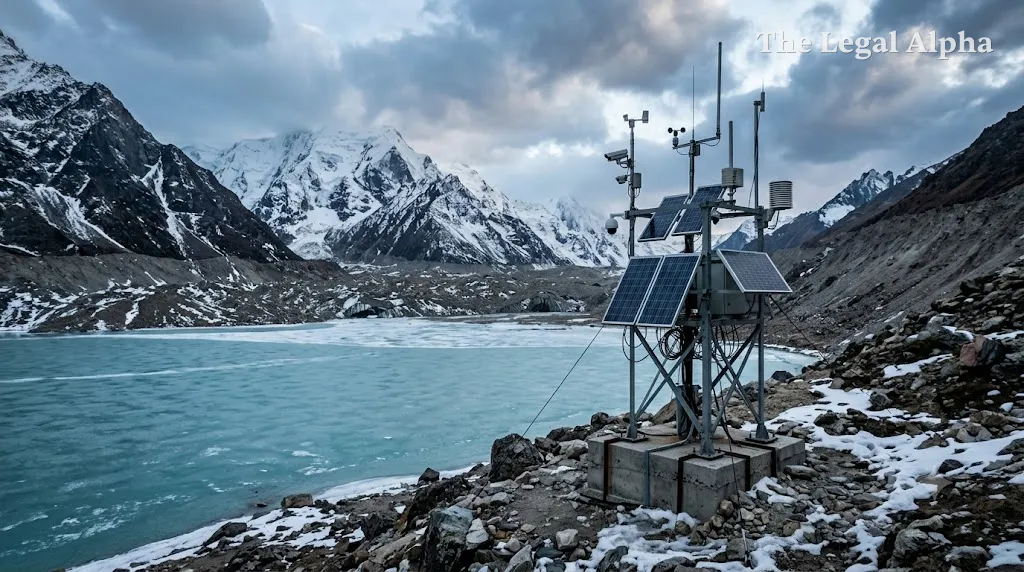
The High Court of Sikkim called upon both the Union and State governments to immediately take steps toward procuring and installing automated Early Warning Systems (EWS) across 40 high-risk glacial lakes identified in the Himalayan State. Hearing a suo motu public interest litigation on climate justice, a Division Bench comprising Chief Justice A. Muhamed Mustaque and Justice Bhaskar Raj Pradhan observed that proactive structural and technological safeguards are critical to avoiding another catastrophic Glacial Lake Outburst Flood (GLOF). The directions were prompted by lingering vulnerabilities following the October 2023 South Lhonak lake outburst, which breached downstream barriers and destroyed key infrastructure across the Teesta valley.
Legal Topic
-
Area of Law: Environmental and Constitutional Law
-
Sub-topic: Climate Justice, Disaster Risk Governance, and the Precautionary Principle
Core Legal Issue
The core legal question centers on the affirmative constitutional and statutory obligation of governments under Article 21 and the Disaster Management Act, 2005 to deploy preemptive mitigation technology in ecologically fragile zones.
The court examined whether administrative reliance on reactive relief satisfies the State's duty to safeguard citizens' right to life and safety when scientific assessments already pinpoint specific, existential natural hazard sites.
What Did the Court / Authority Decide?
The Division Bench persuaded both the Central Government and the Sikkim Government to initiate prompt action for early warning infrastructure, citing comparable systems already operational in Himachal Pradesh, Uttarakhand, and neighboring Bhutan.
The Court further considered structural proposals, such as assigning designated nodal officers to monitor high-risk water bodies individually, and took note of amicus submissions highlighting the broader economic and ecological fallout of erratic weather patterns in the region. Without issuing final binding adjudications on every policy detail, the Bench sought an updated status and action-taken report from the authorities, scheduling the next compliance hearing for November 18, 2026.
Key Legal Points
-
Shift from Reactive Relief to Precautionary Prevention: Judicial oversight in disaster jurisprudence requires governments to implement technology before catastrophe occurs, reinforcing the precautionary principle.
-
Regional Benchmarking in Disaster Mitigation: The Bench underscored that technological standards already adopted in neighboring Himalayan regions should serve as a working benchmark for state preparedness.
-
Institutional Accountability: The court focused on systemic administrative fixes, including the allocation of specific departmental responsibility for each vulnerable site.
-
Wider Scope of Climate Justice: The proceedings linked macro-level natural hazards with grassroots socio-economic vulnerabilities, emphasizing that climate change manifests across multiple systemic fronts.
Relevant Law
-
Constitution of India: Article 21 (Right to life, expanded to include protection against climate-induced hazards and the right to a safe environment) and Article 48A (Protection and improvement of environment)
-
Disaster Management Act, 2005: Sections establishing statutory duties of the National Disaster Management Authority (NDMA) and State Disaster Management Authorities (SDMA) to mandate prevention, mitigation, and preparedness measures
-
Environmental Jurisprudence: The Precautionary Principle enunciated under international conventions and domestic environmental precedents
Arguments of the Parties
-
Amicus Curiae / Petitioner Side: Highlighted the immediate hazard posed by the 40 glacial lakes cataloged by disaster management authorities. The amicus urged the court to direct specific monitoring protocols, warning devices, and accountable nodal administration, pointing to empirical reports illustrating climate impacts on vulnerable sectors.
-
State and Union Governments: Submissions placed on record previous baseline assessments and existing coordination with technical bodies. Government counsel accepted the need for coordinated risk reduction and sought time to present detailed steps taken under administrative programs and ongoing technical appraisals.
Why Does It Matter?
This intervention reflects a critical evolution in how constitutional courts handle climate litigation in India. Rather than reviewing projects purely after ecological damage has occurred, the High Court is enforcing positive obligations on state apparatuses to manage known climate vulnerabilities.
The direction carries operational and financial consequences for infrastructure developers, hydropower projects, and civil protection authorities operating downstream in mountain valleys. By demanding parity with peer Himalayan territories, the order sets a standard for accountability that could influence disaster readiness litigation across other ecologically sensitive mountain states.
Legal Takeaway
The ruling establishes that when scientific data unequivocally identifies high-risk hazards, constitutional governance demands preemptive warning systems rather than retrospective emergency response. State authorities hold an ongoing legal obligation to implement timely, available technologies to safeguard life and public infrastructure against foreseeable climate crises.
Sources
-
Primary Source: High Court of Sikkim, Order dated November 5, 2026, in In re: Climate Justice in the State of Sikkim (WP(C) Suo Motu PIL)
-
Additional Sources: National Disaster Management Authority (NDMA) Glacial Lake Risk Inventories; Department of Science and Technology, Government of Sikkim baseline documentation