Schools Must Enforce Anti-Bullying Protections Across Haryana, Punjab and Haryana High Court Rules
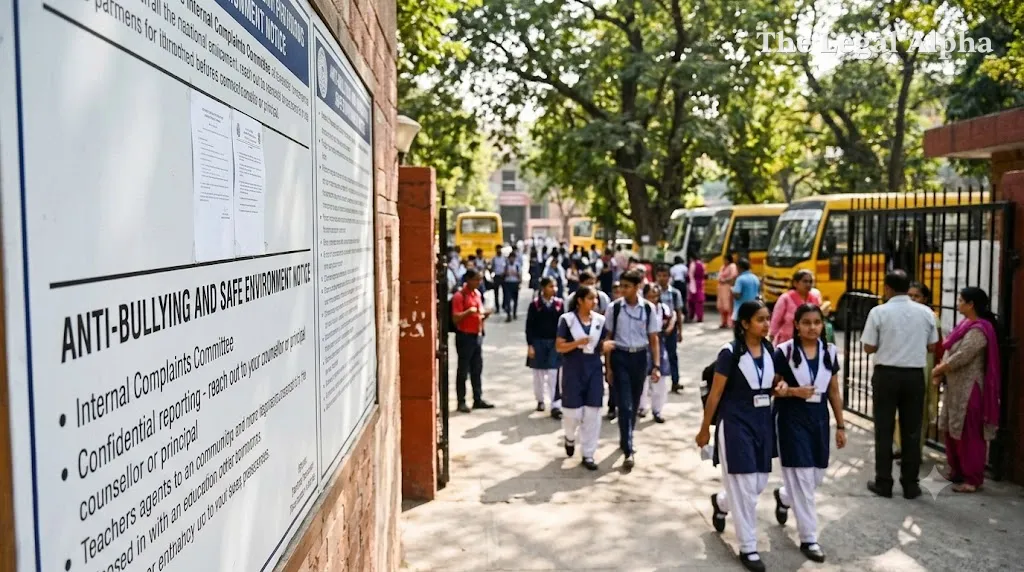
The Punjab and Haryana High Court directed the Department of School Education, Haryana, and the Central Board of Secondary Education (CBSE) to ensure the mandatory and rigorous implementation of anti-bullying safeguards across all schools in the State. The ruling emerged from a petition filed by the mother of a 16-year-old student who died by suicide in Faridabad in February 2022 after facing persistent harassment and bullying.
Justice Manisha Batra observed that existing regulatory safeguards and circulars had remained largely on paper, leaving vulnerable students unprotected. The Court instructed educational authorities to ensure every school establishes a functioning internal complaint committee, guarantees confidential grievance redressal, and mandatorily reports cognizable offences to law enforcement authorities within three months.
Legal Topic
-
Area of Law: Constitutional Law / Child Protection Law
-
Sub-topic: Institutional Safeguards / School Regulatory Compliance and Student Welfare
Core Legal Issue
The principal legal issue before the High Court was whether the absence of enforced anti-bullying frameworks infringes upon students' rights to a safe educational environment, and whether fresh judicial guidelines were required where comprehensive statutory guidelines and board circulars already exist.
The Court examined the enforcement gap between existing administrative directions—such as CBSE anti-bullying circulars and apex court precedents—and actual ground-level compliance by private and state-run educational institutions.
What Did the Court Decide?
-
Declined New Framework / Emphasised Enforcement: The Court declined to frame entirely new nationwide guidelines, holding that adequate regulations already exist under CBSE mandates and Supreme Court rulings, but held that administrative inaction has rendered them ineffective.
-
Mandatory Internal Committees: All schools operating in Haryana, across all board affiliations, must operationalise internal grievance mechanisms that explicitly entertain complaints of harassment and bullying based on gender, gender identity, and sexual orientation.
-
Confidential Redressal and Police Referral: Schools must ensure complaints are handled with strict promptness and confidentiality. Where an inquiry reveals the commission of a cognizable offence, institutions are legally obligated to report the matter immediately to the police.
-
Compliance Timeline: The State Education Department and CBSE were directed to ensure full institutional compliance within three months.
-
Trial Independence: The Bench clarified that its observations would not prejudice or influence ongoing criminal proceedings against individual school authorities or accused individuals before the trial court.
Key Legal Points
-
Institutional Accountability: Educational institutions owe a continuous duty of care to their pupils; administrative circulars are binding obligations rather than discretionary guidelines.
-
Inclusion of Marginalised Identities: Internal anti-bullying protocols must explicitly encompass discrimination, harassment, and bullying targeted at gender identity and sexual orientation.
-
Statutory Duty to Report: Schools cannot treat severe bullying as mere internal disciplinary matters; disclosing cognizable offences triggers a statutory obligation to notify criminal investigative agencies.
-
Implementation Over Proliferation: The judiciary underlined that creating redundant frameworks is futile when regulatory bodies fail to monitor and enforce existing circulars.
Relevant Law
-
Article 21, Constitution of India: The fundamental right to life, dignity, and education in a safe, non-hostile institutional environment.
-
Code of Criminal Procedure, 1973 (CrPC) / Bharatiya Nagarik Suraksha Sanhita, 2023 (BNSS): Mandatory reporting provisions relating to information concerning cognizable offences.
-
CBSE Guidelines on Prevention of Bullying and Ragging in Schools (2015 Circulars): Directives mandating school anti-bullying committees, appointment of counsellors, and safe reporting channels.
-
Judicial Precedents: Sukdeb Saha v. Union of India and associated Supreme Court directives addressing student welfare, mental health, and prevention of institutional distress.
Arguments of the Parties
-
The Petitioner argued that systemic institutional apathy and the school administration's failure to address repeated complaints of bullying led directly to the student's distress and subsequent suicide. The petitioner submitted that educational authorities failed to provide safe reporting mechanisms and sought directions for judicial monitoring as well as comprehensive safeguards to protect vulnerable students.
-
The State and CBSE contended that detailed safety guidelines, anti-bullying circulars, and counselling mandates are already in place for affiliated institutions. They submitted that individual institutional lapses do not point to a statutory vacuum and maintained that criminal investigations into the incident were proceeding in accordance with law.
Why Does It Matter?
This ruling shifts the judicial focus from formulating fresh circulars to strictly enforcing administrative compliance. By explicitly mandating protection mechanisms against harassment based on gender identity and sexual orientation, the High Court provides critical institutional coverage for LGBTQIA+ and vulnerable students who face disproportionate hostility in educational spaces.
For school managements, the order heightens institutional liability. Suppressing complaints or attempting to manage incidents internally without alerting law enforcement in cases of cognizable conduct exposes school leadership to potential regulatory sanctions and criminal culpability.
Legal Takeaway
Anti-bullying and child-safety guidelines issued by boards and courts are legally enforceable institutional mandates, not voluntary recommendations. School administrators face regulatory scrutiny and statutory liability if they fail to maintain active, confidential grievance committees or omit reporting cognizable harassment to law enforcement authorities.
Sources
-
Primary Source: Judgment of the Punjab and Haryana High Court in Aarti Malhotra v. Union of India and Others (Neutral Citation: 2026:PHHC:192847), decided by Justice Manisha Batra.
-
Additional Sources: CBSE Regulatory Circulars on Institutional Anti-Bullying Committees; Supreme Court of India directives in Sukdeb Saha v. Union of India.