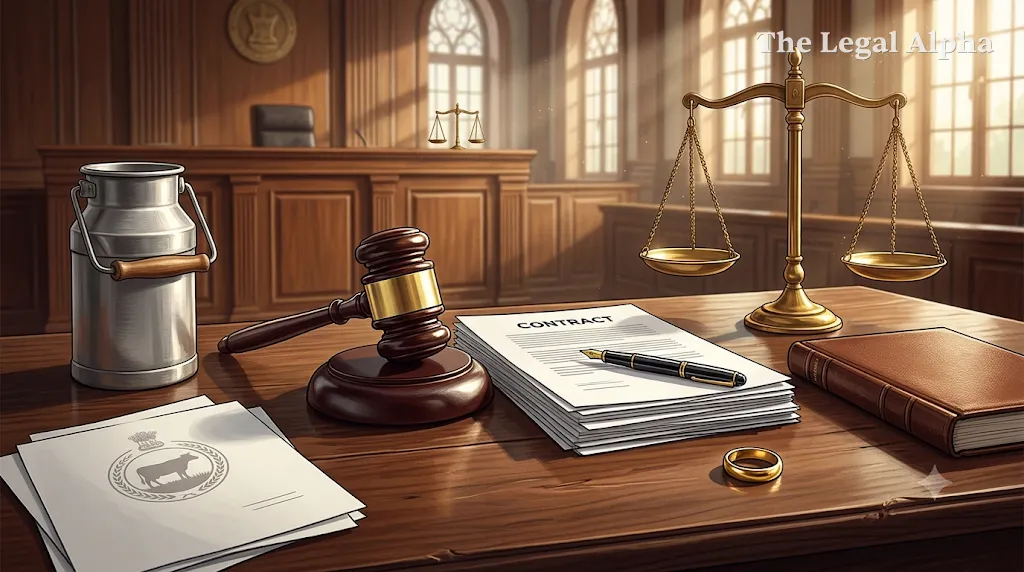
Remarriage After Husband’s Road Death Does Not Forfeit Motor Accident Compensation: Gujarat High Court

The Gujarat High Court held that an insurer cannot deny or withhold statutory motor accident compensation from a woman simply because she remarried following the demise of her husband.
The case arose from a fatal road accident in February 2009 that claimed the life of Kamlesh Pateliya. His surviving spouse approached the Motor Accident Claims Tribunal (MACT) at Panchmahals, Godhra, seeking compensation under the Motor Vehicles Act, 1988. On September 29, 2017, the Tribunal ruled in favour of the claimants and passed an award granting compensation.
Aggrieved by the award, United India Insurance Company appealed to the Gujarat High Court under Section 173 of the Motor Vehicles Act. The insurer challenged the award on the premise that the widow had remarried shortly after the fatal accident and, as a result, had ceased to be financially dependent on the deceased husband's estate. Finding no merit in the challenge, the High Court rejected the insurer's plea and confirmed the original award.
Legal Topic
Area of Law: Motor Vehicles & Insurance Law
Sub-topic: Motor Accident Claims / Entitlement of Legal Representatives Post-Remarriage
Core Legal Issue
The core question before the High Court was whether the subsequent remarriage of a widow during the pendency of a motor accident claim petition disqualifies her from claiming compensation, or whether her entitlement crystalises at the time of the fatal collision.
The court had to determine whether dependency and status under beneficial welfare legislation must be assessed on the date of the casualty or reassessed against subsequent personal life choices such as remarriage.
What Did the Court Decide?
The Gujarat High Court dismissed the appeal filed by United India Insurance Company and affirmed the award delivered by the Panchmahals MACT.
The court reiterated that dependency and the legal right to claim compensation accrue on the precise date of the accident. Consequently, subsequent remarriage does not divest a surviving widow of her vested legal right to compensation arising from the death of her spouse. The High Court directed the Registry to remit the records and proceedings back to the Tribunal for execution and disbursement.
Key Legal Points
-
Right to compensation crystalises instantaneously on the date of the accident; subsequent domestic developments like remarriage do not retroactively strip a claimant of statutory dependency.
-
Remedial welfare provisions under the Motor Vehicles Act must be construed liberally to protect victims and their dependents, rather than to benefit insurance companies looking to evade liability.
-
Remarriage by a surviving widow is a personal and fundamental choice that cannot be weaponised as a financial penalty or disqualification against legitimate statutory claims.
-
Loss of dependency, estate, and loss of consortium are calculated in relation to the deceased at the time of occurrence, rendering later status shifts inconsequential to basic entitlement.
Relevant Law
-
Motor Vehicles Act, 1988:
-
Section 166 (Application for compensation)
-
Section 168 (Award of the Claims Tribunal)
-
Section 173 (Appeals to the High Court)
-
-
Judicial Precedents: Established Supreme Court and High Court jurisprudence affirming that the entitlement of a dependent must be judged strictly on the date of the fatal event.
Arguments of the Parties
Appellant (United India Insurance Company)
Masumi Nanavati, arguing for the insurer, submitted that the claimant had entered into a subsequent marriage soon after the accident occurred. The insurer contended that this change in status brought an end to her dependency on the deceased's estate, making the Tribunal's compensation award untenable.
Respondent (Claimant / Widow)
It was maintained that her status as the legally wedded wife was undisputed at the time of the collision, and her subsequent remarriage was a natural course of life following her husband's death that could not extinguish accrued rights under beneficial legislation.
Why Does It Matter?
This decision reinforces consistency in motor accident jurisprudence and provides a vital check against recurring litigation by insurance companies attempting to withhold payments from young widows.
From a broader social and legal perspective, the ruling prevents archaic moral policing from seeping into statutory compensation proceedings. Denying compensation upon remarriage would create a perverse incentive, effectively penalising young surviving spouses for rebuilding their lives after traumatic bereavement. By affirming that statutory rights crystalise on the day of the tragic incident, the judgment safeguards economic protection under the Motor Vehicles Act for individuals rebuilding their lives.
Legal Takeaway
A widow's right to motor accident compensation is determined strictly on the date of the fatal mishap. Insurers cannot rely on a claimant's subsequent remarriage to defeat an accrued award under Section 166 of the Motor Vehicles Act.
Sources
-
Primary Source: Judgment of the High Court of Gujarat in First Appeal under Section 173 of the Motor Vehicles Act, 1988 (United India Insurance Co. Ltd. v. Dependent Claimants, Panchmahals MACP Award Challenge).
-
Additional Sources: Motor Accident Claims Tribunal (Panchmahals at Godhra) Award dated September 29, 2017; Section 166 & 173 of the Motor Vehicles Act, 1988.