Punjab & Haryana High Court Holds Natural Disasters Do Not Bar No-Fault Motor Accident Compensation
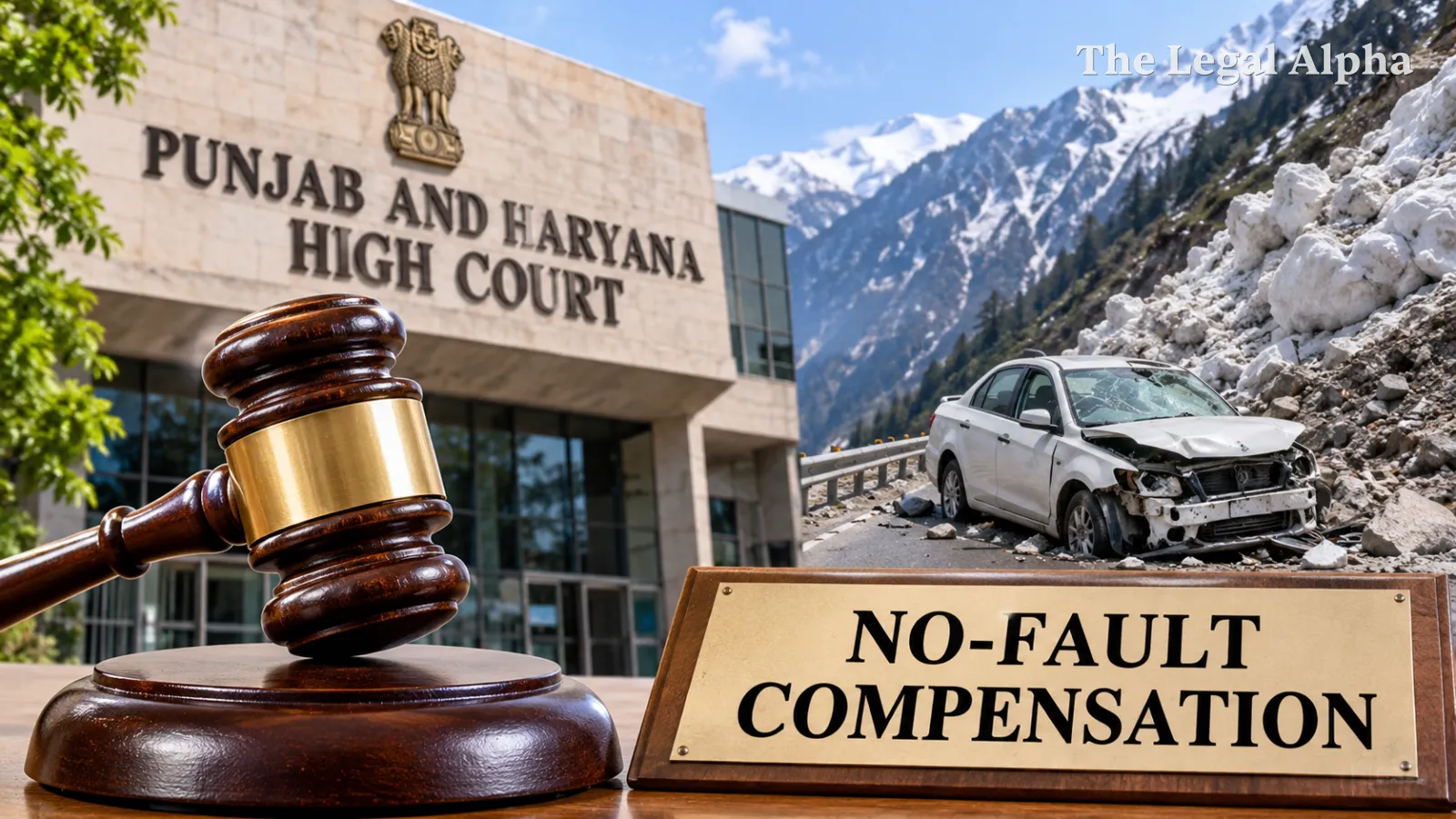
The Punjab and Haryana High Court has ruled that victims of motor vehicle accidents can claim compensation under the no-fault liability framework even when an accident results from an extraordinary natural event, including an avalanche or falling glacier.
In Anju @ Ranju and Others v. The New India Assurance Company Limited, decided on November 3, 2026, Justice Parmod Goyal awarded ₹2.5 lakh each to four family members who suffered grievous injuries when a mass of ice fell on their car near Lakkar Mandi, Dalhousie, on March 9, 1997.
The accident resulted in the death of Dr. Rajiv Rampal, who was driving the vehicle, while the other occupants sustained serious injuries.
The Court allowed the injured claimants' appeals but dismissed the claim relating to the driver's death because he was the owner of the vehicle and the insurance policy did not cover that particular risk.
Legal Topic
Area of Law: Motor Vehicle Law
Sub-topic: No-Fault Liability and Compensation for Motor Accident Victims
Core Legal Issue
The central question before the High Court was whether compensation could be awarded under the no-fault liability provisions of the Motor Vehicles Act, 1988, when an accident was caused by an act of nature rather than established negligence by a vehicle driver.
The Court also examined whether the amended Section 164, which became effective on April 1, 2022, could apply retrospectively to an accident that occurred in 1997, and whether a claim originally pursued on the basis of negligence could receive compensation under the no-fault framework.
What Did the Court Decide?
The High Court held that the occurrence of an accident due to an act of God does not automatically exclude a victim from receiving compensation under no-fault liability.
Justice Parmod Goyal observed that once it is established that the injured persons were travelling in a motor vehicle and their injuries resulted from its use, the statutory requirement for invoking no-fault compensation is satisfied.
The Court clarified that Section 164 can operate even where a claimant fails to establish rash or negligent driving under Section 166. A separate application to convert the original claim into one under Section 164 is not necessary for the provision to become applicable.
The Court further held that the amended Section 164 could apply to accidents occurring before April 1, 2022, relying on Supreme Court decisions recognising the procedural nature and retrospective applicability of the amendment.
Consequently, the four injured claimants were awarded ₹2.5 lakh each, together with interest at 6% per annum from the respective dates of filing their claim petitions until realisation.
However, the Court rejected the compensation claim arising from Dr. Rajiv Rampal's death. Since he owned and was driving the vehicle, and the insurance policy covered only a paid driver without additional coverage for the owner, the insurer was not liable for his death.
Key Legal Points
-
No-fault liability covers acts of God: Compensation may be available even when an accident results from natural events such as falling ice or an avalanche.
-
Proof of negligence is not essential: Establishing the involvement and use of a motor vehicle can be sufficient to invoke Section 164.
-
Section 164 can apply retrospectively: The amended provision may extend to accidents that occurred before April 1, 2022.
-
Automatic application of no-fault provisions: Failure to establish negligence under Section 166 does not necessarily defeat a claim for compensation under Section 164.
-
Owner-driver coverage remains distinct: The owner's entitlement to compensation depends on the applicable insurance coverage and cannot automatically be treated as a third-party claim.
Relevant Law
Motor Vehicles Act, 1988
-
Section 140: Earlier provided compensation under no-fault liability without requiring proof of negligence.
-
Section 163A: Provided structured-formula compensation under no-fault liability, subject to prescribed eligibility conditions, including the earlier income ceiling.
-
Section 164: Provides compensation on a no-fault basis under the amended statutory framework, without requiring proof of negligence.
-
Section 166: Provides compensation through claims based on fault, requiring proof of negligence.
The Court also considered the Motor Vehicles (Amendment) Act, 2019, which brought the amended compensation framework into effect from April 1, 2022.
It relied on the Supreme Court's decisions in Roopa v. The Manager, Orix Auto Infrastructure Service Ltd., The New India Assurance Co. Ltd. v. Urmila Halder and K.R. Jagadish v. National Insurance Company Ltd. concerning the retrospective applicability of the amended compensation provision.
Arguments of the Parties
Claimants
The claimants argued that even if the falling glacier was treated as an act of God and negligence could not be established, the involvement and use of the motor vehicle were undisputed.
They submitted that the injured occupants were therefore entitled to compensation under the no-fault liability provisions, particularly in view of the amended Section 164.
Insurance Company
The insurance company opposed the appeals, arguing that the claimants had failed to establish negligence on the part of any vehicle driver.
Regarding the deceased driver, the insurer further submitted that Dr. Rajiv Rampal was the owner of the car and was driving it himself. The insurance policy covered a paid driver, but no additional premium had been paid to cover the owner's risk.
The High Court accepted the insurer's position concerning the deceased owner's claim but granted compensation to the four injured occupants.
Why Does It Matter?
The ruling clarifies that victims should not automatically lose their statutory right to no-fault compensation merely because an accident results from an extraordinary natural event.
It also reinforces the distinction between fault-based and no-fault compensation under the Motor Vehicles Act. Even where negligence cannot be established, the involvement of a motor vehicle may provide an independent basis for compensation under Section 164.
The decision is particularly significant for older accident claims that remained pending after the introduction of the amended compensation framework. It demonstrates that the procedural nature of the amendment can have practical consequences for victims seeking relief in long-pending proceedings.
At the same time, the ruling highlights that no-fault liability does not eliminate the need to examine the specific insurance coverage applicable to an owner-driver.
Legal Takeaway
The Punjab and Haryana High Court has clarified that an act of God does not, by itself, defeat a motor accident victim's entitlement to no-fault compensation. Where the use of a motor vehicle and the resulting injury or death are established, Section 164 may provide relief even without proof of negligence. However, insurance coverage and the legal status of the person claiming compensation remain important considerations.
Sources
Primary Source:
Shanti Devi v. New India Assurance Co. Ltd. and connected matters, Punjab and Haryana High Court, decided on November 3, 2026, FAO Nos. 4429–4433 of 2004 (O&M), Justice Parmod Goyal.
Additional Sources:
-
ThePrint – Report on the Dalhousie accident and the High Court's ruling.
-
LiveLaw – Coverage of the no-fault compensation ruling.
-
Supreme Court decisions cited in the High Court judgment concerning the retrospective application of Section 164.