No Right by Birth in Property Father Inherited and Partitioned Under Section 8: Supreme Court
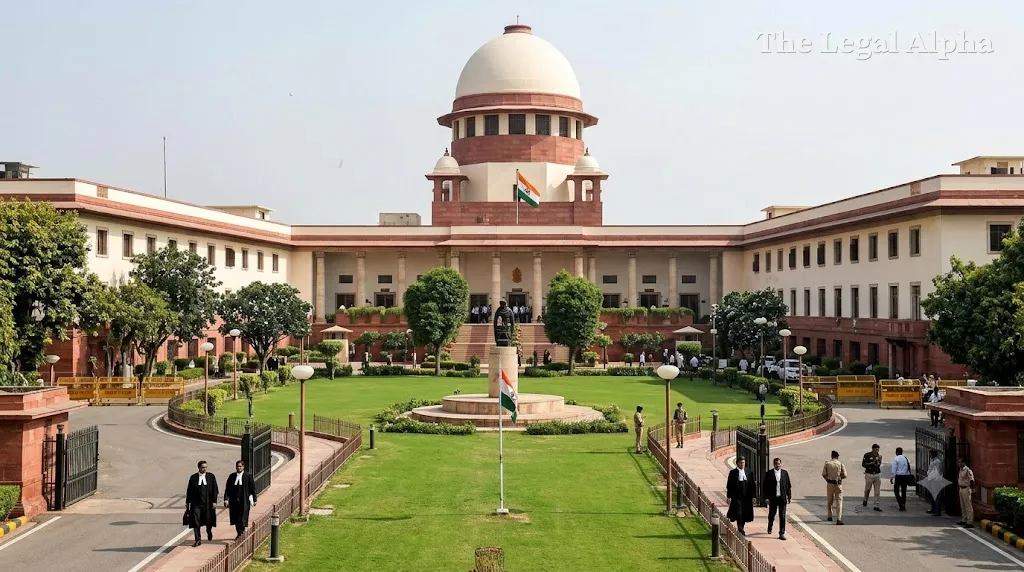
The Supreme Court of India dismissed an appeal by a grandson who claimed a half share by birth in land that his father obtained through a family partition decree.
The dispute centred on an 1,811-square-foot plot in Chennai originally owned by the appellant's grandfather, N. Ramakrishnan. Following the grandfather's death, his daughter filed a partition suit in 1993 among the surviving Class I heirs. While that suit was pending, the appellant, J. Rajesh, was born on January 6, 1994. Shortly thereafter, on February 3, 1994, the family recorded a compromise decree dividing the estate, under which the father was allotted the plot. In April 1997, the father sold the entire plot to third-party purchasers through two registered sale deeds.
Later that year, the minor son, acting through his mother and natural guardian J. Gomathi, instituted a suit demanding partition and separate possession of a half share. Although the trial court initially granted a preliminary decree, the Madras High Court set it aside in 2010. A Supreme Court Bench comprising Justice Augustine George Masih and Justice Sunita Agarwal affirmed the High Court’s ruling, bringing an end to nearly three decades of litigation and confirming the buyers' title.
Legal Topic
Area of Law: Hindu Law / Property Law
Sub-topic: Intestate Succession, Coparcenary Rights, and Alienability of Inherited Shares Under Section 8
Core Legal Issue
The fundamental legal question before the Court was whether a Hindu son acquires a coparcenary right by birth in property that his father inherited from the paternal grandfather and subsequently received pursuant to a partition decree under Section 8 of the Hindu Succession Act, 1956.
The Bench also considered whether such property retains an ancestral coparcenary character vis-à-vis subsequent descendants, or whether it becomes the father's absolute, self-acquired property that can be alienated without family necessity.
What Did the Court Decide?
The Supreme Court dismissed the minor grandson's civil appeal without costs, upholding the validity of the 1997 alienations and confirming that the father was the absolute owner of the partitioned share.
The Court held that:
-
The grandfather died intestate, opening succession under Section 8 of the Hindu Succession Act before the grandson was born.
-
The Class I heirs inherited as tenants in common rather than joint tenants. Once the estate was divided through the 1994 compromise decree, the property allotted to the father ceased to bear any joint family character.
-
Because property devolving under Section 8 is held in an individual capacity and not on behalf of an undivided family, the appellant never acquired any right by birth in his father’s allotted share.
-
The suit suffered from a fatal defect: the plaintiff sought partition on an assumed birthright without challenging either the 1994 compromise partition decree or the 1997 registered sale deeds executed in favour of the purchasers.
Key Legal Points
-
Exclusivity of Section 8: When a male Hindu dies intestate, his estate devolves strictly upon his Class I heirs to the exclusion of others; a son's son is not a Class I heir and obtains no concurrent birthright in the deceased grandfather's property.
-
Individual Ownership Over HUF: Reaffirming established jurisprudence, the Court ruled that an heir taking under Section 8 holds the property individually and not as a karta of an undivided family vis-à-vis his own descendants.
-
Severance of Coparcenary Character: When joint heirs partition an estate as tenants in common, joint coparcenary status is disrupted, rendering each divided share the separate property of the respective recipient.
-
Inapplicability of Survivorship and State Amendments: Neither Section 6 of the Hindu Succession Act nor Section 29-A of the Tamil Nadu Amendment Act, 1989 applied, because succession had already opened upon the grandfather's death prior to the appellant’s birth, precluding any claim as a surviving coparcener.
Relevant Law
-
Section 8, Hindu Succession Act, 1956: General rules of succession in the case of males dying intestate.
-
Section 6, Hindu Succession Act, 1956 (unamended): Devolution of interest in coparcenary property.
-
Section 29-A, Hindu Succession (Tamil Nadu Amendment) Act, 1989: Equal rights to daughters in coparcenary property.
-
Key Precedents Relied Upon:
-
Commissioner of Wealth Tax, Kanpur v. Chander Sen (1986)
-
Yudhishter v. Ashok Kumar (1987)
-
Bhanwar Singh v. Puran (2008)
-
Radha Bai v. Ram Narayan (2020)
-
Arguments of the Parties
Appellant
-
Contended that because he was born on January 6, 1994—before the partition suit culminated in the February 1994 compromise decree—he acquired a vested coparcenary interest by birth under classical Hindu law.
-
Argued that the partition among the grandfather's immediate heirs could not destroy the joint family character of the asset in relation to the father’s own branch, particularly since the minor was never made a party to the compromise decree.
-
Submitted that under customary Mitakshara principles and local amendments, the father held the land as ancestral coparcenary property and could not lawfully alienate it to third parties without proving legal necessity.
Respondents
-
Maintained that the grandfather died intestate, meaning succession was governed exclusively by Section 8, under which only Class I heirs take shares.
-
Argued that under settled law, a grandson does not figure as a Class I heir while his father is alive and cannot introduce a traditional right by birth to disrupt statutory devolution.
-
Pointed out that the purchasers acquired valid, unencumbered title from an absolute owner who took his share under a valid court decree, which the plaintiff never challenged or sought to set aside.
Why Does It Matter?
This ruling provides vital clarity and reassurance for real estate transactions and title verification across India. Under classical Mitakshara Hindu law, property inherited from a paternal grandfather was historically treated as ancestral, giving great-grandsons, grandsons, and sons automatic birthrights. This frequently led to protracted title disputes where descendants challenged sales concluded decades earlier by their fathers.
By reaffirming Chander Sen, the Supreme Court firmly reiterates that the Hindu Succession Act, 1956 is an overriding statutory code. When ancestral property passes to Class I heirs under Section 8 and is subsequently divided, it enters the father’s hands as his absolute and individual holding. Third-party buyers who purchase from an individual heir holding land under an unchallenged partition decree remain protected from retroactive claims of birthright coparcenary interests raised by subsequent offspring.
Legal Takeaway
A grandson acquires no coparcenary right by birth in property that his father inherits and receives through partition from the paternal grandfather under Section 8 of the Hindu Succession Act. Such land constitutes the father's individual, separate estate, granting him the absolute legal authority to sell or transfer it without requiring family necessity or the consent of his children.
Sources
Primary Source:
-
Supreme Court of India Judgment: J. Rajesh (Minor) Through His Mother and Natural Guardian J. Gomathi v. M. Kumaran (Dead) Through LRs and Others, Civil Appeal No. 7020 of 2012, Citation: 2026 INSC 1208 (Decided on November 6, 2026).
Additional Sources:
-
Madras High Court Judgment in A.S. No. 1024 of 2001 (Decided on August 11, 2010).
-
Hindu Succession Act, 1956 (Act No. 30 of 1956), Sections 6, 8, and Schedule.
-
Hindu Succession (Tamil Nadu Amendment) Act, 1989.