No Housing Society Membership for Standalone Parking: Bombay High Court Rejects 8,300 Sq M Claim in Historic Pratibha Tower Redevelopment
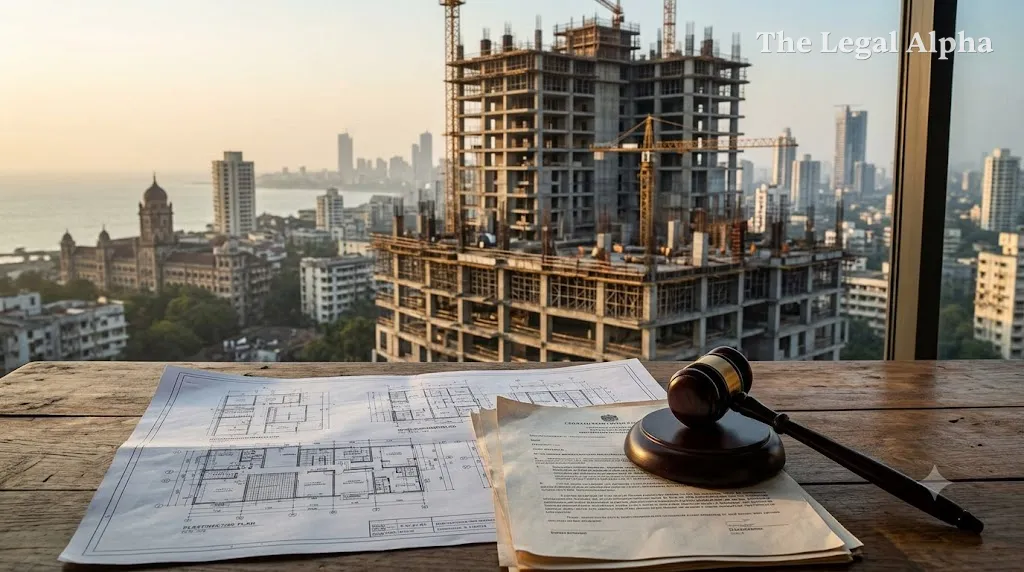
The Bombay High Court turned down an interim plea by an individual seeking reservation of approximately 8,300 square metres of built-up space in the redevelopment project of South Mumbai’s Pratibha Tower. The applicant claimed rights over the substantial area on the premise that her father had acquired 22 parking garages and a commercial shop on the lower podium in her name during the late 1980s.
Justice Sandeep Marne held that under Maharashtra cooperative housing laws, membership rights attach exclusively to habitable premises or flats, ruling out independent membership claims founded merely on car parking bays or garage spaces. While rejecting the claim over the massive parking podium, the Bench granted limited interim relief regarding her claimed shop unit, directing the developer to keep 896 square feet reserved pending final adjudication.
The order brings legal clarity to the high-profile redevelopment of Pratibha Tower at Malabar Hill—a residential structure that came under intense regulatory scrutiny and partial demolition in 1989 over gross Floor Space Index (FSI) violations.
Legal Topic
-
Area of Law: Real Estate & Cooperative Societies Law
-
Sub-topic: Society Membership Rights / Redevelopment Entitlements / Parking Space Allocation
Core Legal Issue
Can an individual claim lawful membership and consequential rehabilitation rights in a cooperative housing society based exclusively on the ownership or allotment of standalone garages and parking spaces?
The High Court was tasked with determining whether car parking areas possess an independent legal identity under the Maharashtra Co-operative Societies Act, 1960, sufficient to confer member status and compel a developer to allot equivalent constructed space in a redevelopment scheme.
What Did the Court Decide?
Justice Sandeep Marne dismissed the interim application seeking reservation of 8,300 square metres of reconstructed podium area.
-
No Membership for Parking Bays: The Court held prima facie that a person cannot be inducted as a member of a cooperative housing society solely in relation to parking slots or garages. Parking spaces have no independent existence outside the beneficial enjoyment of an actual unit or flat.
-
Limited Interim Protection for Shop: Addressing the applicant's claim over a commercial shop, the Court noted that while the membership claim appeared contestable—given that the applicant was a minor when share certificates were issued—the issue could not be discarded summarily at the interim stage. The Court directed the developer to reserve 896 square feet of built-up space in the new tower to protect her claimed commercial interest until the suit is formally decided.
Key Legal Points
-
Accessory Nature of Parking: Car parking spaces and garages are ancillary facilities meant strictly for the reasonable use and enjoyment of a flat; they cannot be decoupled to create standalone proprietary membership in a housing society.
-
Statutory Definition of Member: Under the Maharashtra Co-operative Societies Act, membership requires an underlying right or title in an actual tenement or flat, precluding independent claims anchored purely to utility spaces.
-
Status of Statutory Registers: While share certificates signed by past office-bearers carry evidential weight, entries in statutory records (such as 'I' and 'J' Registers) serve as primary legal records of valid membership.
-
Interim Equitable Balance: Where a claim involves prima facie disputable elements—such as allotments made to a minor without an active managing committee—courts may balance equities by securing the core tenement area without stalling or burdening the broader redevelopment project.
Relevant Law
-
Maharashtra Co-operative Societies Act, 1960: Provisions governing the definition of 'member', issuance of shares, and eligibility rules for acquiring interest in society properties.
-
Model Bye-laws of Cooperative Housing Societies (Maharashtra): Regulations governing the allotment of parking spaces, restriction of membership to tenement holders, and maintenance of statutory membership registers ('I' and 'J' Registers).
-
Development Control and Promotion Regulations (DCPR / DCR Mumbai): Framework regulating FSI calculations, common areas, and mandatory parking allocations in high-density redevelopment projects.
Arguments of the Parties
The Applicant (Minoo Gowani)
-
Contended that she held legitimate share certificates issued by the then chairperson and secretary of the society in respect of a shop and the entire lower-level podium comprising 22 parking garages purchased by her father.
-
Argued that the cooperative housing society (Saidale CHS, formerly Pratibha CHS) and the appointed developer bypassed her legal entitlements by submitting fresh redevelopment plans to the Brihanmumbai Municipal Corporation (BMC) without offering alternative accommodation for her holdings.
The Respondents (Housing Society & Developer)
-
Submitted that the applicant was never formally enrolled as a member and pointed out that her name was entirely absent from the society’s mandatory statutory 'I' and 'J' registers.
-
Emphasised that the applicant was approximately 14 years old when the purported share certificates were issued, arguing that minors could not enter into such membership contracts, particularly during an era when the society had no functional managing committee.
-
Contended that under cooperative law, garage allotments cannot be converted into an independent claim for massive reconstructed floor space.
Why Does It Matter?
This ruling reinforces the long-established principle in urban property jurisprudence that car parking allocations cannot be commodified as independent real estate assets within cooperative housing societies. In cities like Mumbai, where land constraints make redevelopment lucrative yet legally complex, speculative claims over common utility areas, basements, and podiums frequently threaten to stall projects.
By clarifying that parking bays do not carry standalone membership status or rehabilitation entitlements, the High Court shields housing societies and developers from exorbitant claims over common infrastructural spaces. It provides vital predictability for stalled redevelopment initiatives, reaffirming that rehabilitation rights strictly follow primary residential or commercial units rather than ancillary parking facilities.
Legal Takeaway
Cooperative housing society membership and redevelopment allotment rights attach strictly to primary flats or commercial units, not to ancillary parking facilities. Holding share certificates or agreements for standalone garages or car spaces does not entitle a claimant to independent constructed area in a redeveloped building.
Sources
-
Primary Source: High Court of Judicature at Bombay, Single-Judge Bench of Justice Sandeep V. Marne, Interim Application in Suit concerning Saidale Co-operative Housing Society Ltd. (formerly Pratibha CHS).
-
Additional Sources: Proceedings and official updates reported in the High Court cause lists and Hindustan Times (November 2026).