Missing Police Station CCTV Footage and Incomplete Custody Logs Trigger Legal Presumption of Unlawful Detention, Allahabad High Court Orders Monetary Relief
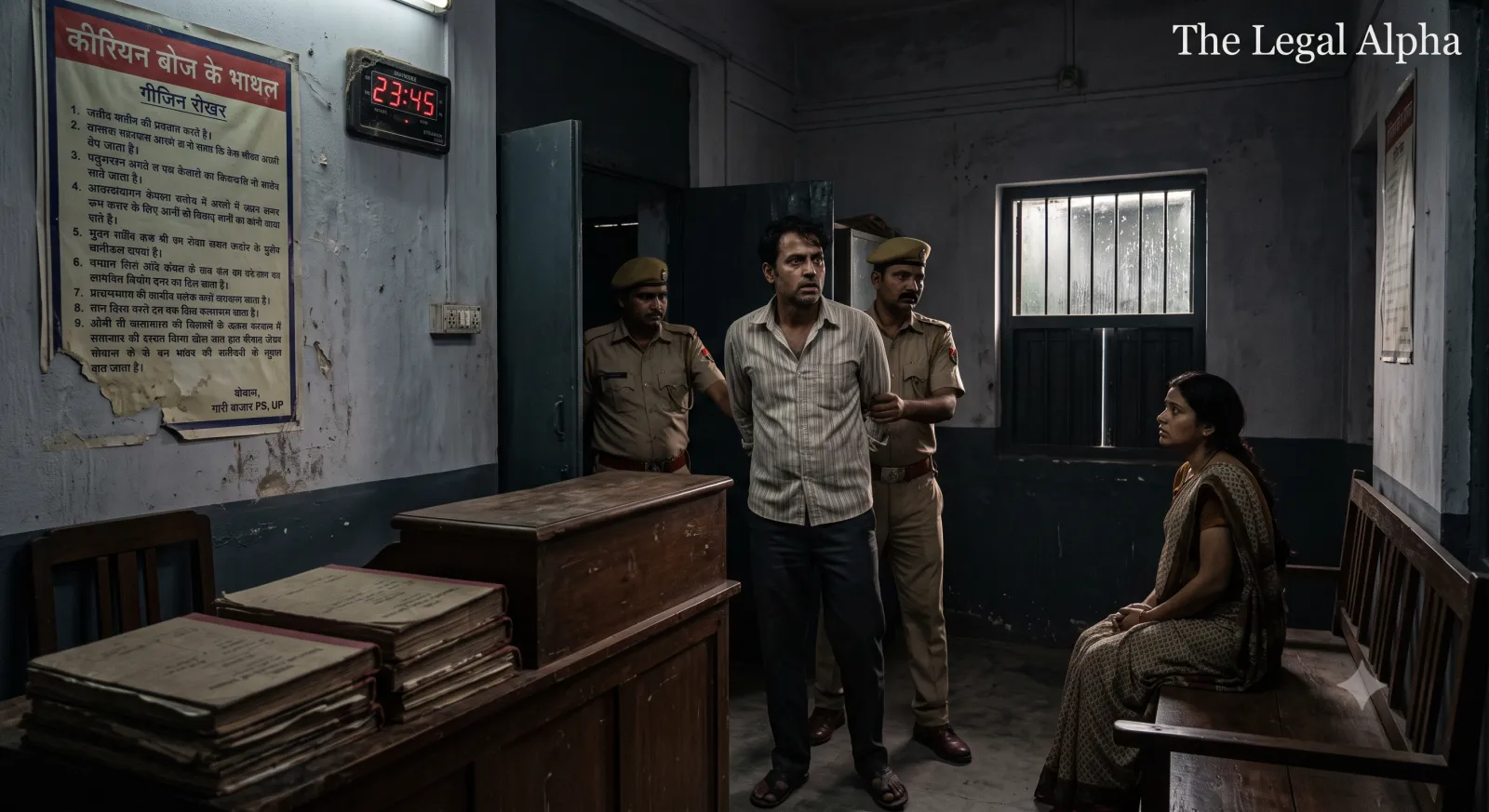
The Allahabad High Court stepped in against arbitrary police detention after four individuals from Deoria district revealed they had been confined inside a local police station without statutory safeguards. The petitioners approached the High Court through a habeas corpus petition, explaining that officers at the Gauri Bazar police station took them in during an investigation connected with Crime No. 152 of 2026 and held them unlawfully for multiple days without entering proper arrest records or producing them before a magistrate.
When the High Court scrutinized the matter, the police failed to supply crucial continuous CCTV footage of the station premises during the dates in dispute. Crucially, the authorities also lacked contemporaneous General Diary records or sign-out documentation demonstrating that the citizens had left the facility voluntarily. Confronted with the gap in objective evidence, a Division Bench comprising Justice Atul Sreedharan and Justice Divesh Chandra Samant held that unexplained camera outages paired with poor recordkeeping empower courts to draw an adverse inference against law enforcement agencies.
Legal Topic
Area of Law: Criminal Jurisprudence / Constitutional Law
Sub-topic: Illegal Custody, Police Station Surveillance Compliance, and Law of Evidence
Core Legal Issue
The central question before the Court was whether the absence of continuous CCTV footage inside a police station, accompanied by a complete lack of verifiable paperwork or General Diary entries showing release, creates a statutory presumption of unlawful confinement under Indian evidence law.
The Bench also considered whether the financial burden of court-ordered compensation for custodial rights violations should be borne entirely by public state revenue or directly recovered from the delinquent officers responsible for the lapses.
What Did the Court Decide?
The High Court held the then Station House Officer directly accountable for the unauthorized confinement of the petitioners. Applying adverse evidentiary presumptions, the Court found petitioner numbers 2 to 4 were held illegally between April 13 and April 23, 2026, while petitioner number 1 endured two days of unlawful custody.
The Court disposed of the habeas corpus writ petition with firm operational and financial directives:
-
Directed the State to disburse Rs 20,000 each to petitioner numbers 2, 3, and 4, and Rs 5,000 to petitioner number 1 as compensation for their wrongful detention.
-
Ordered that the total compensation amount be recovered from the salary of the delinquent police officials found culpable following an internal departmental inquiry.
-
Directed that the Court’s severe displeasure regarding the official misconduct be formally noted on the relevant service records of the concerned personnel.
Key Legal Points
-
Presumption of Unlawful Detention: When police officers claim a suspect was merely called for questioning and released, but camera surveillance gaps coincide with the contested dates, courts will invoke Section 119 of the Bharatiya Sakshya Adhiniyam, 2023 (analogous to Section 114 of the Indian Evidence Act, 1872) to presume the police withheld unfavorable evidence.
-
Non-Negotiable Recordkeeping: A mere verbal assertion that an individual departed the police post voluntarily carries no weight unless supported by contemporaneous entries in the General Diary, case diaries, or formal release acknowledgments signed by the individual.
-
Strict Adherence to Custodial Safeguards: Unrecorded police detention without formal arrest or production before a magistrate within 24 hours violates constitutional safeguards enshrined under Article 22 of the Constitution of India and procedural mandates under the criminal procedure code.
-
Personal Accountability Over State Absorption: Public funds cannot serve as a financial shield for rogue police excesses; compensation awarded for unlawful confinement must ultimately be recouped from the paychecks of the responsible officers to deter administrative impunity.
Relevant Law
-
Section 119, Illustration (g), Bharatiya Sakshya Adhiniyam, 2023: Legal presumption that evidence which could be produced and is withheld would, if produced, be unfavorable to the party withholding it.
-
Article 21 and Article 22, Constitution of India: Fundamental rights ensuring protection of personal liberty and mandating that any arrested individual must be produced before the nearest magistrate within 24 hours.
-
Supreme Court Directions in Paramvir Singh Saini v. Baljit Singh & Others (2020): Mandatory directions instructing all States and Union Territories to install continuous night-vision CCTV systems with audio-video recording capabilities across every police station.
Arguments of the Parties
The petitioners argued that they were picked up by officers from the Gauri Bazar police station and kept under unlawful custody without an arrest memo, formal entry, or presentation before a judicial magistrate, violating their fundamental constitutional protections.
The State authorities maintained that the individuals were not placed under formal arrest but were merely requested to assist in an ongoing criminal inquiry and subsequently allowed to leave. However, the police could not produce uncorrupted, unbroken CCTV recordings or formal release paperwork to verify that the petitioners had exited the police station on the dates alleged.
Why Does It Matter?
This ruling directly tackles the widespread practice of "informal custody," where police officers detain suspects or their relatives for days under the pretext of routine questioning without lodging a formal arrest. By shifting the evidentiary disadvantage squarely onto the police when CCTV systems suddenly go dark or data goes missing, the Allahabad High Court eliminates plausible deniability.
Moreover, enforcing financial clawbacks directly against individual officers' salaries transforms abstract judicial guidelines into tangible administrative accountability, sending an unmistakable warning to station house officers across Uttar Pradesh and beyond.
Legal Takeaway
If police officers bring an individual into a station house, the complete burden lies on the administration to document their presence and voluntary release. Missing CCTV footage, paired with an absence of General Diary entries, creates a direct legal presumption of illegal confinement that exposes individual officers to personal financial liability and disciplinary marks on their service records.
Sources
Primary Source:
-
Mahendra Gaur and 3 Others v. State of U.P. and 2 Others, Habeas Corpus Writ Petition No. 506 of 2026, Neutral Citation: 2026:AHC:188075-DB (Allahabad High Court, Decided on September 9, 2026).
Additional Sources:
-
High Court Cause Lists and Case Status Information System, High Court of Judicature at Allahabad.
-
Guidelines issued in Paramvir Singh Saini v. Baljit Singh, Special Leave Petition (Criminal) No. 3543 of 2020 (Supreme Court of India).