Madras High Court Directs TANGEDCO to Clear Unauthorised Poles and Cables in Madurai Before November 25
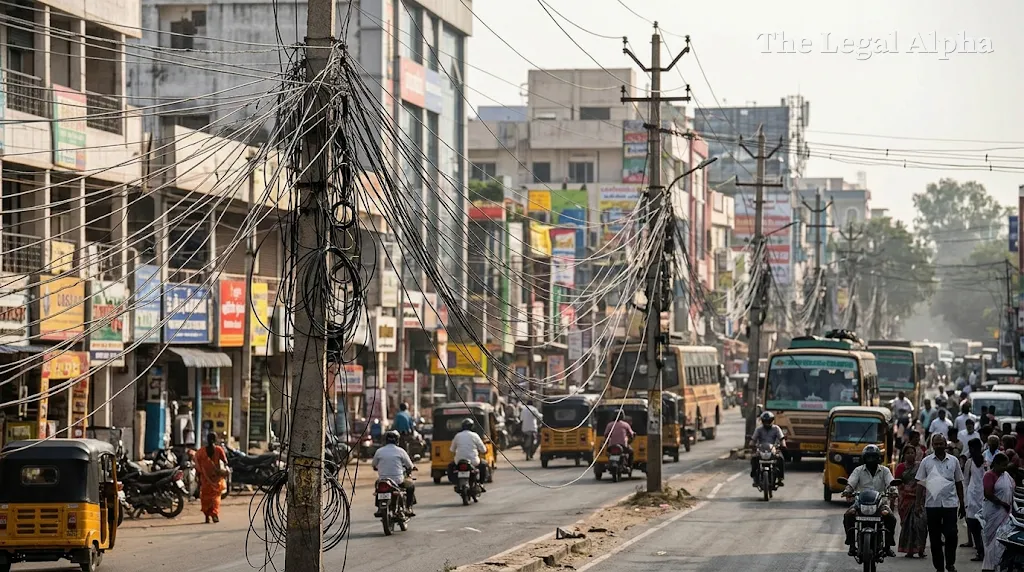
The Madurai Bench of the Madras High Court has instructed the Tamil Nadu Generation and Distribution Corporation (TANGEDCO) to inspect electric lines across Madurai district and clear all unauthorised poles and non-electrical attachments, with particular focus on the Mattuthavani–Othakadai national highway stretch.
A Division Bench comprising Justices P. Velmurugan and K.K. Ramakrishnan passed the interim direction while hearing a Public Interest Litigation (PIL) filed in 2025 by Salem resident A. Radhakrishnan. The petitioner raised concerns over private operators installing unauthorised poles and running low-hanging cable wires alongside existing high-density electricity lines and street lamp posts, creating physical hazards for motorists and pedestrians.
Legal Topic
-
Area of Law: Administrative Law / Public Safety & Municipal Governance
-
Sub-topic: Public Nuisance / Removal of Unlawful Obstructions on Public Thoroughfares
Core Legal Issue
The central legal question before the High Court is whether state electricity and executive authorities have a statutory duty to prevent and remove unauthorised private infrastructure—such as illegal poles and sagging communication cables—that encroach upon public roads, walkways, and high-tension power corridors, thereby endangering public safety.
Additionally, the petition tests the accountability of administrative authorities when they fail to exercise statutory powers designed to abate public nuisances on public thoroughfares.
What Did the Court / Authority Decide?
The Division Bench issued an interim compliance order directing senior TANGEDCO officials—specifically the Director and the Chief Engineer of the distribution division—to take immediate enforcement action.
-
Inspection and Removal: Officials must inspect high-density electric lines throughout Madurai district, particularly along the Mattuthavani–Othakadai highway corridor, and dismantle all unauthorised poles and third-party installations while leaving legitimate electricity wires intact.
-
Compliance Deadline: TANGEDCO must submit a detailed compliance report to the Court on or before November 25, 2026.
-
Consequence of Non-Compliance: If the authorities fail to execute the order and file the report within the stipulated timeframe, the concerned officials must appear in person before the Bench on November 25.
The PIL itself remains pending for further monitoring and verification of compliance on the next date of hearing.
Key Legal Points
-
Duty to Maintain Hazard-Free Public Spaces: Public utilities and civic bodies cannot permit unauthorised third-party encroachments on electric poles or along public roads when such installations create physical risks for commuters and pedestrians.
-
Statutory Power Against Public Nuisance: Under Section 152 of the Bharatiya Nagarik Suraksha Sanhita, 2023 (BNSS)—which corresponds to the former Section 133 of the Code of Criminal Procedure—executive magistrates hold explicit authority to pass conditional orders for the removal of unlawful obstructions or nuisances from any public place or way.
-
Personal Accountability of Officials: By mandating the personal appearance of senior TANGEDCO officers in the event of non-compliance, the High Court reinforced that judicial directions concerning public safety require time-bound administrative execution rather than routine bureaucratic delay.
-
Segregation of Essential Utilities: The Court specifically carved out legitimate power transmission wires from the removal drive, ensuring that enforcement against illegal cable networks does not disrupt essential electricity supply.
Relevant Law
-
Bharatiya Nagarik Suraksha Sanhita, 2023 (BNSS), Section 152: Empowers District Magistrates, Sub-Divisional Magistrates, and other specially empowered Executive Magistrates to order the removal of any unlawful obstruction or nuisance from any public place, river, or channel lawfully used by the public.
-
Constitution of India, Article 226: Grants High Courts the writ jurisdiction to issue directions and orders to public authorities in Public Interest Litigations to enforce statutory duties and protect citizens' fundamental right to life and safety under Article 21.
Arguments of the Parties
-
Petitioner: A. Radhakrishnan contended that numerous unauthorised poles carrying cable wires had been erected alongside high-density power poles and streetlights across Madurai, especially along the Mattuthavani–Othakadai stretch. He argued that these low-hanging wires pose a severe safety hazard to road users and pedestrians, and alleged that executive authorities had failed to invoke their powers under Section 152 of the BNSS to clear the obstructions despite existing statutory mandates.
-
Respondent: Specific counter-arguments or detailed submissions from TANGEDCO and state authorities were not recorded at this stage, as the Bench proceeded to issue time-bound inspection and removal directions ahead of the November 25 compliance hearing.
Why Does It Matter?
Across urban and semi-urban India, the unregulated stringing of television, internet, and private cables on electricity poles—or on makeshift poles along highway shoulders—frequently leads to sagging wires, traffic bottlenecks, and fatal accidents involving two-wheeler riders and pedestrians.
By tying the removal drive to a strict two-week window and warning senior engineers of personal appearance, the Madras High Court's order signals heightened judicial scrutiny over utility governance. For local cable operators and internet service providers, the directive underscores that infrastructure deployed without statutory right-of-way permissions faces summary removal. For municipal and electricity authorities, it serves as a reminder that inaction against visible street-level hazards can trigger direct judicial oversight.
Legal Takeaway
Public utilities and executive magistrates have an enforceable legal obligation to keep roads, pedestrian paths, and power corridors free from unauthorised private installations. Citizens affected by hazardous, low-hanging cables or illegal street obstructions can seek statutory intervention under Section 152 of the BNSS or approach constitutional courts when administrative authorities fail to act.
Sources
-
Primary Source: Interim Order of the Division Bench (Justices P. Velmurugan and K.K. Ramakrishnan), Madurai Bench of the Madras High Court, in the Public Interest Litigation filed by A. Radhakrishnan (November 2026) (exact case number and full text of the order not yet publicly uploaded).
-
Additional Sources: Reports by The New Indian Express ("Remove unauthorised poles in Madurai in two weeks: Madras HC," November 14, 2026) and The Times of India ("HC tells Tangedco to remove unauthorised poles in Madurai," November 14, 2026).