Karnataka High Court Quashes Case Against Landowner, Allows Prosecution of Government Doctor Over Aadhaar Certificates for Bangladeshi Nationals
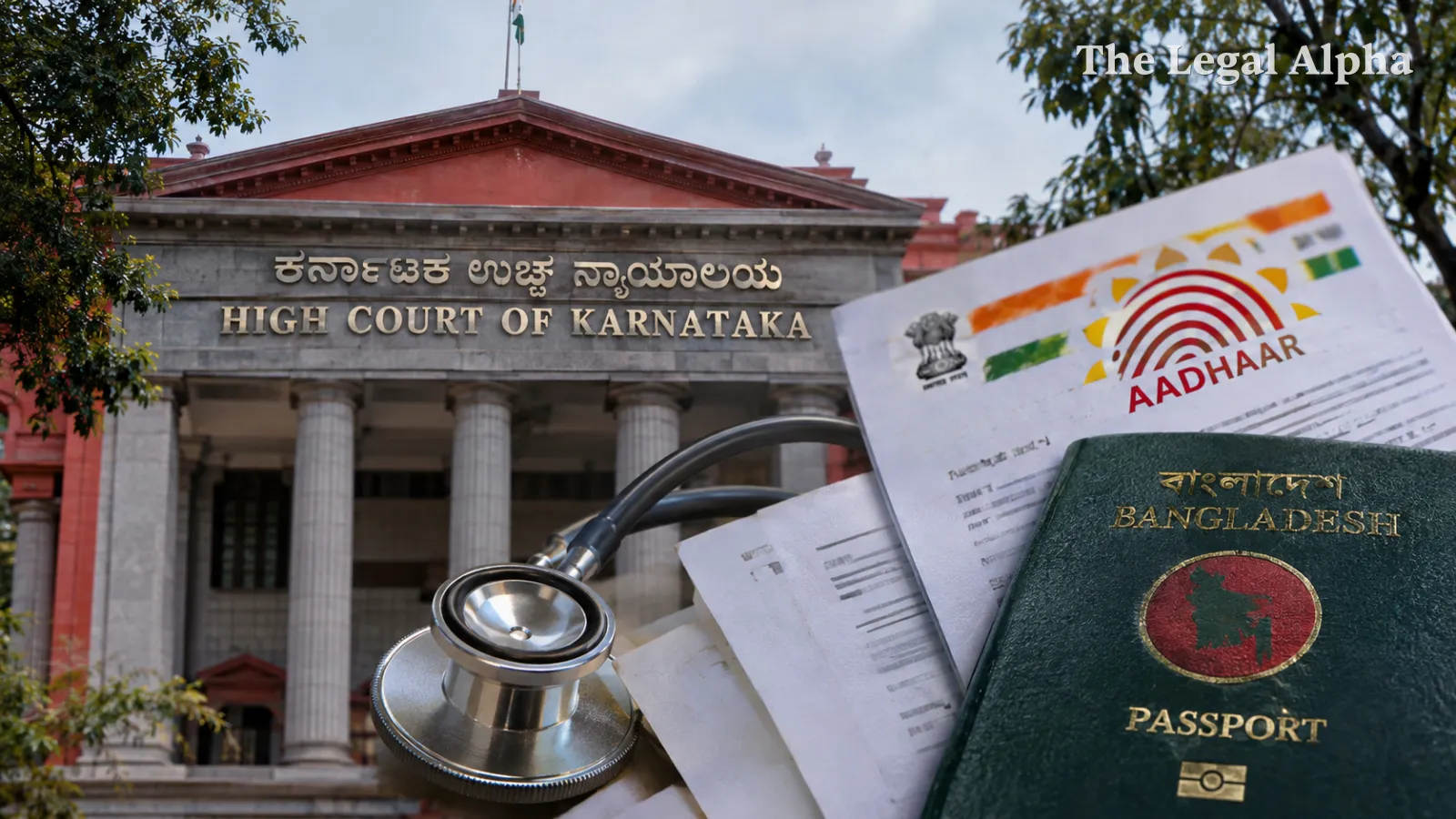
The Karnataka High Court has granted relief to a Bengaluru landowner accused of helping Bangladeshi nationals obtain Aadhaar cards, while refusing to quash criminal proceedings against a government doctor alleged to have attested residential proof documents for 14 Bangladeshi nationals.
Justice H.P. Sandesh passed the order on November 18, 2026, while deciding two criminal petitions arising out of the same criminal case registered by Bellandur Police Station, Bengaluru.
The proceedings concerned allegations that certain Bangladeshi nationals had obtained Indian identity documents using residential certificates and other supporting documents.
The Court examined the individual allegations against the two petitioners and reached different conclusions based on the evidence collected during the investigation.
Area of Law
Area of Law: Criminal Law
Sub-topic: Quashing of Criminal Proceedings, Public Servant Protection and Foreigners Act
Core Legal Issue
The principal issue before the High Court was whether criminal proceedings could continue against individuals accused of facilitating foreign nationals in obtaining Aadhaar cards through allegedly improper residential documentation.
The Court also considered whether a government doctor could claim protection under Section 197 of the Code of Criminal Procedure (CrPC) when accused of attesting residential documents without verifying the supporting records.
What Did the Court Decide?
The Karnataka High Court allowed the criminal petition filed by the landowner, identified as Accused No. 24, and quashed the proceedings against him in C.C. No. 6990/2020.
The Court noted that the investigating agency had failed to collect any rental agreement showing that the petitioner had rented his property to the two Bangladeshi nationals concerned.
It also observed that the addresses appearing on their Aadhaar cards did not establish a connection with the petitioner's property. In the absence of prima facie material linking him to the alleged assistance, continuing the prosecution was not justified.
However, the Court dismissed the petition filed by Dr. Lokesh, a government doctor identified as Accused No. 9.
The allegations against the doctor concerned the attestation of residential proof documents for 14 Bangladeshi nationals. The investigation had collected the documents and sent the doctor's signatures for forensic examination, which confirmed the signatures belonged to him.
The Court held that the doctor's alleged conduct, involving repeated attestation without supporting residential documentation, could not automatically be treated as an act performed in the discharge of his official duties.
Consequently, protection under Section 197 CrPC was unavailable at this stage, and the criminal proceedings against him were permitted to continue.
Key Legal Points
- Absence of prima facie evidence: Criminal proceedings cannot continue against an accused when the investigation has failed to collect material establishing their involvement in the alleged offence.
- Individual assessment of allegations: Persons named in the same criminal case may receive different outcomes depending on the evidence available against each of them.
- Section 197 CrPC protection: Sanction for prosecution is required only when the alleged act has a reasonable connection with the discharge of official duties.
- Attestation of documents: Repeatedly attesting residential documents without supporting verification may fall outside the protection available for acts performed in official capacity.
- Scope of Section 482 CrPC: The High Court can exercise its inherent jurisdiction to prevent criminal proceedings from continuing where the necessary foundational material is absent.
Relevant Law
Section 482, Code of Criminal Procedure, 1973: Recognises the inherent powers of the High Court to prevent abuse of the process of law and secure the ends of justice.
Section 197, Code of Criminal Procedure, 1973: Provides protection against prosecution of certain public servants for acts connected with the discharge of official duties, subject to the statutory requirement of prior sanction.
Sections 419, 420 and 120B read with Section 34 IPC: Relate to cheating by personation, cheating and dishonestly inducing delivery of property, criminal conspiracy and common intention.
Section 14, Foreigners Act, 1946: Provides penalties for contraventions of provisions of the Act and orders made under it.
Arguments of the Parties
Landowner – Accused No. 24
The petitioner argued that there was no documentary evidence establishing that he had rented his property to the alleged Bangladeshi nationals or assisted them in obtaining Aadhaar cards.
He also pointed out that the addresses mentioned in the Aadhaar cards did not correspond with his property at Ibbaluru.
Government Doctor – Accused No. 9
The doctor argued that he was a government employee and that prosecution could not proceed without obtaining the necessary sanction under Section 197 CrPC.
He also questioned the Magistrate's decision to take cognizance, contending that the order had been passed without proper application of mind.
State and Complainant
The respondents maintained that sufficient material had been collected during the investigation against the accused persons.
Regarding the doctor, the complainant argued that attesting residential documents without verifying supporting proof was not an act forming part of his official duties. The respondents also relied on the collected documents and forensic confirmation of the signatures.
Why Does It Matter?
The decision highlights an important distinction in criminal prosecution: being named in a criminal investigation does not automatically justify continuing proceedings against every accused person.
The High Court's treatment of the two petitions demonstrates the importance of examining the specific evidence and alleged role of each individual.
For public servants, the ruling also reinforces that protection under Section 197 CrPC is not a blanket immunity against criminal prosecution. The connection between the alleged conduct and official duties remains central to determining whether prior sanction is necessary.
At the same time, the decision concerning the landowner illustrates why investigating agencies must collect concrete supporting material before proceeding with criminal charges.
Legal Takeaway
The Karnataka High Court has clarified that criminal proceedings must be supported by material establishing a prima facie connection between the accused and the alleged offence. Protection under Section 197 CrPC depends on whether the alleged conduct is connected with official duties, and merely holding public office does not automatically provide immunity from prosecution.
Sources
Primary Source: Karnataka High Court, Sri B.P. Umashankar v. State by Bellandur Police Station, Crl.P. No. 1681/2023 connected with Crl.P. No. 5322/2021, decided on November 18, 2026, by Justice H.P. Sandesh. Read the judgment.
Additional Source: LawLens – Report on the Karnataka High Court decision.