Judicial Morality Cannot Dictate Pre-Trial Liberty: Supreme Court Rebuffs High Court’s Value Judgments in POCSO Bail Plea
Legal Topic
Area of Law: Criminal Jurisprudence & Constitutional Law
Sub-topic: Judicial Discretion in Bail / Presumption of Innocence / Separation of Moral Philosophy from Criminal Adjudication
Core Legal Issue
The primary legal question before the Supreme Court was whether a presiding judge's personal perception of societal morality—specifically concerns regarding the "morals" of a complainant's family and broader social order—constitutes a legally permissible ground to withhold regular bail from an undertrial accused.
The matter examines the constitutional boundaries of judicial discretion: whether courts evaluating pre-trial release under criminal procedural law must remain strictly anchored to objective statutory criteria, or whether they can legitimately invoke subjective value judgments to curtail an individual's personal liberty under Article 21 of the Constitution.
What Did the Court / Authority Decide?
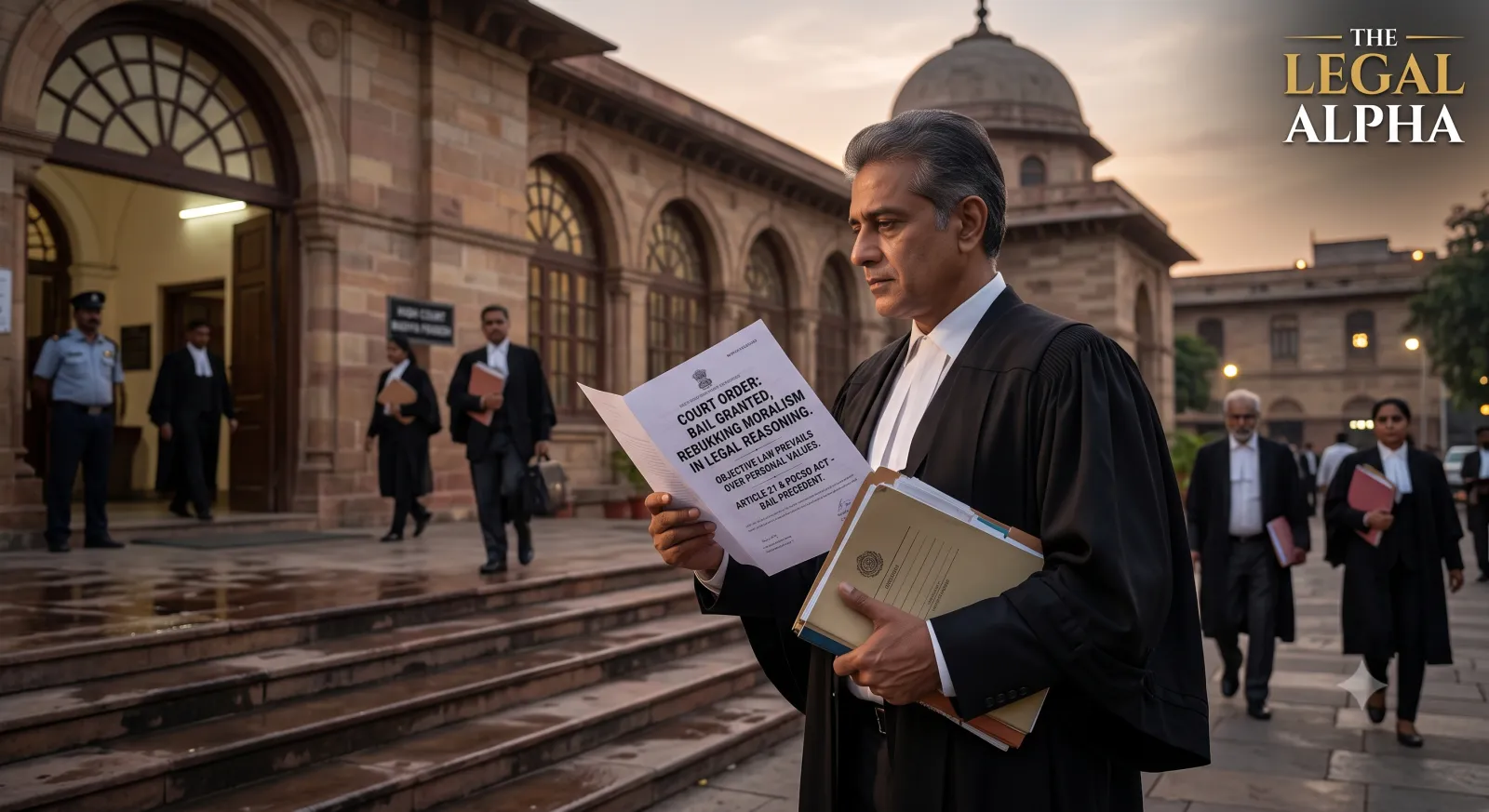
A Division Bench of the Supreme Court comprising Justice Ujjal Bhuyan and Justice Atul S. Chandurkar set aside the Madhya Pradesh High Court's order dated March 20, 2026, and enlarged the appellant on regular bail.
The Supreme Court firmly disapproved of the High Court's rationale, which had declined bail out of concern for the potential impact on social order and the morals of the prosecutrix's household. The Bench explicitly held:
"Courts should refrain from imposing the personal views or value judgment of the Presiding Judge on morality or otherwise while adjudicating a matter relating to bail, or even a criminal trial of an accused."
On the factual merits, the apex court observed that the appellant had remained in continuous judicial custody since September 10, 2025—undergoing over a year of incarceration—while only five out of fifteen prosecution witnesses had been examined, indicating that the trial would take considerable time to conclude.
The Court directed that the appellant be produced before the jurisdictional Special Court within seven days to be released on appropriate terms and conditions. The Bench clarified that this bail relief remains subject to his custody status in a separate pending criminal appeal challenging his conviction in an earlier case.
Key Legal Points
-
Rejection of Moralizing in Criminal Adjudication: The ruling establishes that presiding judges cannot substitute statutory legal principles with subjective ethical standards, individual philosophy, or value judgments regarding family honor and social propriety during bail hearings or criminal trials.
-
Primacy of Objective Bail Determinants: Adjudication of pre-trial liberty must turn exclusively on established statutory metrics—such as the gravity of the prima facie charge, potential tampering with evidence, flight risk, and the pace of trial proceedings.
-
Prolonged Incarceration Outweighs Speculative Harms: Where an undertrial has suffered substantial pre-trial detention and the trial's conclusion is protracted due to numerous remaining witnesses, continued detention cannot be justified on abstract moral apprehensions.
-
Procedural Independence of Collateral Custody: The grant of bail in one criminal prosecution operates independently of separate convictions, preserving procedural clarity while collateral appellate challenges run their course.
Relevant Law
-
Bharatiya Nagarik Suraksha Sanhita, 2023 (BNSS) / Code of Criminal Procedure, 1973 (CrPC): Provisions governing the discretionary powers of superior courts in granting regular bail (Section 483 BNSS / Section 439 CrPC).
-
Constitution of India:
-
Article 21: Fundamental guarantee of personal liberty, protecting undertrials from arbitrary, subjective detention procedures.
-
Article 14: Principle of non-arbitrariness and the uniform application of the rule of law.
-
-
Protection of Children from Sexual Offences (POCSO) Act, 2012 & SC/ST (Prevention of Atrocities) Act, 1989: Substantive enactments governing the underlying allegations.
-
Judicial Precedents:
-
Satender Kumar Antil v. CBI (2022): Reaffirming that personal liberty is the rule, incarceration is an exception, and bail orders must not be guided by extra-legal considerations.
-
Aparna Bhat v. State of Madhya Pradesh (2021): Establishing that courts must scrupulously avoid patriarchal, moralistic, or extraneous observations while deciding bail applications.
-
Arguments of the Parties
Appellant (Kanha @ Kanhaiya Singh)
-
Counsel submitted that the appellant had already suffered more than twelve months of pre-trial incarceration since his arrest in September 2025.
-
The appellant pointed out that the trial was unlikely to conclude in the near future because ten prosecution witnesses were yet to depose.
-
It was argued that the present prosecution was an offshoot of personal animosity arising from his past relationship with the complainant's elder sister, instituted primarily to harass him.
-
Counsel further noted that an appeal had already been lodged against his conviction in the prior case, urging that moral lectures could not replace legal merit in evaluating regular bail.
Respondent (State of Madhya Pradesh)
-
The State opposed the bail plea by emphasizing the serious nature of the allegations, noting that the case involved the alleged sexual exploitation of a minor prosecutrix under POCSO and SC/ST Act provisions.
-
The prosecution drew attention to the appellant's criminal antecedents, pointing to his conviction on July 1, 2026, in an earlier case involving the victim's elder sister.
-
Counsel submitted that the trial was actively moving forward with five witnesses already examined, asserting that releasing the appellant could disrupt social order and adversely affect the victim's family.
Why Does It Matter?
The Supreme Court’s ruling addresses a persistent systemic issue within India's lower and appellate judiciary: the tendency of presiding judges to use bail orders as platforms for moral lectures and social commentary. In recent years, orders conditioning or denying bail based on concepts of chastity, traditional family honor, or community morality have drawn criticism for departing from constitutional principles.
By setting aside the High Court's reasoning, the Supreme Court reinforces the principle that courts are instruments of the codified law, not arbiters of private ethics. When judicial officers condition liberty on subjective notions of "morality," it undermines legal certainty and exposes accused individuals to arbitrary detention.
For the wider criminal justice system, this decision provides an unambiguous directive to trial courts and High Courts: bail hearings must evaluate statutory evidence, custody duration, and witness integrity, leaving moral policing out of the courtroom.
Legal Takeaway
Bail adjudication must remain strictly confined to objective legal standards and statutory evidence, completely insulated from a judge's personal worldview or moral philosophy. Subjective concerns over societal morals or family honor cannot be deployed to override an undertrial's constitutional right to pre-trial liberty under Article 21.
Sources
Primary Source:
-
Supreme Court of India, Order dated September 23, 2026, in Kanha @ Kanhaiya Singh v. State of Madhya Pradesh & Anr., Criminal Appeal arising out of SLP (Crl.) No. 9810/2026 (Coram: Justices Ujjal Bhuyan and Atul S. Chandurkar).
Additional Sources:
-
High Court of Madhya Pradesh (Bench at Indore), Order dated March 20, 2026, in Miscellaneous Criminal Case No. 9942/2026.
-
Case proceedings and documentation reported via Bar and Bench (October 1, 2026).