Dibrugarh Prison Officials Decline Revised Custody Parole Request for Khadoor Sahib MP Amritpal Singh
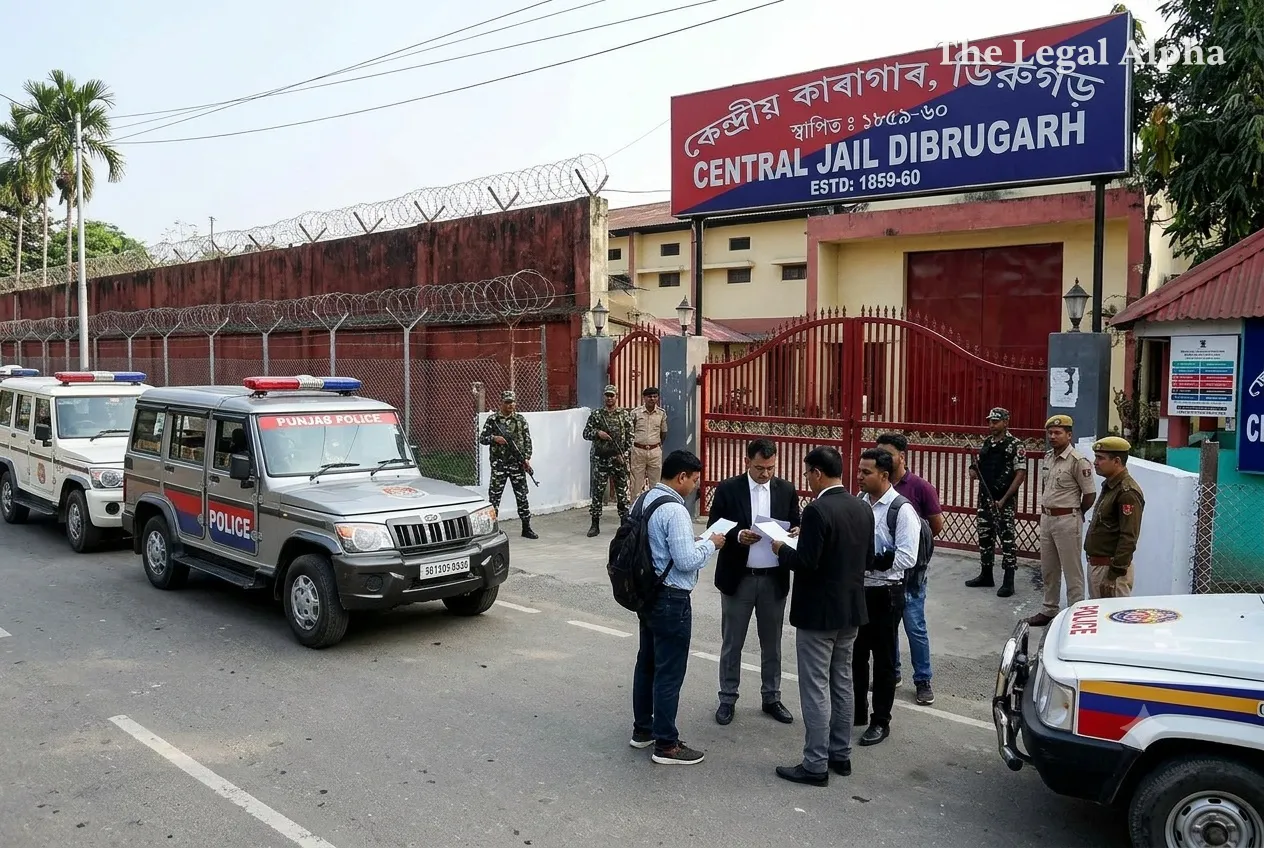
Legal counsel for jailed Khadoor Sahib Member of Parliament Amritpal Singh has alleged that officials at Dibrugarh Central Jail in Assam refused to accept an amended application to facilitate his temporary release for his grandmother's last rites. While the Court of the Additional Sessions Judge in Amritsar had granted Singh a one-day interim custody parole on humanitarian grounds to attend the cremation, prison authorities reportedly cited logistical constraints and short notice as reasons for not executing the original release order. Following the family's decision to postpone the funeral rituals to November 20, 2026, Singh's counsel attempted to submit a revised application, which jail officials allegedly declined to entertain. The development highlights a procedural standoff between judicial relief granted on humanitarian grounds and the administrative capacity of high-security prison authorities to execute inter-state transit orders.
Legal Topic
Area of Law: Criminal Procedure and Prison Administration Sub-topic: Interim Custody Parole / Execution of Judicial Release Orders
Core Legal Issue
The central legal question is whether prison authorities can decline to accept or act upon a revised application for temporary release when an underlying judicial order granting interim custody parole already exists, or whether any modification to the date and logistical terms of a court-mandated release must be routed exclusively through the granting court. Additionally, the dispute raises questions regarding the administrative obligations of custodial authorities to facilitate time-sensitive humanitarian relief ordered by a criminal court across state jurisdictions.
What Did the Court / Authority Decide?
On Friday, November 13, 2026, the Additional Sessions Judge in Amritsar allowed Singh's application for a one-day interim custody parole on humanitarian grounds to attend the cremation of his grandmother, Mata Charan Kaur, at his native village of Jallupur Khera in Punjab. The court attached strict conditions to the temporary release: Singh was permitted to travel only under armed police escort, barred from interacting with the media, public gatherings, or prosecution witnesses, and required to bear the full financial cost of his inter-state transportation and security arrangements.
However, Dibrugarh Central Jail officials informed Singh's legal team that they could not comply with the release schedule on short notice, given the logistical requirements of transporting a high-security prisoner from Assam to Punjab. When the family postponed the cremation to November 20 and Singh's counsel sought to submit an amended request directly to prison officials, the authorities declined to accept the revised filing. No formal judicial order modifying the original parole date has been issued yet, and Singh's legal team has indicated plans to approach the High Court or Supreme Court to enforce or modify the relief.
Key Legal Points
-
Custody Parole vs. Regular Parole: Unlike regular parole, which suspends a sentence and is typically governed by executive prison rules, interim custody parole is a court-supervised temporary release where the detainee remains under continuous armed police guard throughout the visit.
-
Judicial Authority Over Modifications: Once a criminal court issues a conditional order specifying the purpose and terms of temporary release, prison superintendents generally lack independent statutory discretion to alter the dates or conditions of that order without a fresh judicial directive.
-
Inter-State Transit Logistics: Executing custody parole for an undertrial or detainee housed outside the home state requires coordinated security clearances, transit warrants, and escort deployment between two state police forces, which often creates friction against tight humanitarian timelines.
-
Strict Conditional Compliance: Courts balance humanitarian considerations under criminal procedure with public order concerns by imposing self-executing revocation clauses—meaning any breach of speech, movement, or gathering restrictions automatically cancels the temporary release.
Relevant Law
-
Bharatiya Nagarik Suraksha Sanhita, 2023 (BNSS) / Code of Criminal Procedure, 1973 (CrPC): Under inherent and supervisory powers governing undertrial custody, criminal courts exercise discretion to grant temporary release in police custody on compelling humanitarian grounds, such as the death of a close family member.
-
The Prisons Act, 1894 and State Prison Manuals (Assam and Punjab): Govern the custody, removal, and inter-state transfer of prisoners, requiring superintendents to execute lawful warrants and orders of competent courts while adhering to prescribed security protocols.
-
Article 21 of the Constitution of India: Protects the right to life and personal liberty, which Indian courts have consistently interpreted to include the right of a prisoner or undertrial to participate in essential family rites under reasonable, security-vetted conditions.
Arguments of the Parties
Petitioner / Applicant (Amritpal Singh) Counsel for Singh, Advocate Karamvir Singh Pannu, contended that Singh's physical presence is essential to perform the customary last rites for his grandmother and that the Amritsar court had already recognized this necessity by granting one-day custody parole. The petitioner's side submitted that the family agreed to bear all transportation and security expenses as directed by the court, yet the administration failed to communicate the cost estimates or facilitate transit in time. Counsel further alleged that when the family deferred the funeral to November 20 to accommodate logistical delays, Dibrugarh prison officials arbitrarily refused to accept their amended application.
Respondent / Prison Authorities Dibrugarh Central Jail officials indicated to the applicant's representatives that complying with the Amritsar court's order on immediate notice was logistically unfeasible, given the high-security protocols required to transport Singh from Assam to Punjab. Regarding the revised application, prison authorities maintained that they could not process or act upon an amended schedule directly without appropriate procedural clearance.
Why Does It Matter?
This episode underscores a recurring practical gap in India's criminal justice system: obtaining a humanitarian court order does not always translate into immediate execution when a prisoner is lodged in a high-security facility far from home. When undertrials or detainees are transferred across state lines on security grounds, the administrative machinery required to arrange air or rail escorts, inter-state police coordination, and cost assessments can easily outlast the narrow window of an emergency family event. For legal practitioners and families of detainees, the situation illustrates that any operational delay in executing a custody parole order typically requires returning immediately to the issuing court for a formal modification order rather than seeking administrative adjustments at the prison gate.
Legal Takeaway
A court order granting interim custody parole does not authorize prison officials to unilaterally reschedule the release if logistical delays occur. When practical hurdles prevent a prisoner from being transported on the originally approved date, the applicant must formally move the concerned court—or a higher constitutional court—for a modified order specifying the revised schedule and directing compliance by jail authorities.
Sources
Primary Source:
-
Order of the Court of Additional Sessions Judge, Amritsar (dated November 13, 2026) granting one-day interim custody parole to Amritpal Singh, and official statements by petitioner's counsel Advocate Karamvir Singh Pannu.
Additional Sources:
-
News reports from Asianet Newsable / ANI, Hindustan Times, The Tribune, and The Statesman covering the Amritsar court proceedings and Dibrugarh Central Jail developments (November 13–15, 2026).