Delhi High Court Invalidates TERI Sexual Harassment Inquiry, Directs Fresh Examination Under POSH Act
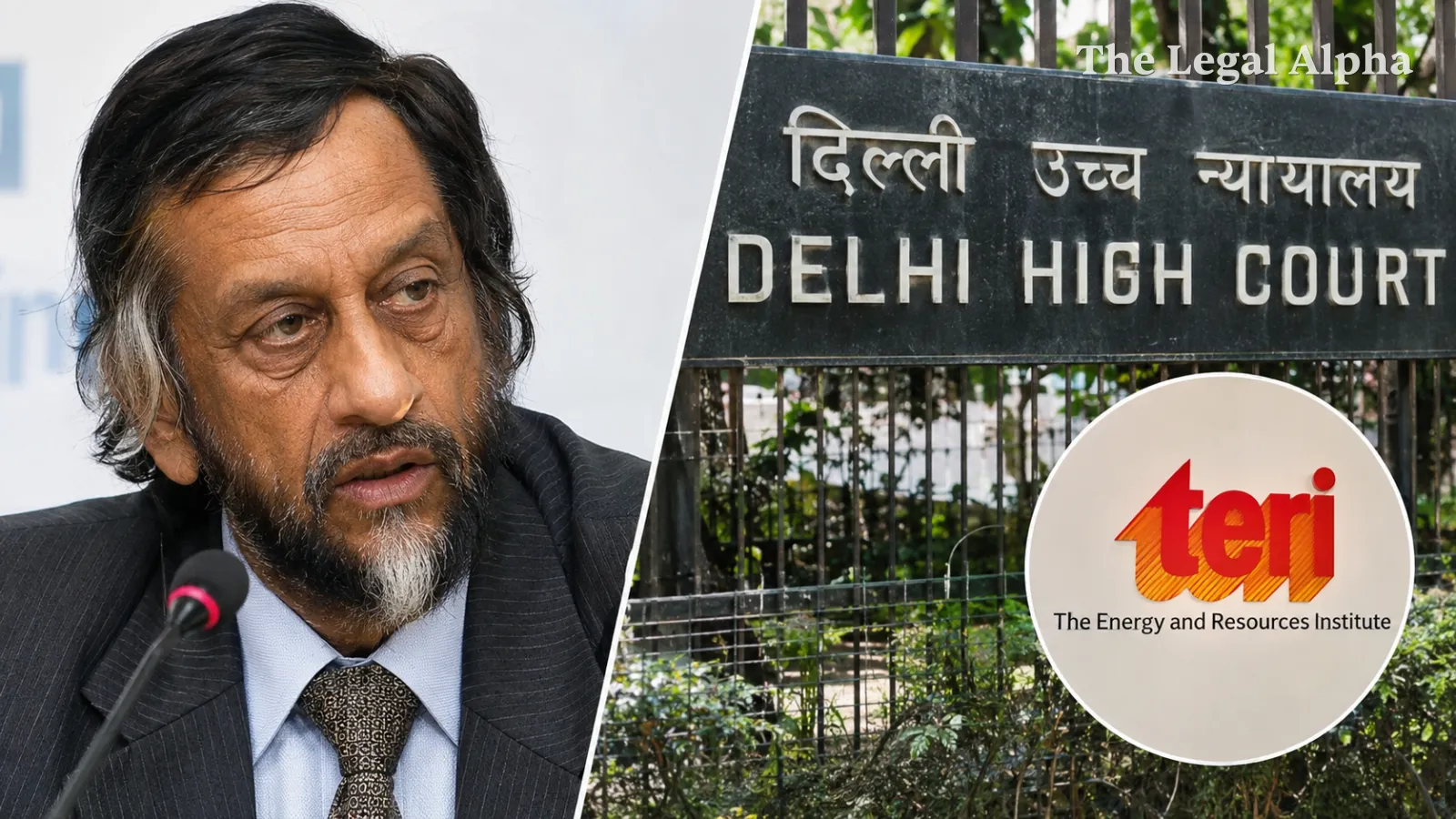
The Delhi High Court has set aside the findings of The Energy and Resources Institute's (TERI) Internal Complaints Committee (ICC) against its former Director General, RK Pachauri, in a sexual harassment case, holding that the committee did not have the statutory authority to investigate the complaint.
In an order dated November 17, 2026, Justice Amit Mahajan directed that the complaint be reconsidered by the competent district-level Local Complaints Committee under the Sexual Harassment of Women at Workplace (Prevention, Prohibition and Redressal) Act, 2013.
The case originated in February 2015, when a woman research assistant at TERI accused Pachauri of workplace sexual harassment. TERI's ICC subsequently conducted an inquiry and returned findings against him in May 2015.
Pachauri challenged the findings before the Industrial Tribunal, which upheld the ICC's decision in July 2023. Following his death in February 2020, his legal representatives continued the legal challenge before the High Court.
The High Court's decision primarily concerns the jurisdiction of workplace sexual harassment committees and the procedural safeguards required during such inquiries.
Legal Topic
Area of Law: Employment Law and Women's Rights
Sub-topic: Workplace Sexual Harassment, POSH Act, Jurisdiction of Internal Complaints Committees and Principles of Natural Justice.
Core Legal Issue
The central legal question before the High Court was whether an organisation's Internal Complaints Committee could investigate a sexual harassment complaint against the head of the organisation when that individual falls within the statutory definition of an employer under the POSH Act, 2013.
The Court also considered whether an inquiry could sustain adverse findings against an individual without providing access to witness statements and other materials relied upon during the proceedings.
The matter therefore involved two important legal considerations: the statutory allocation of jurisdiction between Internal Committees and Local Committees, and the requirement to provide a fair opportunity to respond to allegations.
What Did the Delhi High Court Decide?
Justice Amit Mahajan held that RK Pachauri, as TERI's Director General, fell within the definition of an employer under Section 2(g) of the POSH Act.
Under Section 6 of the legislation, complaints against an employer himself are required to be examined by the district-level Local Complaints Committee rather than the organisation's Internal Complaints Committee.
Consequently, the High Court set aside:
-
TERI's ICC inquiry report dated May 19, 2015.
-
The Industrial Tribunal's judgment dated July 3, 2023, which had upheld the findings.
However, the Court did not terminate the complaint on its merits. Instead, it remitted the matter to the competent Local Committee for fresh consideration.
The Committee has been directed to independently examine the complaint and the available material while following the applicable procedure and principles of natural justice.
Importantly, the Court clarified that the effect of Pachauri's death on February 13, 2020, concerning the maintainability and feasibility of further proceedings must be considered by the competent forum.
The Court also addressed procedural fairness, observing that although cross-examination is not an absolute right in sexual harassment proceedings, a person facing adverse findings must receive a fair opportunity to respond to the evidence relied upon.
Where witness statements or documents form the basis of adverse conclusions, those materials must be supplied to the concerned individual.
The Court further clarified that a standard of proof lower than proof beyond reasonable doubt does not eliminate the requirement of procedural fairness.
Key Legal Points
- Jurisdiction under Section 6: Complaints against an employer himself fall within the jurisdiction of the district-level Local Complaints Committee under the POSH Act.
- Definition of Employer: The position of TERI's Director General brought Pachauri within the statutory definition of an employer under Section 2(g).
- Principles of Natural Justice: Individuals facing adverse findings must receive a meaningful opportunity to respond to the evidence relied upon.
- Access to Evidence: Witness statements and documents forming the basis of adverse findings must be made available to the person facing the allegations.
- Cross-Examination: The Court clarified that cross-examination is not an automatic or absolute right in every workplace sexual harassment inquiry, but procedural fairness must be maintained.
Relevant Law
Sexual Harassment of Women at Workplace (Prevention, Prohibition and Redressal) Act, 2013
-
Section 2(g): Defines the term 'employer' for the purposes of the legislation.
-
Section 4: Provides for the constitution of an Internal Committee.
-
Section 6: Deals with the constitution and jurisdiction of the Local Committee, including complaints against the employer himself.
-
Section 18: Provides for an appeal against recommendations or actions under the Act.
Principles of Natural Justice
The requirement of a fair hearing, access to relevant evidence and a reasonable opportunity to respond remains important in workplace sexual harassment inquiries.
Arguments of the Parties
Legal Representatives of RK Pachauri
Advocate Ashish Dixit, appearing for Pachauri's legal representatives, argued that Pachauri, being TERI's Director General, qualified as an employer under the POSH Act.
It was submitted that the complaint should therefore have been examined by the district-level Local Complaints Committee under Section 6 rather than TERI's ICC.
The legal representatives also contended that Pachauri had not received copies of witness statements and had not been given an opportunity to cross-examine the witnesses whose statements were relied upon during the inquiry.
Complainant
Advocate Pulkit Malhotra appeared for the complainant.
The complainant's side opposed the challenge to the inquiry, including raising objections concerning the timing of the jurisdictional challenge and the absence of an absolute right to cross-examine witnesses in sexual harassment proceedings.
The Court nevertheless examined the question of statutory jurisdiction and the procedural fairness of the inquiry.
Why Does It Matter?
The ruling highlights the importance of following the statutory framework established under the POSH Act when investigating workplace sexual harassment complaints.
Organisations cannot assume that their Internal Complaints Committee has jurisdiction over every complaint arising within the workplace. The identity and position of the person against whom the complaint is made can determine which statutory authority is competent to investigate it.
The decision also reinforces the importance of procedural fairness in workplace investigations. While sexual harassment inquiries require sensitivity towards complainants, the proceedings must also provide individuals facing allegations with a reasonable opportunity to respond to the evidence.
For employers, institutions and organisations, the judgment underlines the need to constitute appropriate complaint mechanisms and ensure that inquiries comply with statutory requirements.
It also makes clear that procedural safeguards and the protection of complainants are not necessarily competing objectives. Both must be accommodated within a legally compliant inquiry.
Legal Takeaway
The Delhi High Court has reaffirmed that complaints of workplace sexual harassment against an employer himself must be examined by the competent Local Complaints Committee under Section 6 of the POSH Act, rather than the organisation's Internal Committee.
The ruling also emphasises that every inquiry resulting in adverse findings must comply with the principles of natural justice. A fair investigation requires both the correct statutory authority and a meaningful opportunity to respond to the evidence.
Sources
Primary Source: Delhi High Court order dated November 17, 2026, in AX v. Union of India (order attachment referenced in the news report; full order text could not be independently retrieved).
Additional Sources: