Delhi High Court Directs High-Powered Panel to Tackle Dilapidated Buildings Amid GRAP Demolition Curbs
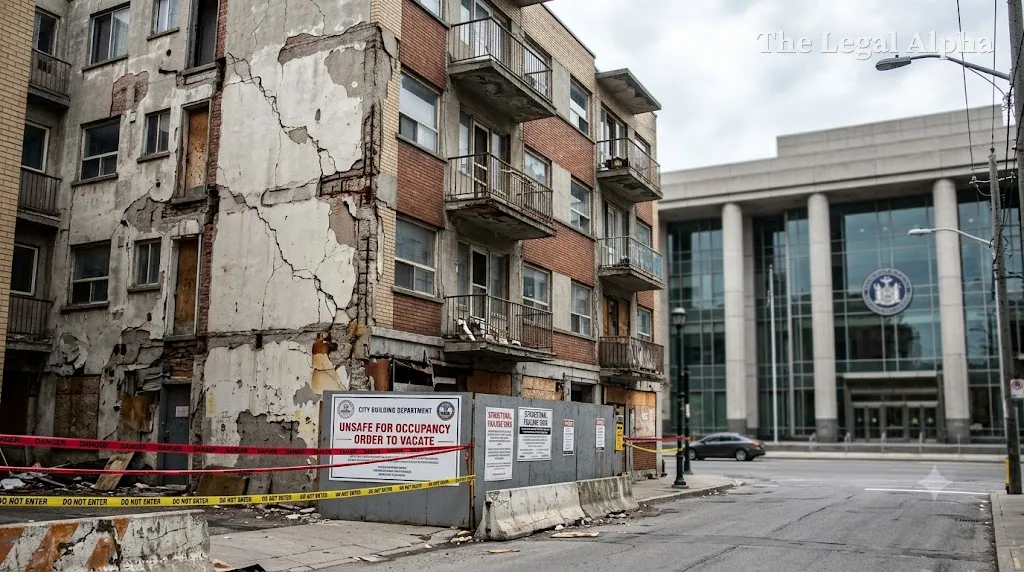
The Delhi High Court ordered the Municipal Corporation of Delhi (MCD) to urgently form a high-powered committee in consultation with the Chief Minister of Delhi to devise alternative protocols for handling structurally compromised buildings during winter pollution bans.
The ruling came while the bench was examining an enforcement dispute involving a demolition notice issued under Section 348 of the Delhi Municipal Corporation Act, 1957, against a ruinous structure. Recognizing that anti-pollution curbs under the Graded Response Action Plan (GRAP) routinely ban construction and demolition activities until mid-February, the court noted that civic bodies cannot simply leave citizens exposed to collapsing structures while waiting for pollution restrictions to lapse.
Legal Topic
Area of Law: Municipal Law / Constitutional Law
Sub-topic: Public Safety, Structural Regulation, and Right to Life under Article 21
Core Legal Issue
The core legal question centers on the conflict between statutory environmental enforcement under the Graded Response Action Plan and the affirmative duty of local municipal bodies to safeguard human life from hazardous premises.
The court had to determine whether blanket seasonal prohibitions on demolition work under clean-air protocols permit civic authorities to pause statutory interventions against structurally unstable buildings, leaving occupants and neighboring residents vulnerable to fatal collapses.
What Did the Court Decide?
Justice Saurabh Banerjee directed the Commissioner of the Municipal Corporation of Delhi, in consultation with Chief Minister Rekha Gupta, to constitute a high-powered committee expeditiously, preferably within one week.
The court mandated that this specialized body formulate practical intermediate protocols—including controlled demolitions, structural sealing, urgent stabilization, and temporary evacuations—specifically designed for hazardous properties during the subsistence of GRAP curbs. The court made it clear that mere issuance of notices or conduct of routine inspections without taking corrective action amounts to an abdication of statutory duty. The proceeding has been scheduled for further hearing on January 20, 2027.
Key Legal Points
-
Affirmative Obligation of the State: The constitutional guarantee under Article 21 places a non-delegable duty on municipal authorities to protect human life from identifiable, foreseeable structural risks.
-
Administrative Inaction Rejected: Civic bodies cannot hide behind statutory notices or environmental curbs while dangerous structures remain unaddressed until a collapse occurs.
-
Balancing Competing Public Interests: Environmental containment measures such as clean-air construction halts cannot override emergency public safety requirements concerning imminent structural collapses.
-
Inter-Departmental Coordination: Formulating exceptions and specialized intervention guidelines during environmental bans requires direct collaboration between executive civic bodies and the state political leadership.
Relevant Law
-
Article 21, Constitution of India (Protection of life and personal liberty)
-
Section 348, Delhi Municipal Corporation Act, 1957 (Power to order removal, repair, or fencing of dangerous buildings)
-
Section 349, Delhi Municipal Corporation Act, 1957 (Power to direct vacation of dangerous buildings)
-
Air (Prevention and Control of Pollution) Act, 1981 / CAQM Directives on Graded Response Action Plan (GRAP enforcement frameworks)
Arguments of the Parties
The property owners questioned the immediate execution of sweeping municipal orders during seasonal demolition bans, highlighting the administrative pause in ground-level interventions.
The Municipal Corporation of Delhi maintained that the contested building exhibited structural decay that rendered it an immediate threat to life, necessitating coercive action under Section 348 of the DMC Act. However, the agency acknowledged the practical limitations created by prevailing winter pollution restrictions prohibiting standard mechanical demolitions.
Why Does It Matter?
This ruling directly resolves an administrative deadlock that recurs every winter in the National Capital Region. While GRAP bans are vital for curbing seasonal air pollution spikes, a blanket pause on demolition work has historically frozen municipal action against precarious, aging structures, leading to preventable tragedies in dense settlements.
By requiring an executive framework for controlled exceptions, urgent stabilization, and structural sealing, the High Court ensures that environmental policy does not paralyze basic civic safety administration. The decision serves as a clear guidepost for urban local bodies across north India where clean-air directives intersect with urgent building safety enforcement.
Legal Takeaway
Statutory environmental restrictions on construction and demolition cannot serve as an administrative shield for civic inaction when a dilapidated building threatens human safety. Municipal authorities remain constitutionally required under Article 21 to employ targeted safety mechanisms—such as sealing, shoring up, or controlled interventions—to prevent foreseeable disasters even while anti-pollution curbs are in force.
Sources
Primary Source: Delhi High Court Order dated November 6, 2026, passed by Justice Saurabh Banerjee under the Delhi Municipal Corporation Act, 1957.
Additional Sources: Statutory provisions under Sections 348 and 349 of the DMC Act, 1957; Commission for Air Quality Management (CAQM) Graded Response Action Plan (GRAP) guidelines; Municipal Corporation of Delhi notices and judicial reports.