Delhi Firecracker Ban: Supreme Court Grants 48-Hour Window for Certified Green Crackers Amid Enforcement Concerns
The Supreme Court of India granted a limited 48-hour relaxation of the firecracker ban across the National Capital Region (NCR) for the Diwali festive period, permitting the sale and bursting of certified "green crackers". The two-judge Bench allowed fireworks exclusively within designated morning and evening time bands, requiring traders to operate under temporary retail permissions while mandating verifiable packaging to prevent the circulation of toxic compounds.
The direction came as part of the long-standing Arjun Gopal environmental litigation. The decision reflects ongoing judicial difficulty in balancing severe seasonal air pollution with festive observances, coming despite concerns raised by court-appointed amici curiae that previous regulatory relaxations had failed to produce required compliance and monitoring data.
Legal Topic
-
Area of Law: Environmental and Constitutional Law
-
Sub-topic: Air Pollution Regulation / Fundamental Right to Clean Environment vs. Freedom of Trade & Religion
Core Legal Issue
The central question before the Court was whether regulatory authorities could maintain a balanced, limited relaxation for low-emission pyrotechnics without violating the fundamental right to life and clean air under Article 21 of the Constitution.
The Court was required to examine whether the lack of verified empirical enforcement data from prior test relaxations warranted a complete, indefinite prohibition, or whether calibrated, time-bound exceptions for scientifically certified alternatives could be sustained alongside statutory market oversight.
What Did the Court Decide?
The Bench approved a temporary relaxation permitting the sale and ignition of certified green crackers for 48 hours across Delhi-NCR within two daily operational windows: 6:00 AM to 7:00 AM and 8:00 PM to 10:00 PM.
-
Licensing and Safeguards: Authorities were permitted to temporarily restore suspended retail licenses strictly for certified inventory. The Court ordered the mandatory application of non-transferable QR codes to verify chemical compositions and mandated 300-metre buffer zones around sensitive locations such as hospitals.
-
Directions and Oversight: The Court directed administrative bodies, including the Commission for Air Quality Management (CAQM), to conduct air quality audits, track hospital admission metrics during the festive window, and submit compliance and monitoring reports by mid-December.
-
Public Engagement: The Bench underscored that technical enforcement must be paired with wide-reaching public awareness campaigns to encourage self-restraint and adherence to environmental safeguards.
Key Legal Points
-
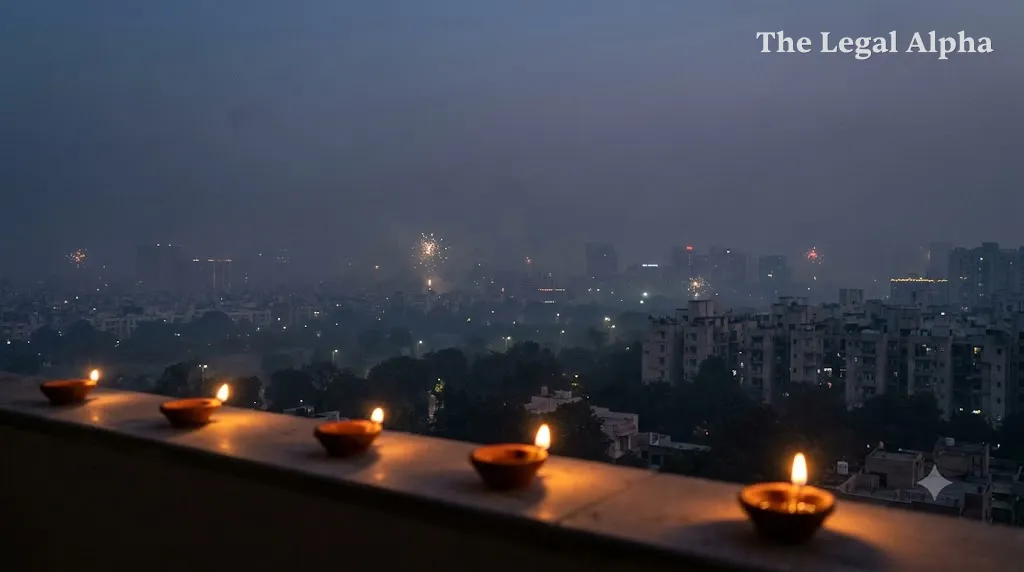
Scriptural and Historic Context: In reviewing liturgical origins, the Court noted that classical historical observances centered on lighting earthen lamps rather than chemical pyrotechnics, observing that industrial fireworks emerged centuries later through military gunpowder usage.
-
Limitations of Conditional Exemptions: While laboratory-formulated green crackers achieve an estimated 30 percent reduction in particulate emissions at the individual unit level, this technical metric does not equate to an ambient pollution reduction across an enclosed airshed prone to seasonal winter temperature inversions.
-
Administrative Burden: The ruling highlighted the operational challenge of enforcing chemical standards and verifying digital codes across informal and decentralized retail markets in real-time.
-
Evidentiary Gaps in Interim Relief: The Bench renewed a provisional relaxation despite an absence of structured compliance metrics from earlier test windows, directing fresh air-quality data collection before determining permanent regulatory measures.
Relevant Law
-
Constitution of India:
-
Article 21: The right to life and personal liberty, interpreted to encompass the right to a clean, non-toxic, and breathable environment.
-
Article 19(1)(g): The freedom to practice any profession, trade, or business, subject to reasonable public health restrictions under Article 19(6).
-
Article 25: Freedom of religion, expressly conditioned on public order, morality, and public health.
-
-
Statutory Framework: The Environment (Protection) Act, 1986, and the Air (Prevention and Control of Pollution) Act, 1981.
-
Judicial Precedent: Arjun Gopal and Others v. Union of India (2018), which outlawed joined crackers (ladis) and toxic barium salts while restricting the market to CSIR-NEERI-certified low-emission alternatives.
Arguments of the Parties
-
The Petitioners and Amici Curiae: Senior counsel appearing for the petitioners and amicus curiae opposed any relaxation, arguing that ambient air quality in Delhi-NCR already exceeds safe thresholds, leaving children and vulnerable populations facing severe respiratory health risks. They submitted that prior interim relaxations lacked verification data, banned chemical formulations remained widely available in unorganized supply chains, and brief operational bursts generate persistent particulate plumes in winter atmospheric conditions.
-
The Firecracker Manufacturers: Counsel for the industry argued that an absolute prohibition causes severe economic fallout for licensed domestic producers, affecting hundreds of thousands of manufacturing jobs. They contended that compliant manufacturers adhere to CSIR-NEERI formulas and that blanket bans inadvertently open the market to unregulated, highly hazardous grey-market and illicit imports.
-
The State and Regulatory Authorities: Government counsel and the Commission for Air Quality Management submitted that administrative frameworks, monitoring systems, and dedicated enforcement protocols were prepared to police authorized sales windows and isolate non-compliant inventory.
Why Does It Matter?
This development highlights the ongoing struggle to reconcile fundamental public health protections with commercial interests and seasonal public sentiment. The reliance on short-term experimental relaxations reflects institutional hesitation to enforce blanket bans, even when past exemptions lacked empirical follow-through.
For commercial manufacturers and retailers, the recurring shift between total bans and short-term test relaxations creates long-term regulatory uncertainty. On an environmental level, the order underscores that technical product improvements—such as a 30 percent reduction in laboratory emissions—remain difficult to translate into tangible air quality gains without comprehensive ground-level market policing and cross-jurisdictional enforcement.
Legal Takeaway
The ruling demonstrates that while the Supreme Court recognizes clean air as a non-negotiable component of Article 21, it continues to pursue a middle path through conditional exemptions for certified green pyrotechnics. In the absence of strict ground-level verification of QR codes and active supply-chain compliance, the practical burden of balancing public health against commercial and festive practices remains largely unresolved.
Sources
-
Primary Source: Supreme Court of India, Arjun Gopal and Others v. Union of India & Ors. (Writ Petition (Civil) No. 728 of 2015), Order dated October 29, 2026.
-
Additional Sources: Reports and scientific guidelines by CSIR-National Environmental Engineering Research Institute (CSIR-NEERI) on Green Cracker Formulations; Notifications of the Commission for Air Quality Management in NCR and Adjoining Areas (CAQM).