Consumer Forum Holds Airline Liable for Rs 26 Lakh After Denied Boarding Delays Ailing Passenger’s Surgery
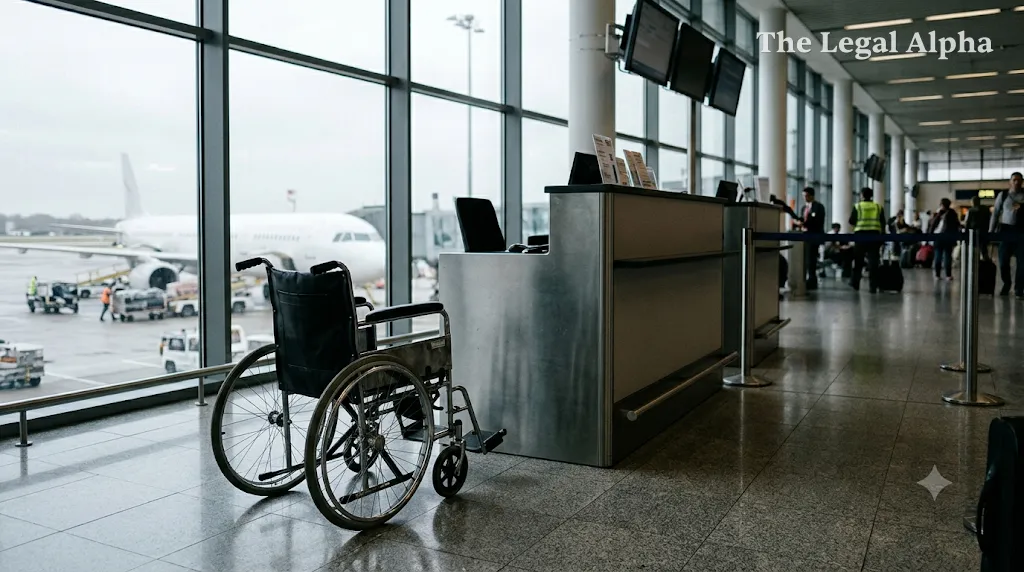
The District Consumer Disputes Redressal Commission (South Delhi) has directed a private airline to pay Rs 26 lakh in compensation to the widow of a 49-year-old nurse who died at Mumbai airport after being denied boarding on a confirmed connecting flight.
In July 2019, the man—who worked in Tel Aviv and suffered from a severe spinal condition—booked business-class tickets for himself and an accompanying relative to travel from Israel to Mangaluru via Mumbai. He had requested wheelchair assistance in advance and was scheduled to go directly from Mangaluru airport to a hospital for urgent spinal surgery on July 8, 2019. However, upon reaching Mumbai airport on July 8, airline staff refused to let the duo board their connecting flight to Mangaluru, citing overbooking. Instead, the carrier unilaterally rebooked them onto a flight the next day. The following morning, July 9, 2019, the passenger collapsed at the Mumbai airport terminal while waiting for a wheelchair and was declared dead shortly afterward.
Legal Topic
Area of Law: Consumer Protection Law
Sub-topic: Deficiency in Service / Aviation Liability
Core Legal Issue
The commission examined whether an airline commits gross deficiency in service and negligence by involuntarily bumping a medically vulnerable passenger with a confirmed ticket due to overbooking, and whether a carrier can escape liability on the ground that the passenger did not submit a formal Medical Information Form (MEDIF) prior to travel.
What Did the Court / Authority Decide?
In an order dated October 29, 2026, a two-member bench comprising President Monika A. Srivastava and Member Kiran Kaushal ruled in favour of the deceased passenger's wife.
The commission held the airline guilty of gross deficiency in service and negligence, issuing the following directions:
-
Compensation: Pay Rs 26 lakh to the complainant for the physical and mental agony suffered by her late husband that culminated in his death.
-
Ticket Refund: Refund Rs 90,000 towards the cost of the air tickets from Israel to Mumbai and Mumbai to Mangaluru.
-
Litigation Costs: Pay Rs 30,000 towards the complainant's legal expenses.
Key Legal Points
-
Duty to Prioritise Vulnerable Flyers: When accommodating passengers from previously misconnected flights, an airline cannot treat a wheelchair-assisted passenger as a routine booking case and must prioritise their boarding over general overbooking adjustments.
-
Limits of the MEDIF Requirement: A mandatory Medical Information Form (MEDIF) is required only when a traveller needs specialised medical equipment such as a stretcher, oxygen cylinder, or incubator. An advance request for a wheelchair is sufficient to put a prudent carrier on notice that the passenger has mobility limitations and health concerns.
-
Seeking Volunteers Before Denied Boarding: Rather than arbitrarily bumping confirmed passengers—especially those with visible or notified medical vulnerabilities—airlines are expected to seek volunteers willing to surrender their seats in exchange for benefits.
-
Reasonableness of Alternative Routing: Offering an alternative flight to a nearby city (Goa) requiring an onward road journey does not absolve an airline of liability when the passenger's frail physical condition makes road travel unviable.
Relevant Law
-
Consumer Protection Act, 1986 / Consumer Protection Act, 2019 (Provisions governing "deficiency in service" and unfair trade practices by service providers).
-
DGCA Civil Aviation Requirements (CAR), Section 3, Series M, Part IV (Rules governing facilities to be provided to passengers by airlines due to denied boarding, cancellation of flights, and delays, which mandate seeking volunteers before involuntary denied boarding).
-
DGCA Civil Aviation Requirements (CAR), Section 3, Series M, Part I (Regulations on carriage by air of persons with disability and/or persons with reduced mobility).
Arguments of the Parties
Complainant The widow contended that the airline had prior notice of her husband's medical condition through the advance wheelchair request and was explicitly informed at the Mumbai counter that he needed to reach Mangaluru immediately for scheduled spinal surgery. She argued that refusing boarding without consent delayed critical medical intervention and directly contributed to his collapse and death the next morning.
Opposite Party (Airline) The airline denied any negligence, asserting that the passenger and his attendant failed to report to the check-in counter on time after the flight was already fully checked in. It further argued that the passenger had not disclosed a medical emergency through the mandatory MEDIF form, that it had offered an alternative flight via Goa, and that the man ultimately died of natural causes unrelated to the airline's operations.
Why Does It Matter?
Overbooking is a standard commercial practice in aviation, but this ruling draws a sharp boundary around how airlines manage seat shortages when passenger health is at stake. Carriers frequently rely on technical compliance defences—such as the absence of a MEDIF form—to contest claims involving medical distress. By clarifying that an advance wheelchair request already places a duty of care on the airline, the commission prevents carriers from using administrative formalities to shield themselves from operational lapses. For air travellers, particularly senior citizens and those travelling for medical treatment, the decision reinforces that confirmed tickets coupled with mobility assistance requests carry heightened protection against arbitrary off-loading.
Legal Takeaway
Airlines cannot offload confirmed passengers with known mobility or health issues simply to accommodate overbooked seats, nor can they hide behind the absence of a formal medical clearance form when a wheelchair request was already made. Travellers flying for urgent medical procedures should document their wheelchair or assistance requests in writing at the time of booking and immediately notify ground staff on record if a flight disruption threatens scheduled treatment.
Sources
Primary Source
Order dated October 29, 2026, passed by the District Consumer Disputes Redressal Commission (South Delhi), Bench of President Monika A. Srivastava and Member Kiran Kaushal.
Additional Sources
Report by The Indian Express ("Airline ordered to pay Rs 26 lakh to widow after passenger dies following overbooking", published November 10–11, 2026).