Coastal Safety: Madras High Court Urges Drone Deployment and Inter-Agency Coordination for Beach Rescues
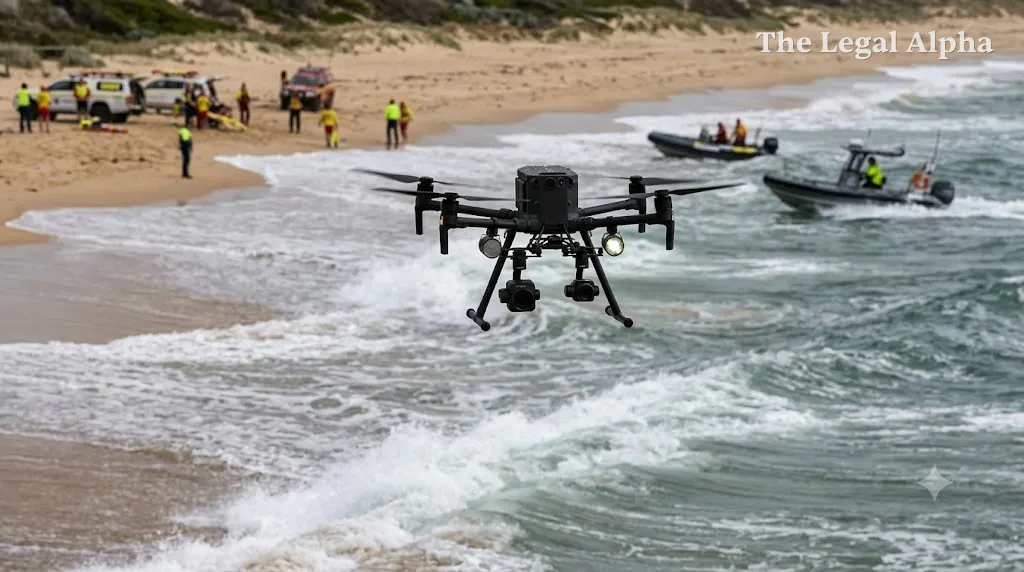
The Madras High Court raised sharp concerns over institutional disconnect between Central and State emergency rescue entities, observing that seamless coordination could prevent drowning tragedies along Tamil Nadu's coastline. A Division Bench comprising Justice A. D. Jagadish Chandra and Justice B. Karthikeyan directed the Chennai Commissioner of Police to assess the feasibility of deploying camera-equipped drones for real-time surveillance and rescue operations at Marina Beach. The order came during proceedings initiated by K. Gopal, whose minor son went missing at sea on July 5 and remains untraced, despite two peers being rescued.
Legal Topic
Area of Law: Constitutional & Administrative Law
Sub-topic: Coastal Safety Administration / State Positive Duty under Right to Life
Core Legal Issue
The matter addresses whether the State's administrative duty to preserve human life under Article 21 extends to establishing enforceable Standard Operating Procedures (SOPs) and technology-assisted disaster management mechanisms among disparate law enforcement and maritime agencies.
Specifically, the Court examined whether existing coastal policing arrangements suffice without integrated operational protocols linking local shore patrols to national search and rescue networks.
What Did the Court Decide?
The High Court expressed strong dissatisfaction with the lack of inter-agency synchronisation documented in official submissions. It issued specific interim directives to administrative authorities:
-
The Chennai Commissioner of Police must file comprehensive details regarding standard operating procedures governing immediate beach rescues.
-
Authorities must submit an evaluation detailing the technical and operational feasibility of operating drone cameras to spot and aid distressed swimmers in surf zones.
-
The administration must account for how local coastal security units align with the National Maritime Search and Rescue Plan.
The Court adjourned the proceeding to November 20 for further compliance and examination of the proposed framework.
Key Legal Points
-
Positive Affirmative Duty to Protect Life: The State's obligation under Article 21 involves not only post-incident response, but also preventive surveillance and coordinated infrastructure to avert foreseeable fatal incidents in public hazard zones.
-
Administrative Institutional Friction: Ineffective communication and siloed operations between State policing bodies and Central maritime authorities undermine emergency responsiveness, defeating statutory rescue mandates.
-
Judicial Mandate on Technological Modernisation: The Court highlighted modern aerial tools—such as unmanned aerial vehicles (UAVs)—as essential mechanisms to eliminate patrol blind spots across expansive coastlines.
Relevant Law
-
Constitution of India: Article 21 (Protection of life and personal liberty) and Article 226 (Writ jurisdiction of High Courts).
-
Disaster Management Act, 2005: Provisions mandating inter-agency cooperation, emergency preparedness, and the integration of specialized technology into disaster response.
-
National Maritime Search and Rescue Plan, 2022: Promulgated by the National Maritime Search and Rescue Coordinating Authority to streamline search operations across Indian maritime search and rescue regions.
Arguments of the Parties
Petitioner
The petitioner, a distressed father, submitted that authorities failed to deploy adequate, synchronized resources in time when his minor son was swept away into the sea on July 5, leaving the boy's fate unconfirmed despite extensive water stretches along the Chennai coast.
Respondent / State
The Chennai Commissioner of Police filed a status report detailing existing security deployments:
-
50 personnel from the 12th Battalion of the Tamil Nadu Special Police maintain rotational shore vigilance daily at Marina Beach.
-
Dedicated beach assets include seven operational jet skis, an off-road utility vehicle, and two mini-tractors for shore patrolling.
-
Two 12-tonne boats from the Coastal Security Group (CSG) patrol the waters extending from Pazhaverkadu to Neelankarai.
The State, however, conceded that the report lacked documented coordination mechanisms showing how these local units integrate with central marine agencies during active distress calls.
Why Does It Matter?
This intervention highlights persistent operational gaps where public spaces border high-risk maritime domains. Despite deploying significant ground personnel and heavy patrol craft, urban beach fronts remain susceptible to tragic drownings due to fragmented rescue protocols.
By pushing for the adoption of drone technology and clear Standard Operating Procedures aligned with national search-and-rescue blueprints, the High Court is shifting coastal administration from fragmented patrolling to unified aerial and maritime emergency response. If successfully instituted in Chennai, this model offers a standardized blueprint for coastal safety across other high-footfall maritime states in India.
Legal Takeaway
Public safety along national coastlines requires coordinated administrative execution, not just standalone machinery and siloed patrol squads. The State holds a legal responsibility to adopt modernized aerial search tools and institutional Standard Operating Procedures to safeguard human life in high-risk recreational waters.
Sources
Primary Source:
-
Madras High Court, Division Bench (Justice A. D. Jagadish Chandra & Justice B. Karthikeyan), Order dated November 9, 2026, in the plea concerning coastal search and rescue operations.
Additional Sources:
-
National Maritime Search and Rescue Plan (2022), issued by the National Maritime Search and Rescue Coordinating Authority / Maritime Rescue Coordination Centre (MRCC).
-
Status Report filed by the Commissioner of Police, Greater Chennai Police.