Clean Water and Working Toilets at Railway Stations: Supreme Court Moved to Enforce Strict Deadlines and Official Accountability
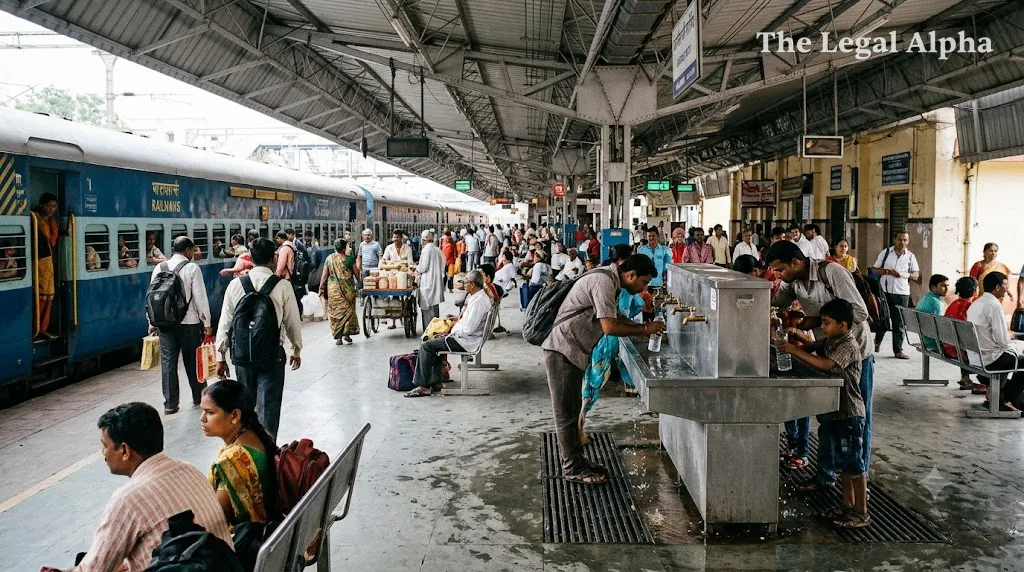
A public interest petition has been moved before the Supreme Court of India seeking judicial enforcement of time-bound upgrades to basic amenities across railway stations nationwide. Highlighting findings from an audit tabled by the Comptroller and Auditor General (CAG) of India, the plea flags widespread deficiencies in passenger infrastructure—including bacterial contamination in station water coolers, unhygienic toilets, poor sanitation, and deficient emergency medical readiness.
The matter is slated to be heard on November 16 by a three-judge Bench headed by Chief Justice Surya Kant and comprising Justices Joymalya Bagchi and V. Mohana. The petition urges the top court to enforce mandatory water testing, station-wise corrective roadmaps, and personal administrative accountability for defaulting rail officials.
Legal Topic
Area of Law: Constitutional Law & Administrative Law Sub-topic: Fundamental Rights (Article 21) / Public Utility Services & Passenger Safety
Core Legal Issue
The petition raises the question of whether the failure of a State-run monopoly carrier to maintain potable drinking water, clean sanitation, and basic public health infrastructure amounts to a breach of the constitutional right to health and life under Article 21 of the Constitution of India.
It also asks whether the Supreme Court should invoke its writ jurisdiction to translate statutory duties, internal service benchmarks, and parliamentary audit findings into legally binding, time-bound mandates backed by administrative penalties for official non-compliance.
What Did the Court / Authority Decide?
The petition is newly instituted and awaits substantive consideration; no final directions or judicial rulings have been rendered yet.
The Supreme Court Registry has listed the matter for preliminary hearing on November 16 before the Bench led by Chief Justice Surya Kant. Until the matter is formally adjudicated, the petitioner has prayed for interim directions mandating immediate remedial drives against critical passenger hazards, notably contaminated drinking water and substandard sanitation facilities.
Key Legal Points
-
Constitutional Dimensions of Public Amenities: Safe drinking water, hygiene, and emergency medical accessibility at transit hubs fall within the ambit of the right to live with dignity and the right to health protected under Article 21.
-
Judicial Enforceability of Audit Findings: The plea seeks to elevate statutory audit observations and recommendations by the CAG into court-monitored, actionable compliances with fixed deadlines.
-
Individual Bureaucratic Accountability: The petition asks the court to move beyond broad institutional directions and explicitly fix personal liability on responsible railway officers for failure, neglect, or unjustified delay.
-
Precautionary Public Health Safeguards: The petitioner seeks a mandamus requiring prompt suspension and replacement of contaminated water points failing microbiological standards (such as the detection of E. coli and total coliforms) until proper rectification and certification occur.
Relevant Law
-
Article 21, Constitution of India: Guarantee of the right to life and personal liberty, judicially interpreted to encompass access to safe drinking water, basic sanitation, and public health.
-
Article 32, Constitution of India: Writ jurisdiction of the Supreme Court to enforce fundamental rights.
-
The Railways Act, 1989: Provisions governing passenger amenities, safety, and statutory obligations of the railway administration to maintain minimum standards across railway stations.
-
Article 148 to 151, Constitution of India: Constitutional framework governing the Comptroller and Auditor General of India and the submission of audit reports to Parliament.
Arguments of the Parties
Petitioner The petitioner argued that rail commuters are entitled to basic minimum facilities as an aspect of their fundamental rights, which are currently compromised by administrative lethargy. Citing the CAG report, the petitioner pointed out that routine water samples from railway coolers tested positive for E. coli bacteria and coliform contamination, posing severe public health risks. The petitioner submitted that systemic failures persist despite existing internal guidelines, necessitating judicial intervention to mandate periodic chemical and bacteriological testing, shut down contaminated outlets, enforce station-specific compliance schedules, and hold administrative officers individually accountable under the law for non-performance.
Respondent (Union of India / Railway Administration) The matter has not yet been formally argued in court, and the Union of India's formal reply is awaited. Customarily in infrastructure-related public interest litigations, public transport authorities maintain that station upgradation and maintenance are ongoing, resource-intensive operational processes governed by executive schemes and administrative policies, which are continuously monitored through departmental grievance and modernization mechanisms.
Why Does It Matter?
Millions of passengers use the Indian railway network daily, making passenger hygiene, station sanitation, and safe drinking water issues of wide public interest. If the Supreme Court entertains the plea and issues continuous mandamus or oversight mechanisms, it could shift how internal audits and CAG findings are treated by executive agencies—moving them from advisory parliamentary reviews to actionable legal mandates.
Furthermore, imposing direct bureaucratic liability on railway division chiefs or facility managers for hygiene failures would mark a noticeable shift toward personal administrative accountability in public utility management.
Legal Takeaway
The petition seeks to transform basic public transport amenities—such as certified potable water and clean washrooms—from discretionary administrative goals into judicially enforceable constitutional obligations. Its outcome will test the extent to which constitutional courts are willing to enforce administrative deadlines and individual official liability based on parliamentary audit findings.
Sources
Primary Source:
-
Supreme Court of India Cause List for November 16 (Bench of Chief Justice Surya Kant, Justice Joymalya Bagchi, and Justice V. Mohana); Public Interest Litigation on Passenger Amenities and Implementation of CAG Report on Railway Stations.
Additional Sources:
-
Report of the Comptroller and Auditor General of India on Railway Station Amenities (Tabled in Parliament, August 2026).
-
Press Trust of India (PTI) court filing report, November 9, 2026.