Centre Seeks Removal of Krishi Bhawan Mosque in Delhi High Court, Citing Secular Nature of Public Land
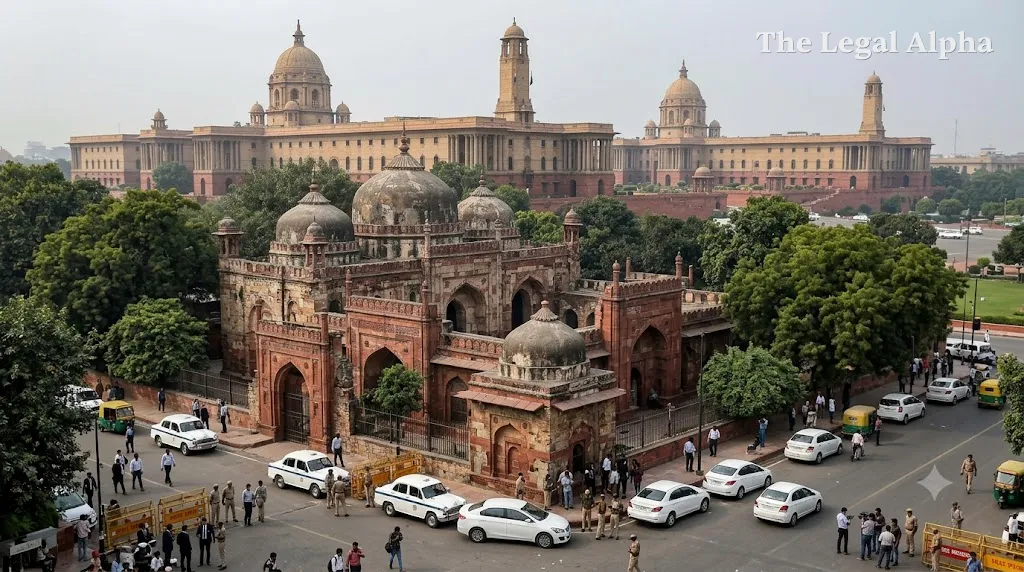
The Union Government has submitted a formal status report before the Delhi High Court declaring that the century-old Qadeemi Masjid located inside the Krishi Bhawan administrative complex must be cleared.
The submission came through the Land and Development Office (L&DO) under the Ministry of Housing and Urban Affairs in response to a plea moved by the mosque's managing and caretaking committee. The caretakers had approached the High Court seeking protection against anticipated demolition after tenders were issued to construct new common administrative secretariat blocks under the Central Vista Redevelopment Master Plan. Responding directly to the plea, the Centre made its stand explicit: the religious structure cannot be accommodated or preserved within the proposed central administrative zone.
Legal Topic
Area of Law: Constitutional Law / Property & Municipal Law Sub-topic: Religious Freedom under Article 25 vs State Ownership of Public Land and Permissive Licences
Core Legal Issue
The matter centers on whether the constitutional protection of freedom of religion under Article 25 grants a religious body an enforceable legal entitlement to preserve a place of worship on public property against the government's redevelopment and urban planning mandates.
Specifically, the High Court must consider whether land allotted under a historical permissive arrangement can mature into a permanent encumbrance on State property, or if the government, as the absolute landowner, retains full authority to revoke permissive use for public administrative infrastructure without violating constitutional guarantees.
What Did the Court / Authority Decide?
The proceedings remain sub judice before the Delhi High Court, with no final determination or order on demolition yet pronounced.
The latest development represents the Union Government's formal stand articulated via an official status report executed by the Deputy Land and Development Officer. In the affidavit, the Centre has unequivocally rejected requests to earmark or carve out land for the mosque inside the new secretariat perimeter. The matter remains pending for judicial consideration, during which the High Court will evaluate the legality of the committee's claims against the Centre's redevelopment blueprints.
Key Legal Points
-
Public Land and Secular Character: The Centre asserts that state-owned administrative hubs must retain a secular character, rendering the permanent reservation or retention of religious structures on such land legally impermissible.
-
Permissive Licence vs Proprietary Right: The government contends that an arrangement dating back to 1940 conferred strictly permissive possession for prayer, creating no title, leasehold right, or perpetual easement.
-
Scope of Article 25: The State maintains that constitutional religious safeguards do not create an unalterable right to offer prayers at a specific parcel of government land, especially when alternative places of worship exist nearby.
-
Public Purpose and Eminent Domain: The planned redevelopment forms part of the master plan for the Central Vista, which the government classifies as essential public administrative infrastructure taking precedence over permissive occupancies.
Relevant Law
-
Article 25 of the Constitution of India (Freedom of conscience and free profession, practice, and propagation of religion)
-
Article 226 of the Constitution of India (High Court jurisdiction to issue prerogative writs)
-
The Indian Easements Act, 1882 (Provisions governing revocable licences and permissive occupancy)
-
Public Premises (Eviction of Unauthorised Occupants) Act, 1971
-
M. Ismail Faruqui v. Union of India (1994) 6 SCC 360 (Supreme Court ruling holding that a mosque is not an indispensable part of Islam unless it possesses unique religious significance, and can be acquired or removed by the State for a public purpose)
Arguments of the Parties
Petitioner (Qadeemi Masjid Caretaking Committee)
The managing committee contended that the Qadeemi Masjid is a historical structure that predates the construction of Krishi Bhawan, having served worshippers and government personnel for decades. They argued that the structure carries heritage and religious significance, having also been notified as Waqf property in 1970. Consequently, the committee urged the High Court to restrain authorities from demolishing or damaging the mosque during the execution of the new secretariat building plans.
Respondent (Union Government / Land & Development Office)
The Centre submitted that Plot No. 120 on Dr. Rajendra Prasad Road vests exclusively in the Government of India. It maintained that the November 8, 1940 agreement merely granted permissive use without parting with proprietary rights. The government emphasized that public property inside a central administrative zone cannot be encumbered with religious reservations, nor does Article 25 establish a right to worship at a designated government plot when functional alternatives—such as Shahi Masjid Zabta Ganj near India Gate—exist within close proximity.
Why Does It Matter?
This litigation reinforces the delicate legal boundary between constitutional religious liberties and the State's proprietary rights over public administrative land.
By leaning on the principle of the "secular character" of government offices, the Centre is setting a firm precedent regarding whether permissive religious enclaves can survive comprehensive master planning projects. If the High Court accepts the government’s interpretation, it will solidify the doctrine that historical or long-standing permissive use does not ripen into an adverse or unassailable right against State-backed public utility redevelopments.
Legal Takeaway
A permissive licence granted by the government to use public land for worship does not confer an enforceable property right or a permanent shield under Article 25 against State infrastructure projects. Where the State requires its land for genuine public administration, freedom of religion cannot be invoked to compel the government to preserve or re-allot premises within a dedicated administrative zone.
Sources
Primary Source:
-
Status Report filed by Deputy Land and Development Officer, Ministry of Housing and Urban Affairs, in Qadeemi Masjid Caretaking Committee v. Union of India & Ors. before the High Court of Delhi.
-
Agreement of Possession dated November 8, 1940, annexed to the Union Government's Status Report.
Additional Sources:
-
High Court reporting and record proceedings, LiveLaw and Bar & Bench.