'Why Register Against Unknowns When Caught on Spot?': Supreme Court Demands Explanation from UP Police Over Biased Investigation
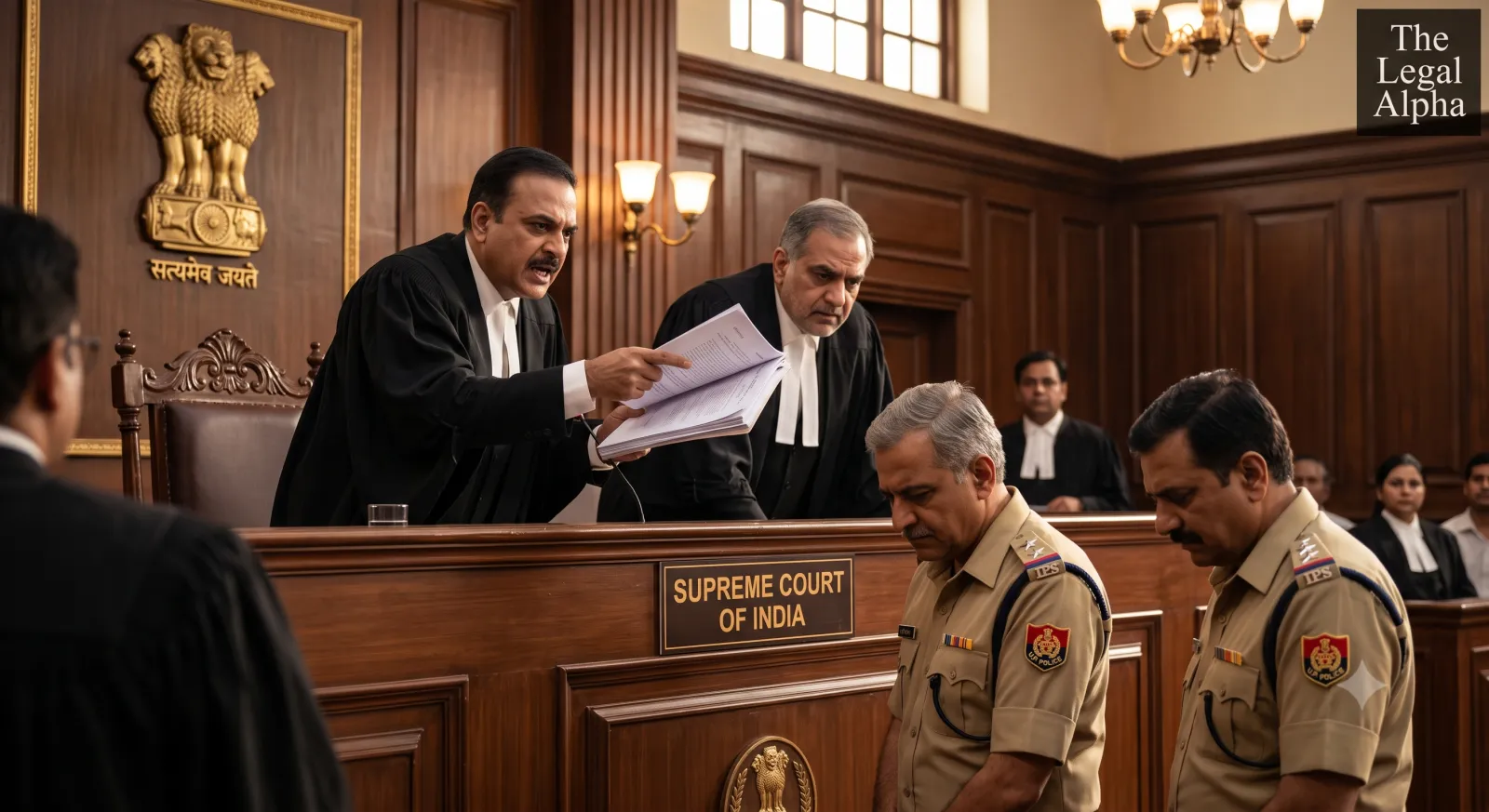
The Supreme Court of India sharply reprimanded the Uttar Pradesh Police on September 30, 2026, over serious irregularities in a criminal probe where officers registered a case against an "unknown" person despite the suspect being caught red-handed at the scene.
The matter came before a Bench comprising Justice Sanjay Kumar and Justice Sanjeev Sachdeva through a petition filed by a complainant in person. The complainant alleged that following a road incident involving a motorcycle, he caught the motorcyclist on the spot and immediately handed him over to the police. However, the police recorded the First Information Report (FIR) against an unidentified rider, omitting the suspect's name entirely. It was only after judicial intervention by the High Court that the police named the suspect in their papers—identified in subsequent affidavits as Tushar—only to grant him a clean chit shortly thereafter.
Dismayed by apparent manipulation of case documents, the Bench warned that compromised investigations erode public faith in law enforcement, directing the investigating officer to appear before the court in person.
Legal Topic
Area of Law: Criminal Procedure & Constitutional Law
Sub-topic: Integrity of Police Investigations / Statutory Duties under FIR Registration / Fair Trial Rights
Core Legal Issue
The core legal question before the Supreme Court is whether an investigating agency can deliberately register an FIR against an "unknown" person when the suspect has been physically apprehended and handed over at the scene of the alleged crime.
This issue strikes at the statutory fidelity required under the criminal justice framework: does withholding an accused’s identity at the threshold of a probe permit improper police manipulation, arbitrary substitution of suspects, or manufactured exonerations, thereby vitiating the complainant's fundamental right to an impartial investigation?
What Did the Court / Authority Decide?
The Supreme Court did not dismiss or finally dispose of the proceedings; instead, it issued stern directions calling the Uttar Pradesh Police to account:
-
Rejection of Current Affidavit: The Bench held that the initial reply affidavit submitted by the state police was "completely uninspiring" and failed to justify the procedural anomalies.
-
Personal Appearance Ordered: The Court directed the concerned investigating officer to remain personally present on the next date of hearing.
-
Requirement of a Detailed Affidavit: The officer must submit a fresh, comprehensive affidavit explaining why the FIR was lodged against an unknown motorist despite on-the-spot custody, and under what circumstances the name was omitted initially and supplemented later.
-
Oral Reprimand: In sharp oral observations, the Court remarked that such conduct resembled a "cover up job" and cautioned that if state agencies continue to conduct biased probes, the judiciary would have little choice but to transfer all state investigations to independent agencies like the Central Bureau of Investigation (CBI).
The substantive petition remains pending for further consideration upon receipt of the officer's explanation.
Key Legal Points
-
Fidelity of the FIR: An FIR under criminal procedure is meant to record facts as they exist at the time of reporting; omitting an apprehended suspect's identity creates an impermissible opening for subsequent manipulation or selective prosecution.
-
Right to an Impartial Probe: Investigating authorities are constitutionally obligated to conduct investigations that are fair, transparent, and untainted by extraneous considerations.
-
Judicial Scrutiny of Evidentiary Discrepancies: Courts retain inherent power to question arbitrary shifts in evidence during a probe, such as the retrospective identification of vehicles or sudden exoneration of suspects.
-
Institutional Accountability: Evasive or boilerplate affidavits filed by police departments will not suffice when core statutory procedures appear bypassed.
Relevant Law
-
Code of Criminal Procedure, 1973 (CrPC), Section 154 / Bharatiya Nagarik Suraksha Sanhita, 2023 (BNSS), Section 173: Mandates the prompt and accurate recording of information relating to the commission of a cognizable offence.
-
Code of Criminal Procedure, 1973 (CrPC), Section 173 / Bharatiya Nagarik Suraksha Sanhita, 2023 (BNSS), Section 193: Governs the submission of police reports upon completion of an investigation.
-
Constitution of India, Article 21: Guarantees the right to life and personal liberty, which the Supreme Court has consistently interpreted to include the right of both victims and accused persons to a free, fair, and unbiased investigation.
-
Judicial Precedents: Babubhai v. State of Gujarat (2010), establishing that an investigation must be judicious and completely free of bias; and Lalita Kumari v. Government of Uttar Pradesh (2014), underscoring the mandatory obligation to register FIRs based on actual facts without arbitrary preliminary gatekeeping.
Arguments of the Parties
Petitioner (Complainant in Person)
-
The petitioner submitted that the investigation conducted by the state police was biased and compromised from its inception.
-
He stated that he caught the suspect at the scene of the incident and handed him over to the police, making it incomprehensible why the FIR was registered against an unidentified party.
-
He highlighted that the suspect's name was entered into the case record only after the High Court intervened and directed a status report, following which the police arbitrarily granted the accused a clean chit.
-
He further pointed out that the motorcycle involved carried no registration plate when seized, yet an official registration number was subsequently entered into the case records during the inquiry.
Respondent (Uttar Pradesh Police / State Counsel)
-
The State relied on its reply affidavit, confirming that the rider's identity had indeed been disclosed as Tushar in paragraph 6 of their pleadings.
-
Counsel sought to maintain that standard procedures were observed and that the investigation progressed in accordance with collected evidence.
Why Does It Matter?
Leaving an accused person’s name blank in an FIR—particularly when the individual was apprehended at the spot—creates dangerous latitude for police malpractice. As the Supreme Court observed during the hearing, such procedural loopholes allow investigating agencies to substitute identities, shift liability, or protect favoured individuals by later issuing unquestioned clean chits.
This scrutiny sends a clear warning to law enforcement agencies across jurisdictions that procedural subterfuge in case diaries and initial charging documents will not pass judicial muster. For citizens and victims pursuing criminal remedies, the order reinforces that constitutional courts will look behind administrative reports and demand personal accountability from police officers when foundational documents show deliberate tampering.
Legal Takeaway
An FIR must accurately reflect the facts and suspects known at the time of reporting; omitting an apprehended suspect's name is a serious procedural irregularity. When investigating authorities engage in evasive documentation or questionable exonerations, courts will intervene to ensure fair investigation standards are maintained.
Sources
-
Primary Source: Supreme Court of India, Proceedings before the Division Bench of Justice Sanjay Kumar and Justice Sanjeev Sachdeva, September 30, 2026.
-
Additional Sources: Bar and Bench reporting on the proceedings in Complainant in Person v. State of Uttar Pradesh & Ors. (September 30, 2026).