Telangana High Court Bars Disclosure of Court CCTV Footage to Individuals Under RTI, Clarifying Release Only Permissible for Police Investigations
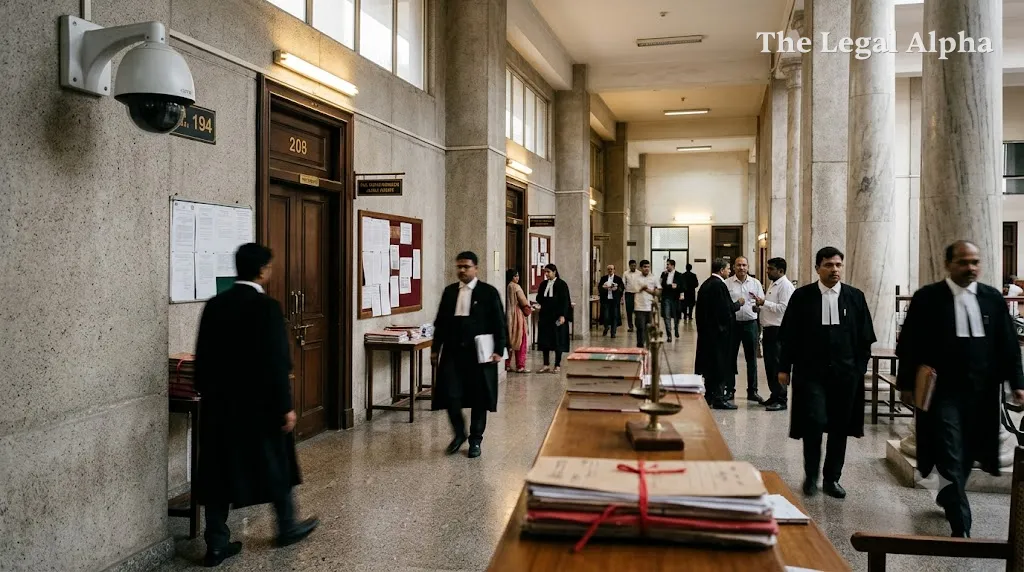
The Telangana High Court has dismissed a petition filed by an advocate seeking access to closed-circuit television (CCTV) surveillance footage recorded on court premises.
The petitioner, advocate Ranjit Charan Kumar, initially approached a district court’s Public Information Officer (PIO) under the Right to Information Act, requesting video records from April 20. After the PIO rejected the disclosure request, Kumar filed a writ petition before the High Court seeking directions to release the preserved surveillance recordings. A division bench comprising Acting Chief Justice P. Sam Koshy and Justice Narsing Rao Nandikonda dismissed the petition, ruling that internal judicial surveillance recordings cannot be disclosed to private individuals for personal purposes.
Legal Topic
Area of Law: Administrative and Information Law
Sub-topic: Right to Information / Judicial Administration and Court Security
Core Legal Issue
The core question before the bench was whether CCTV recordings captured within judicial premises constitute disclosable information accessible to individual litigants or advocates under the Right to Information Act, or whether court administration circulars framed under Supreme Court directives bar such disclosures.
In addition, the court addressed the threshold circumstance under which court security footage can lawfully be requisitioned and inspected by external authorities.
What Did the Court Decide?
The division bench rejected the writ petition, upholding the administrative stance taken by district court authorities.
The court held that:
-
Individuals cannot obtain CCTV footage recorded within court premises for private or personal use under the RTI Act or via independent administrative requests.
-
Granting private parties access would directly contravene the High Court's administrative circular issued in July 2024, which barred district unit heads from parting with footage of proceedings or premises pursuant to directions issued by the Supreme Court of India in August 2017.
-
Access to court CCTV footage is strictly limited to law enforcement: an Investigating Officer (IO) may request and receive such surveillance material solely for the purpose of investigating a formal complaint or a registered First Information Report (FIR).
Key Legal Points
-
Inapplicability of General RTI Disclosure: Security and procedural surveillance installed inside court buildings cannot be requisitioned as routine public records by private applicants.
-
Primacy of Judicial Administrative Circulars: The High Court's July 2024 circular—prohibiting district judicial units from releasing camera recordings—binds subordinate registries and PIOs.
-
Conformity with Supreme Court Mandates: High Court administrative restrictions align with apex court rulings on the installation, custody, and confidentiality of electronic monitoring systems within courts.
-
Sole Exception for Criminal Probes: Court surveillance records are primarily preserved for judicial administration and security; they can only be shared with investigating officers conducting official inquiries arising out of criminal complaints or FIRs.
Relevant Law
-
Right to Information Act, 2005 (RTI Act): Provisions governing disclosure and statutory exemptions regarding administrative and judicial records.
-
Article 226 of the Constitution of India: Writ jurisdiction invoked to seek mandamus against the judicial registry.
-
High Court Administrative Circular (July 2024): Directives issued to district court unit heads barring the release of judicial and court premises CCTV footage.
-
Supreme Court Directives on Court CCTV Installation (August 2017): Guiding principles framing the deployment, preservation, and non-dissemination of video systems in judicial corridors and courtrooms.
Arguments of the Parties
The Petitioner:
The petitioner contended that the district court authorities had duly preserved the surveillance footage from the relevant date but arbitrarily refused to provide it. He submitted that the High Court ought to bypass or disregard the July 2024 circular and direct the registry to hand over the footage in the interest of justice.
The Respondent / Court Administration:
The position taken in accordance with judicial circulars was that court surveillance is maintained for administrative oversight, institutional integrity, and security. Releasing audio-visual records of court premises to individuals would compromise court privacy and violate clear binding directions issued by the Supreme Court and the High Court.
Why Does It Matter?
This ruling establishes a clear boundary between institutional court transparency and court security. While the Indian judiciary has steadily moved toward open justice through official live-streaming frameworks, the installation of CCTV cameras within court buildings is treated strictly as an institutional safety measure rather than an open-access archive for private disputes.
By ruling out personal RTI access and delineating a narrow exception exclusively for police officers investigating formal criminal allegations, the judgment prevents litigants and lawyers from using court surveillance footage for collateral disputes, internal altercations, or unverified claims.
Legal Takeaway
Court premises CCTV footage is installed for institutional security and cannot be accessed by advocates or litigants as a matter of right under the RTI Act. Surveillance recordings can only be disclosed to an investigating officer in connection with an active criminal investigation or a registered FIR.
Sources
Primary Source:
-
Order of the High Court for the State of Telangana in Writ Petition filed by Ranjit Charan Kumar (Decided by Acting Chief Justice P. Sam Koshy and Justice Narsing Rao Nandikonda).
-
High Court for the State of Telangana Circular (July 2024).
-
Supreme Court of India Guidelines/Directions on CCTV installation in Courts (August 2017).
Additional Sources:
-
Deccan Chronicle, "HC Says CCTV Footage Of Court Cannot Be Provided To Individuals" (October 2026).
-
The Times of India, "HC rejects advocate’s plea seeking CCTV footage of court premises" (October 2026).