Supreme Court Special Bench Takes Up CAPF Contempt Over IPS Deputations After Case Mysteriously Dropped from Cause List
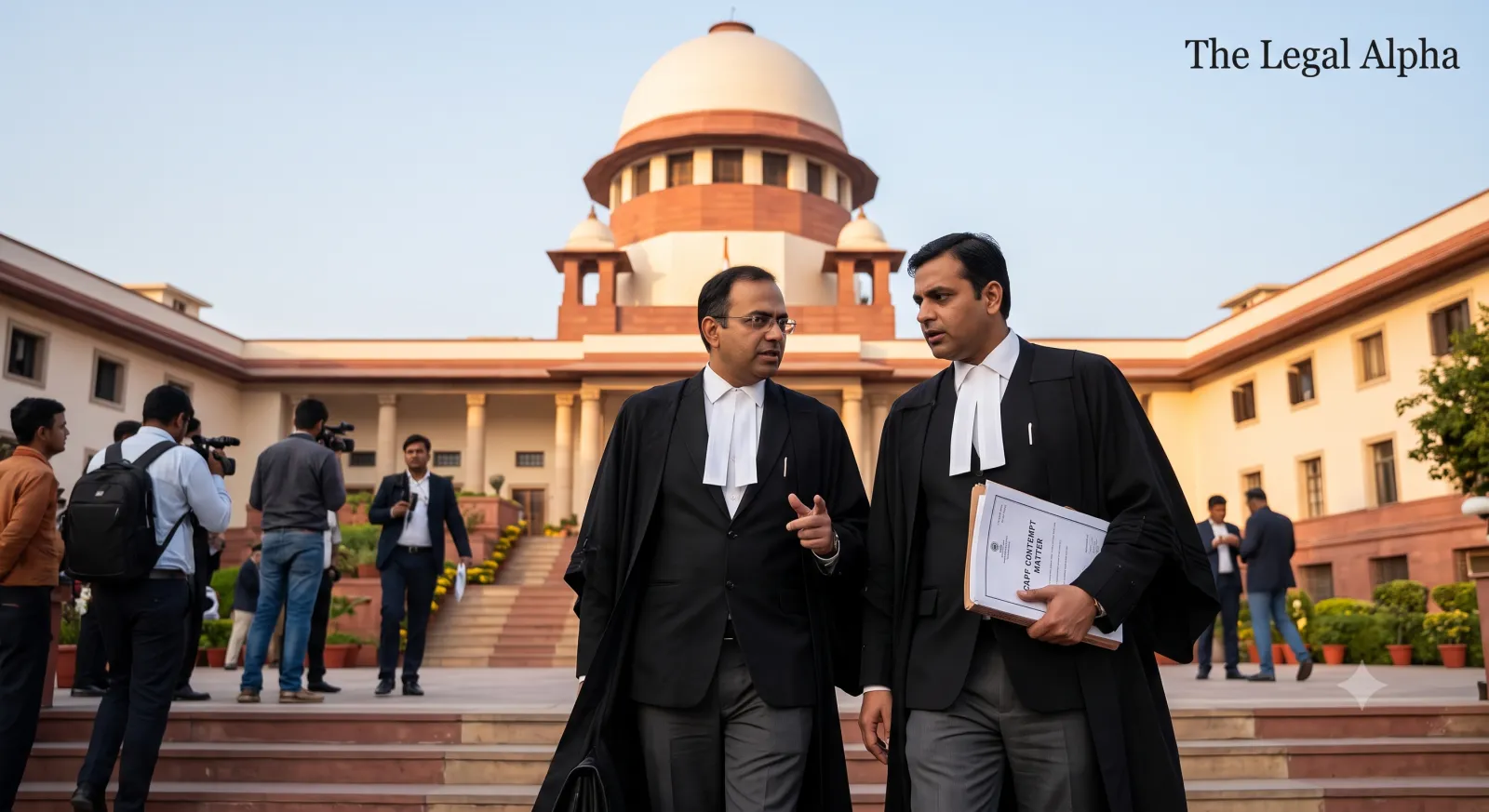
The Supreme Court of India constituted a Special Bench comprising Justice Manoj Misra and Justice Ujjal Bhuyan to hear a series of contempt petitions against Union Home Secretary Govind Mohan concerning the deputation of 46 Indian Police Service (IPS) officers to Central Armed Police Forces (CAPFs).
The matter reached an emergency listing after a bench headed by Justice Bhuyan raised sharp questions regarding how the case was abruptly struck off and deleted from the court's cause list during the lunch break, despite explicit judicial orders fixing its hearing for 2:00 PM. Demanding a formal explanation from the Supreme Court Registry, the court re-listed the matter before the newly assigned Special Bench. The underlying proceedings accuse the Ministry of Home Affairs (MHA) of defying a binding May 2025 Supreme Court verdict that ordered the government to phase down IPS deputation in paramilitary forces to prevent career stagnation for cadre officers.
Legal Topic
Area of Law: Service Law / Constitutional Law
Sub-topic: Contempt of Court / Deputation Quotas & Organised Group 'A' Services (OGAS)
Core Legal Issue
The core question before the bench is whether the Union Government committed wilful disobedience under the Contempt of Courts Act, 1971, by clearing the deputation of 46 IPS officers into senior supervisory vacancies within paramilitary formations—such as the BSF, CRPF, CISF, ITBP, and SSB—in the teeth of explicit judicial mandates requiring the gradual reduction of external deputations.
The issue is further intertwined with administrative law and constitutional mechanics: whether the Central Government can justify its non-compliance and continued appointments by relying on a newly enacted legislative intervention, the Central Armed Police Forces (General Administration) Act, 2026, which purports to restore statutory quotas for IPS officers despite a final ruling of the top court.
What Did the Court / Authority Decide?
-
Registry Called to Account: The court took serious exception to administrative interference with judicial listings, demanding an explanation from the Supreme Court Registry regarding the deletion of the matter from the published cause list.
-
Special Bench Constitution: Chief Justice of India constituted a Special Bench pairing Justice Manoj Misra (who is currently presiding over writ petitions challenging the constitutional validity of the 2026 Act) alongside Justice Ujjal Bhuyan (author of the original May 2025 judgment).
-
Status of Proceedings: While the constitutional validity of the 2026 overriding Act remains pending in independent writ proceedings, the Special Bench has taken up the contempt petitions to address whether executive actions taken prior to or alongside the new enactment violated binding court directions.
Key Legal Points
-
Sanctity of the Cause List: A judicial order listing a matter for hearing cannot be superseded or administratively removed by the court registry without express judicial authorization.
-
Judicial Mandate vs. Executive Inaction: The court reaffirmed its supervisory jurisdiction over final judgments; executive authorities cannot stall compliance with directions concerning cadre stagnation while legislative countermeasures are being litigated.
-
Limits of Legislative Overrides: When an ongoing contempt petition intersects with fresh legislation designed to alter the basis of a decree, the court must ascertain whether non-compliance occurred prior to the statute's validity being upheld.
-
OGAS Cadre Rights: Recognition of CAPFs as Organised Group 'A' Services carries structural requirements regarding promotional avenues that cannot be bypassed arbitrarily by parallel cadre induction.
Relevant Law
-
Contempt of Courts Act, 1971: Section 2(b) (Civil Contempt for wilful disobedience of court orders) and Section 12 (Punishment for contempt).
-
Constitution of India:
-
Article 14 (Equality before the law) and Article 16 (Equality of opportunity in matters of public employment).
-
Article 129 and Article 142 (Power of the Supreme Court to punish for contempt and enforce its decrees).
-
-
Central Armed Police Forces (General Administration) Act, 2026: Specifically statutory sections establishing IPS quotas up to the level of Senior Administrative Grade (SAG) and Higher Administrative Grade (HAG).
-
Binding Precedents: Sanjay Prakash & Ors. v. Union of India (May 2025) (mandating the progressive reduction of IPS deputation in CAPFs); Union of India v. Harananda (2019) (classification of CAPFs as OGAS).
Arguments of the Parties
Petitioners (CAPF Cadre Officers)
-
The petitioners contended that the Ministry of Home Affairs committed deliberate and wilful contempt by posting 46 IPS officers into DIG and IG-level vacancies in blatant violation of the May 2025 verdict.
-
They submitted that the subsequent enactment of the Central Armed Police Forces (General Administration) Act, 2026, is an impermissible legislative override aimed purely at negating a judicial pronouncement without curing the legal flaws identified by the court.
-
They asserted that cadre officers who spend decades in harsh operational fields continue to face severe promotion stagnation because senior administrative posts remain blocked by deputationists.
Respondent (Union of India / MHA)
-
The Union Government maintained that the deployment of IPS officers is vital for inter-agency coordination, border management, and national security oversight.
-
In response to judicial queries, the Home Secretary filed a compliance affidavit detailing administrative circumstances and the statutory framework governing service allocations.
-
The State argued that recruitment rules and deputation frameworks fall squarely within executive and parliamentary policy domains, now governed by the statutory scheme enacted in 2026.
Why Does It Matter?
This dispute sits at the fault line between India's internal security bureaucracy and the limits of executive power. For hundreds of thousands of personnel serving in the BSF, CRPF, CISF, ITBP, and SSB, the outcome determines whether the glass ceiling blocking cadre officers from reaching senior leadership will finally be dismantled.
Institutionally, the case highlights two critical judicial principles: first, the administrative integrity of court registries, ensuring that registry officials cannot manipulate cause lists to shield high-ranking bureaucrats; and second, the doctrine of separation of powers, testing how far Parliament can go in negating court judgments through retrospective or overriding statutes without violating Articles 14 and 16.
Legal Takeaway
A pending constitutional challenge against a new enactment does not grant executive authorities automatic immunity from complying with prior, binding judicial directions. Furthermore, internal administrative mechanisms cannot derail court cause lists when constitutional benches are monitoring compliance with service law mandates.
Sources
Primary Source:
-
Supreme Court of India proceedings and cause lists in Mahendra Singh Deo & Ors. v. Govind Mohan, Union Home Secretary (Contempt Petitions arising out of Sanjay Prakash & Ors. v. Union of India, Writ Petition (Civil) No. 442/2021).
Additional Sources:
-
Central Armed Police Forces (General Administration) Act, 2026.
-
DoPT Office Memorandum dated November 19, 2009 (OGAS Attributes & Cadre Review Guidelines).
-
Union of India v. Harananda (Civil Appeal No. 1474/2019).