Supreme Court Sets Aside Allahabad HC Directions For CBI, ED Verification Of Allegations Against Rahul Gandhi
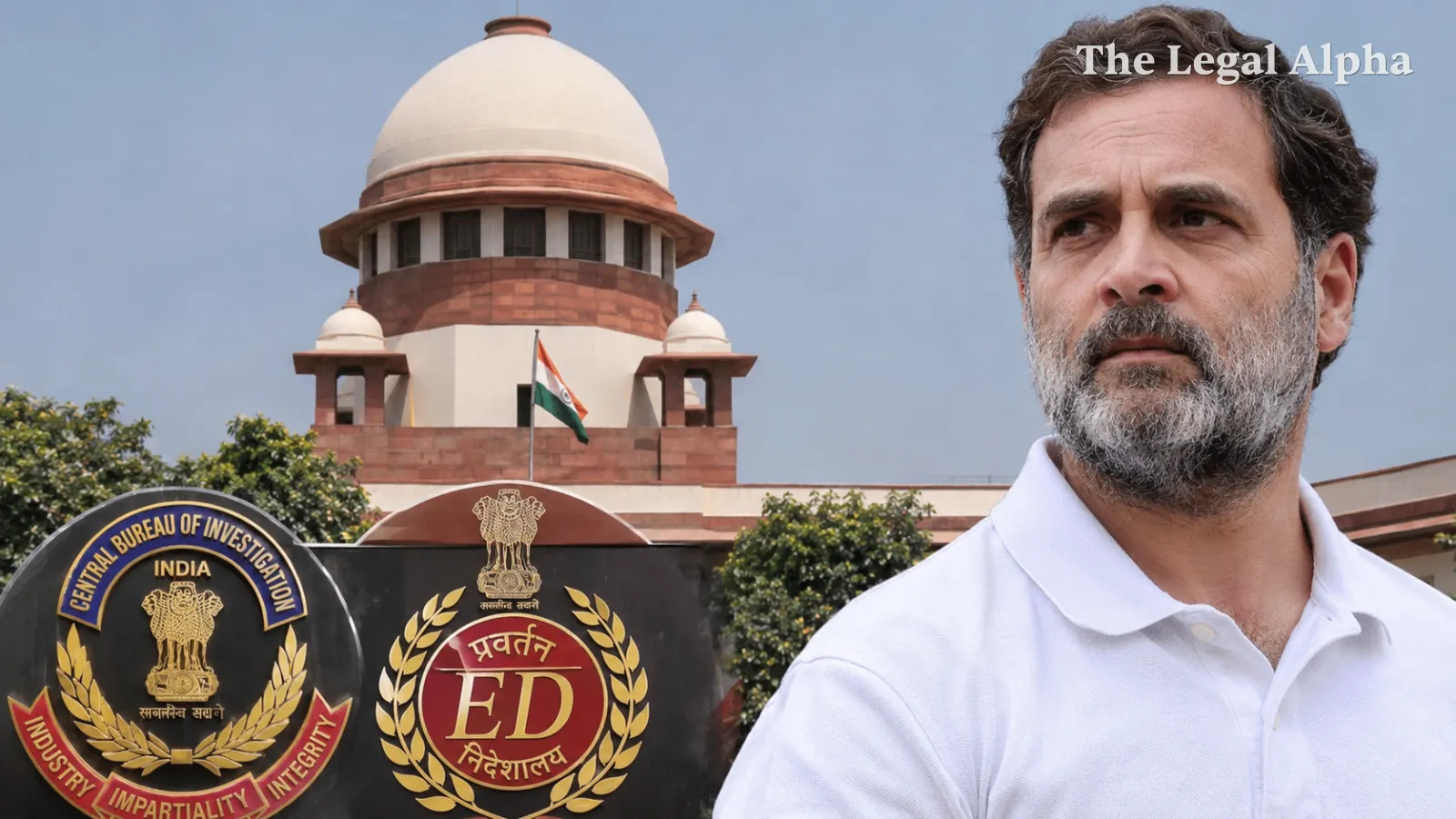
The Supreme Court of India has set aside the Allahabad High Court's orders directing the Central Bureau of Investigation (CBI) and the Enforcement Directorate (ED) to verify allegations that Congress leader and Leader of Opposition Rahul Gandhi possessed assets disproportionate to his known sources of income.
On November 25, 2026, a Bench comprising Chief Justice of India Surya Kant, Justice Joymalya Bagchi and Justice V. Mohana sent the matter back to the Allahabad High Court for fresh consideration.
The Supreme Court directed that Rahul Gandhi must be made a party to the proceedings and given an opportunity to present his arguments before the High Court passes any further orders.
The decision follows Gandhi's challenge to the High Court's earlier directions, which he argued were issued without hearing him.
Area of Law: Constitutional Law and Criminal Law
Sub-topic: Principles of Natural Justice, Judicial Review and Disproportionate Assets Allegations.
The proceedings originated from a petition filed by Karnataka-based BJP worker S. Vignesh Shishir, who alleged that Rahul Gandhi possessed assets disproportionate to his known sources of income. The petitioner had also sought action against other members of Gandhi's family.
In May 2026, the Allahabad High Court directed the CBI and ED to verify the allegations in accordance with law and take appropriate steps if necessary.
Subsequently, on July 20, the High Court expressed dissatisfaction with the CBI's affidavit, observing that it did not adequately explain the progress of the inquiry. The Court also observed that the ED could proceed further if its investigation disclosed material warranting legal action.
Rahul Gandhi subsequently approached the Supreme Court, challenging the High Court's directions.
The Supreme Court set aside the Allahabad High Court's impugned orders and directed the matter to be reconsidered by a fresh Bench.
The key directions include:
-
The Allahabad High Court must constitute a fresh Bench to hear the matter.
-
Rahul Gandhi must be formally impleaded as a party to the proceedings.
-
He must be given an opportunity to present his arguments, including on whether the original petition is legally maintainable.
-
The matter must be heard afresh in open court.
-
The High Court will reconsider the issues without being bound by the earlier directions.
The Supreme Court has not ruled on whether the allegations concerning disproportionate assets are true or false. Those issues remain open for consideration before the High Court.
The central legal question was whether a High Court could issue directions to investigative agencies concerning allegations against an individual without first providing that person an opportunity to be heard.
The case also raises questions about the maintainability of a petition seeking an investigation and the extent to which courts should ensure compliance with the principles of natural justice while exercising their judicial powers.
Rahul Gandhi's Arguments
Rahul Gandhi challenged the Allahabad High Court's directions, arguing that the proceedings were legally unsustainable and that he had not been given an opportunity to respond before orders affecting him were passed.
His counsel, Senior Advocate Kapil Sibal, also questioned the petitioner's locus standi and bona fides.
Petitioner's Position
The petition was filed by BJP worker S. Vignesh Shishir, who alleged that Gandhi possessed assets disproportionate to his known sources of income.
He sought verification of the allegations by the CBI and ED and appropriate action in accordance with law.
Principles of Natural Justice: A person whose rights or interests may be adversely affected by judicial proceedings should ordinarily receive a fair opportunity to present their case.
Audi Alteram Partem: This principle requires that the other side must be heard before an adverse decision is taken.
Article 14 of the Constitution: Guarantees equality before the law and equal protection of the laws.
Article 21 of the Constitution: Protects life and personal liberty and has been interpreted to encompass procedural fairness.
These principles provide the constitutional context for the Supreme Court's insistence on a fresh hearing.
The decision highlights the importance of procedural fairness when courts deal with petitions seeking investigations against individuals.
Even where allegations are serious, judicial directions must follow established legal procedures. A person directly affected by such proceedings should have an opportunity to challenge the maintainability of the petition and respond to the allegations.
The ruling also makes clear that setting aside an earlier procedural order does not amount to a finding that the underlying allegations are false.
For investigative agencies, the matter will now proceed in accordance with the fresh proceedings before the Allahabad High Court.
The Supreme Court's decision reinforces that the seriousness of an allegation does not eliminate the requirement of a fair hearing. Rahul Gandhi will now have an opportunity to contest the maintainability of the petition and respond before the Allahabad High Court considers the matter afresh.
Primary Source: Supreme Court order dated November 25, 2026, in Rahul Gandhi v. S. Vignesh Shishir & Others, SLP (Crl.) Nos. 15416–15418 of 2026. The full order was not independently available for verification at the time of writing.
Additional Sources: