Supreme Court Quashes Anand Mohan’s Premature Release; Uma Krishnaiah Welcomes Verdict as Justice for Slain IAS Officer
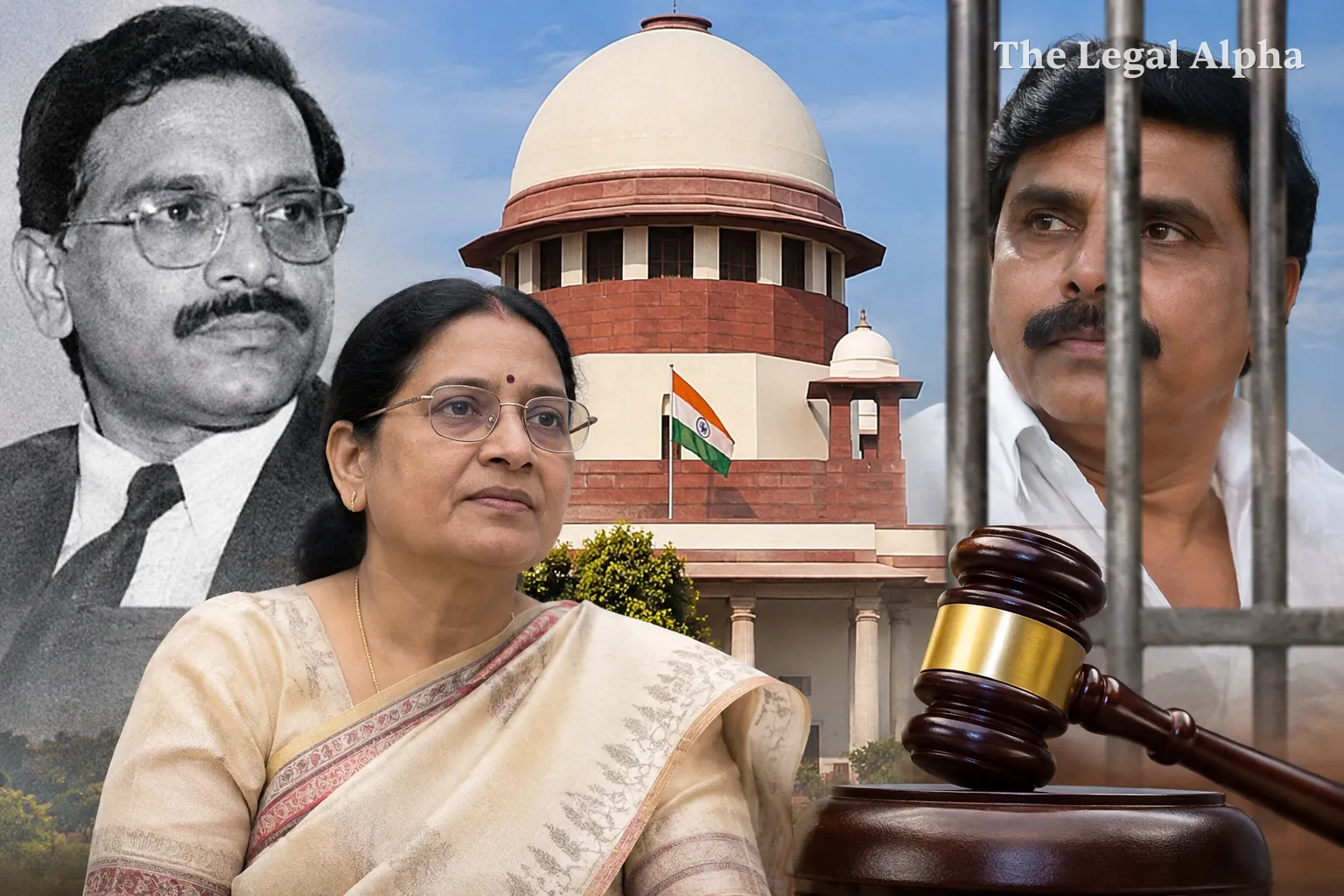
The Supreme Court of India has overturned the Bihar government's decision to grant premature release to former MP Anand Mohan, who was convicted in the 1994 murder of IAS officer G. Krishnaiah. The Court has directed Mohan to surrender before the prison authorities within one month.
The verdict has been welcomed by Uma Krishnaiah, the widow of the slain officer. She described the decision as a significant moment for her family and the IAS officers who stood by them throughout the prolonged legal battle.
Uma Krishnaiah said that although justice had taken a long time, the Supreme Court's intervention would strengthen the morale of civil servants who fought to ensure accountability in her husband's murder case.
The judgment was delivered on November 26, 2026, by a Bench comprising Justice Dipankar Datta and Justice Sheel Nagu, on a petition filed by the deceased officer's widow.
Legal Topic
Area of Law: Constitutional Law and Criminal Law
Sub-topic: Prisoner Remission, Premature Release and Constitutional Validity of Executive Decisions
Background of the Case
G. Krishnaiah, who was serving as the District Magistrate of Gopalganj in Bihar, was killed by a mob in Muzaffarpur on December 5, 1994. Anand Mohan was convicted for his role in instigating the mob.
The Patna High Court initially imposed the death penalty, which was subsequently commuted to life imprisonment. The Supreme Court upheld the life sentence in 2012.
In April 2023, the Bihar government amended its prison remission rules, removing a restriction that had prevented prisoners convicted of murdering public servants on duty from being considered for premature release.
Following this amendment, Anand Mohan was released from prison on April 24, 2023, after serving approximately 14 years.
Uma Krishnaiah challenged the amendment and the subsequent release order before the Supreme Court, questioning the legality of the government's decision.
Core Legal Issue
The central legal question before the Supreme Court was whether the Bihar government could selectively amend its remission policy to remove the restriction applicable to prisoners convicted of murdering public servants on duty, thereby making Anand Mohan eligible for premature release.
The Court also examined whether the victim's family was entitled to participate in the remission process and whether the authorities had followed the mandatory legal safeguards before granting the release.
What Did the Supreme Court Decide?
The Supreme Court allowed the petition filed by Uma Krishnaiah and set aside both the Bihar government's April 10, 2023 notification and the subsequent premature release order dated April 24, 2023.
The Bench held that the amendment removing the restriction on remission for murder of public servants on duty was manifestly arbitrary and violated Article 14 of the Constitution.
The Court also found serious procedural irregularities in the remission process, particularly the reliance on an earlier opinion of the Presiding Judge without obtaining a fresh, reasoned opinion as required under Section 432(2) of the Code of Criminal Procedure.
The Court issued the following directions:
-
Anand Mohan must surrender before the competent prison authority within one month.
-
If he fails to surrender, the authorities must take steps to bring him into custody.
-
The Bihar government may initiate a fresh remission process in accordance with law.
-
Uma Krishnaiah must be given a reasonable opportunity to submit her representation if fresh consideration of remission takes place.
Importantly, the Court clarified that the victim's family has a right to be heard but does not possess a veto over the final decision.
Key Legal Points
-
Article 14: Government decisions concerning remission must satisfy constitutional standards of fairness, reasonableness and non-arbitrariness.
-
Victim's right to participation: An identifiable victim or legal representative must receive a reasonable opportunity to submit a representation before remission is granted.
-
Section 432(2) CrPC: The opinion of the Presiding Judge must be properly reasoned and based on relevant considerations.
-
No automatic right to remission: A life convict may seek consideration for premature release but cannot claim release merely because a particular period of imprisonment has been completed.
-
Judicial review of executive power: Government remission policies remain subject to constitutional scrutiny and cannot be exercised arbitrarily.
Relevant Law
Constitution of India
-
Article 14 – Equality before law and protection against arbitrary State action.
-
Article 21 – Protection of life and personal liberty.
-
Article 32 – Constitutional remedies before the Supreme Court.
Statutory Provisions
-
Section 59, Prisons Act, 1894 – Power to make prison rules.
-
Section 432(2), Code of Criminal Procedure, 1973 – Consultation with the Presiding Judge before granting remission.
-
Rule 481(i)(a), Bihar Prison Manual, 2012 – Restrictions governing eligibility for premature release.
Arguments of the Parties
Petitioners – Uma Krishnaiah and Another
The petitioners challenged the constitutional validity of the Bihar government's 2023 amendment and the consequential premature release order.
They questioned the legality of using the amended remission policy to secure Anand Mohan's release and argued that the life sentence imposed in the murder case could not be diluted through an arbitrary change in prison rules.
They also raised concerns about the absence of proper consideration of relevant factors and procedural safeguards during the remission process.
Respondents – State of Bihar and Anand Mohan
The State defended the amendment by arguing that it was intended to bring the Bihar Prison Manual in line with the Model Prison Manual, 2016, and remission practices followed in other States.
Anand Mohan and the State also relied on his conduct during incarceration as a justification for premature release.
The Supreme Court, however, found that good behaviour alone could not replace compliance with the applicable legal requirements.
Why Does It Matter?
The judgment carries significance beyond the individual dispute because it clarifies the constitutional limits on the executive government's power to grant remission.
It establishes that State governments cannot selectively modify established remission rules without demonstrating a legitimate public purpose and a rational basis for the change.
The recognition of the victim's family's right to participate also strengthens procedural fairness in premature-release proceedings. Families affected by serious crimes must have an opportunity to place their concerns before the competent authority.
The ruling further reinforces that remission decisions must balance the rights of prisoners, victims and society rather than treating the interests of one side as the only relevant consideration.
Legal Takeaway
The Supreme Court's decision reinforces that executive discretion in granting remission is subject to constitutional safeguards and judicial review. A government cannot use arbitrary amendments to alter the consequences of a criminal sentence, while victims and their families must receive a meaningful opportunity to participate in premature-release proceedings.
Sources
Primary Source:
- Supreme Court of India, Telugu Umadevi Krishnaiah & Anr. v. State of Bihar & Ors., Writ Petition (Criminal) No. 204 of 2023, 2026 INSC 1281, decided November 26, 2026. Read the Supreme Court judgment.
Additional Sources:


