Regulate, Don’t Prohibit: Supreme Court Backs Conditional Return of Joint Firecrackers, Defers Decision on Barium and Delhi-NCR
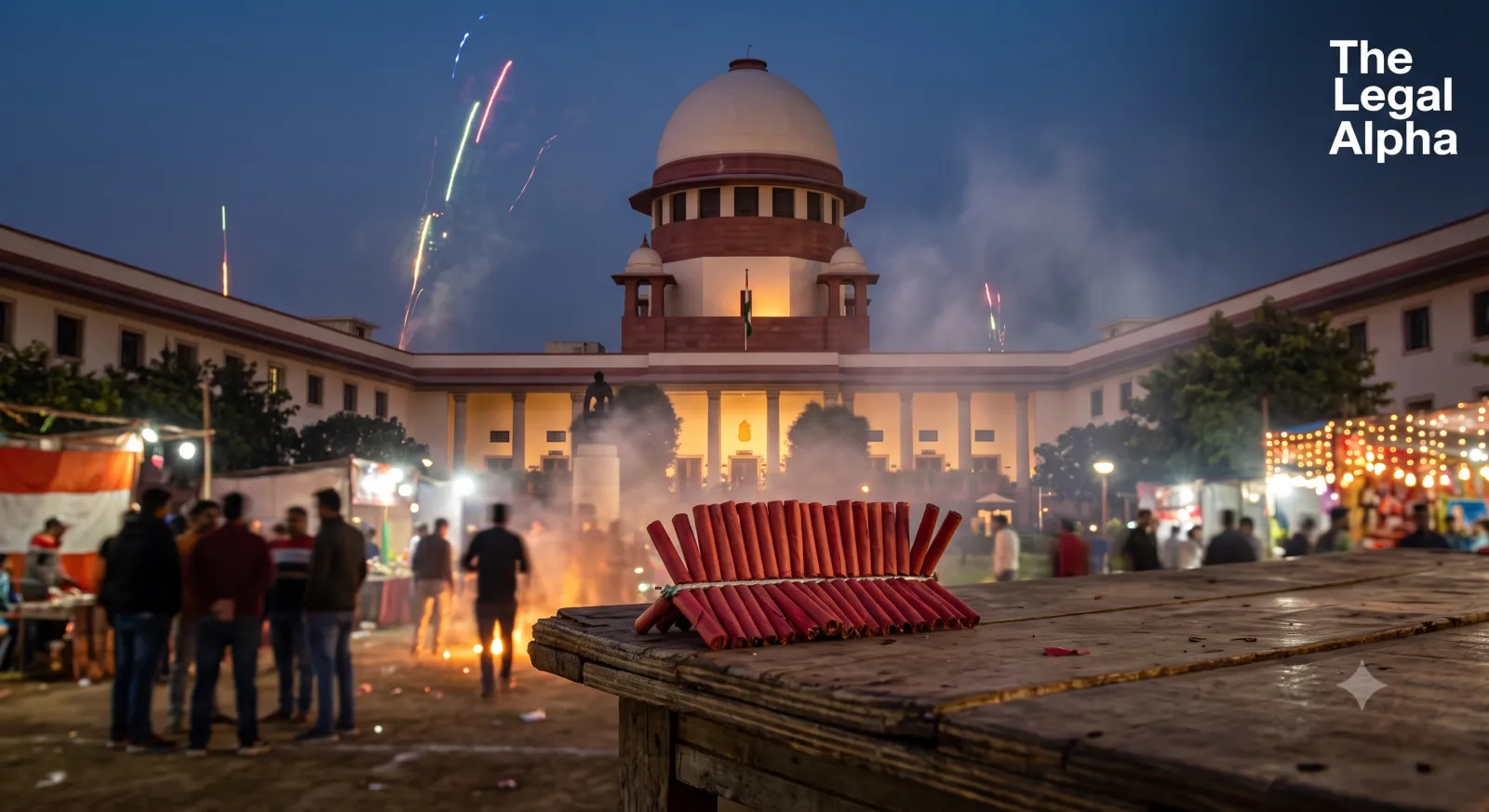
The Supreme Court of India has indicated that it will not sanction either an outright, nationwide ban on firecrackers or an unrestricted regime allowing round-the-clock bursting. A two-judge bench of Justice M.M. Sundresh and Justice Augustine George Masih, presiding over the long-running Arjun Gopal environmental litigation, stressed that the judiciary must strike a workable middle ground between honoring festive and religious traditions and protecting the constitutional right to health of vulnerable populations, including infants, senior citizens, and patients with chronic illnesses.
In a notable shift from previous blanket prohibitions, the bench accepted the Union Government's recommendation to conditionally permit the manufacture and sale of redesigned "joint firecrackers" (popularly called ladis or series crackers), provided they conform to scientific limits on shell numbers, sizing, and burst intervals. However, the Court withheld approval for the inclusion of barium in next-generation green crackers until outdoor pollution assessments across four Indian cities are completed in mid-October. Crucially, the bench declined to extend any immediate relaxation to the National Capital Region (NCR), directing stakeholders to approach the Chief Justice-led bench managing the parallel M.C. Mehta clean-air proceedings.
Legal Topic
-
Area of Law: Environmental Law / Constitutional Law
-
Sub-topic: Air and Noise Pollution Regulation / Reconciling Public Health with Cultural Practice
Core Legal Issue
The central question before the Court is whether the fundamental right to health and a clean environment under Article 21 requires a total, non-negotiable ban on firecrackers, or whether that right can be preserved through calibrated regulations—such as technological reformulations, decibel ceilings, and designated bursting windows—without extinguishing festive cultural traditions.
Subsidiarily, the bench had to determine whether new manufacturing designs for series crackers alleviate the severe smoke and solid-waste hazards that originally led to their 2018 prohibition, and whether barium nitrate can be safely reintroduced into commercial green firecracker formulations without causing significant ambient air degradation.
What Did the Court / Authority Decide?
-
Rejected Absolute Prohibition and Unchecked Usage: The bench explicitly ruled out a total ban, noting its negative impact on public sentiment, while simultaneously rejecting uninhibited 24-hour usage due to the acute health threat it poses to vulnerable demographics.
-
Conditional Clearance for Redesigned Joint Crackers: Acting on submissions from the Ministry of Environment, Forest and Climate Change (MoEFCC), the Court approved the reintroduction of "new generation" joint crackers. Manufacturing will remain strictly governed by CSIR-NEERI parameters regarding shell size, the maximum count of connected units, spacing between successive explosions, and compliance with the 125-decibel sound threshold.
-
Deferred Barium Decision Pending Multi-City Field Data: The Court granted the Union Government until October 15 to submit results from outdoor trials conducted by CSIR-NEERI and the Central Pollution Control Board (CPCB) across Bhopal, Chennai, Delhi, and Kolkata to evaluate how barium-laced green crackers behave in diverse atmospheric environments.
-
Delhi-NCR Restrictions Kept Intact for Now: The Court refrained from issuing any relaxation orders for Delhi-NCR, citing the binding restrictions and pending applications before the three-judge bench hearing the M.C. Mehta case. The bench gave parties liberty to mention the matter before the Chief Justice of India for harmonised consideration.
Key Legal Points
-
Proportionality Over Blanket Prohibitions: The Court affirmed that judicial regulation of environmental nuisances should prioritize proportionate, technologically feasible restrictions over blanket bans that disproportionately stifle cultural customs.
-
Reliance on Scientific and Evidentiary Thresholds: The relaxation of earlier curbs was conditioned on verified standards developed by expert statutory bodies (CSIR-NEERI and CPCB), underscoring that environmental modifications must be grounded in scientific evidence rather than judicial impressions.
-
Protection of Vulnerable Groups as the Constitutional Baseline: The bench reiterated that regulatory concessions cannot come at the expense of non-consenting citizens—specifically children, the aged, and the medically fragile—who bear the brunt of seasonal air spikes.
-
Judicial Comity and Harmonisation: Recognising the danger of issuing contradictory directives across parallel public interest litigations, the bench adhered to judicial discipline by deferring Delhi-NCR issues to the bench seized of the larger capital airshed case.
Relevant Law
-
Constitution of India:
-
Article 21: Right to life, encompassing clean air, unpolluted surroundings, and public health.
-
Article 25: Freedom of conscience and the right freely to profess, practise, and propagate religion.
-
Article 19(1)(g): Right to practice any profession, trade, or business (relevant to firecracker manufacturers and licensed retailers).
-
-
Environment (Protection) Act, 1986 & Air (Prevention and Control of Pollution) Act, 1981: Statutory mechanisms authorizing ambient air standard-setting and regulatory curbs on atmospheric pollutants.
-
Noise Pollution (Regulation and Control) Rules, 2000: Prescribed ambient sound ceilings, specifically capping firecracker noise at 125 dB(A) at a distance of 4 meters.
-
Explosives Act, 1884 & Explosives Rules, 2008: Statutory framework governing the chemical composition, manufacturing licenses, and distribution of pyrotechnic materials under the Petroleum and Explosives Safety Organization (PESO).
-
Judicial Precedents:
-
Arjun Gopal v. Union of India (2018) 13 SCC 523 (mandated green crackers, barred toxic chemicals like barium, and prohibited series crackers).
-
M.C. Mehta v. Union of India (Writ Petition (Civil) No. 13029 of 1985) (ongoing apex court supervision of severe atmospheric degradation in Delhi-NCR).
-
Arguments of the Parties
The Petitioners (Represented by Advocate Pooja Dhar)
-
Opposed any rollback of the ban on joint crackers, emphasizing that previous court orders prohibited ladis precisely because of their extreme concentration of particulate matter and noise.
-
Contended that designated time windows are virtually unenforceable in practice and that festival bursting typically starts well ahead of Diwali, lasting from Durga Puja through Dussehra.
-
Warned that festival emissions coincide with seasonal agricultural stubble burning in Northern India, creating an unlivable toxic haze that inflicts severe respiratory trauma.
-
Resisted lifting restrictions in Delhi-NCR, pressing for an uncompromised ban on manufacture, storage, and transport throughout the sensitive capital belt.
The Union Government (Represented by Additional Solicitor General Aishwarya Bhati)
-
Recommended allowing reformed joint firecrackers based on extensive technical consultations and formulation standards developed by CSIR-NEERI to curb particulate emissions.
-
Informed the Court that laboratory trials on Generation 2 green crackers had been concluded, but multi-city outdoor trials across varying climatic zones were essential to determine barium's environmental footprint before any commercial clearance.
-
Requested additional time until mid-October to place the outdoor test results on record.
Manufacturers and Traders (Represented by Senior Advocates J. Sai Deepak, K. Parameshwar, and Advocate Pranav Sachdeva)
-
Submitted that the industry had invested substantial resources into research and redesign to satisfy the Court’s 125 dB noise limit and reduce particulate emissions.
-
Argued against segregating Delhi-NCR from a uniform national policy, contending that local traders face disproportionate commercial hardship without a sound scientific justification.
-
Sought the restoration of existing commercial licenses so that traders could conduct lawful, regulated business during the upcoming festival season without repetitive bureaucratic delays.
Why Does It Matter?
This development signals a transition in the Supreme Court’s environmental doctrine from prohibitive bans toward regulated, technology-driven coexistence. For the domestic pyrotechnics sector—an industry heavily concentrated in Tamil Nadu’s Virudhunagar district—the conditional return of series crackers offers substantial commercial relief and regulatory predictability following years of existential distress.
However, the ruling brings back the long-standing problem of regulatory enforcement. Past experience shows that local law enforcement agencies frequently struggle to police restricted time windows or prevent non-compliant, counterfeit stock from reaching the market. Furthermore, by isolating Delhi-NCR and withholding judgment on barium, the Court demonstrated an awareness that severe regional pollution pockets require tailored, evidentiary interventions rather than hasty, sweeping relaxations.
Legal Takeaway
The Supreme Court has reiterated that environmental jurisprudence under Article 21 favors scientifically regulated activity—utilizing strict chemical formulations and defined operational windows—over absolute prohibitions that clash with cultural customs and dismantle commercial livelihoods. However, judicial tolerance remains strictly contingent upon compliance with expert scientific standards and local environmental carrying capacities.
Sources
Primary Source:
-
Supreme Court of India: Record of Proceedings in Arjun Gopal and Others v. Union of India and Others [Writ Petition (Civil) No. 728 of 2015], Bench of Justice M.M. Sundresh and Justice Augustine George Masih (Hearings dated September 2 and September 30, 2026).
Additional Sources:
-
Supreme Court of India: Directives and Orders in M.C. Mehta v. Union of India & Ors. [Writ Petition (Civil) No. 13029 of 1985].
-
Landmark Judgment: Arjun Gopal & Ors. v. Union of India & Ors. (2018) 13 SCC 523.
-
Technical specifications and reports by the Council of Scientific and Industrial Research – National Environmental Engineering Research Institute (CSIR-NEERI) and the Central Pollution Control Board (CPCB).