Punjab and Haryana High Court Questions Unauthorised Changes to Land Acquisition Awards, Seeks Six Years of NHAI Data
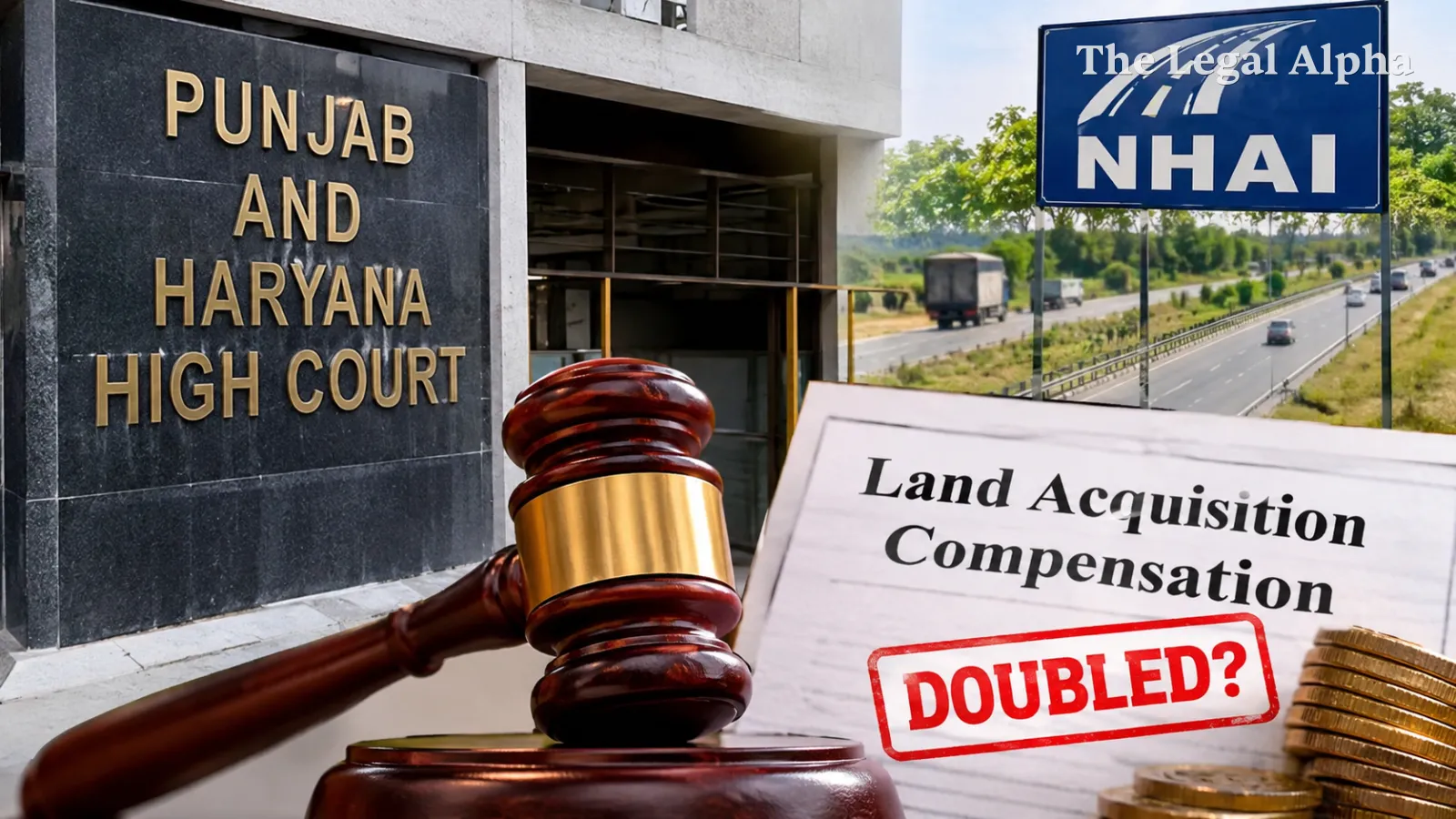
The Punjab and Haryana High Court has set aside supplementary land acquisition awards that doubled compensation payable to certain landowners, holding that the authorities lacked the power to reopen the original awards after they had been passed.
The matter concerns land acquired for widening National Highway-95, which connects Mohali with Ferozepur through several towns in Punjab. Justice Jagmohan Bansal also directed the National Highways Authority of India (NHAI) to submit details of similar supplementary and corrigendum awards issued between 2019 and 2025.
The court's intervention raises important questions about the limits of administrative powers in land acquisition proceedings and the procedural safeguards that must be followed before changing compensation awards.
Legal Topic
Area of Law: Land Acquisition Law
Sub-topic: Determination of Compensation, Modification of Land Acquisition Awards and Principles of Natural Justice
Core Legal Issue
The central legal question was whether the Competent Authority for Land Acquisition (CALA) could substantially modify an already-issued compensation award several years after its passing, particularly when the modification increased the financial liability of NHAI without giving it an opportunity to be heard.
The court also examined the extent of the authority's power to correct an award and whether changes involving the reassessment of land value could legitimately be treated as corrections of clerical or typing errors.
What Did the Court Decide?
The High Court held that the supplementary awards in question could not be sustained because they were issued years after the original awards and without providing NHAI an opportunity to present its objections.
The court observed that CALA became functus officio after passing the original award, meaning that it could no longer review or substantively modify its decision. Its limited power to correct clerical or typing mistakes could not be used to reassess compensation.
Consequently, the court set aside the impugned supplementary awards.
The court also directed NHAI to submit a report within four months containing details of supplementary and corrigendum awards passed by CALA in Punjab between 2019 and 2025, including the number of cases in which NHAI accepted the revised awards and released enhanced compensation.
The Registry was further directed to send a copy of the order to the Punjab Chief Secretary for consideration and appropriate instructions.
Key Legal Points
-
Limited power to correct awards: A land acquisition authority cannot review or substantially modify its own quasi-judicial award unless the relevant legislation expressly grants such power.
-
Six-month limitation: Section 33 of the 2013 Land Acquisition Act permits correction of clerical or arithmetical mistakes within the prescribed six-month period, subject to the statutory conditions.
-
Right to a hearing: An authority cannot make changes that adversely affect a party without providing a reasonable opportunity to be heard.
-
Nature of land matters: Changing the classification of acquired land from agricultural to commercial is a substantive modification, not merely a clerical correction.
-
Alternative legal remedy: Landowners dissatisfied with the original compensation determination must pursue the remedies available under the applicable statutory framework rather than seek an unauthorised review by CALA.
Relevant Law
National Highways Act, 1956
-
Section 3A: Empowers the Central Government to notify land proposed for acquisition for national highway purposes.
-
Section 3D: Deals with the declaration of acquisition and the vesting of acquired land in the Central Government.
-
Section 3G: Governs the determination and payment of compensation for acquired land, including recourse to arbitration in cases of disagreement.
-
Section 3I: Confers specified civil court powers on the competent authority during proceedings.
Right to Fair Compensation and Transparency in Land Acquisition, Rehabilitation and Resettlement Act, 2013
-
Section 33: Provides for correction of clerical or arithmetical mistakes in an award, subject to prescribed limitations and procedural safeguards.
-
Section 36: Provides the appropriate Government with powers to call for records before the award is made, subject to statutory conditions.
-
Section 113(1): Empowers the Central Government to issue directions and make provisions for removing difficulties in implementing the legislation.
The court also referred to the Central Government's notification dated August 28, 2015, applying specified compensation and rehabilitation provisions of the 2013 Act to acquisitions under the National Highways Act.
Important Judicial Precedent
Kalabharati Advertising v. Hemant Vimalnath Narichania, (2010) 9 SCC 437, concerning the principle that a statutory authority cannot exercise review powers unless the law expressly confers such authority.
Arguments of the Parties
National Highways Authority of India (NHAI)
NHAI challenged the supplementary awards on the ground that CALA had exceeded its statutory authority by modifying compensation determinations several years after passing the original awards.
It argued that the authority could only correct limited clerical, mathematical or similar errors within the prescribed period. It also contended that the supplementary awards were issued without notice or an opportunity of hearing, despite substantially increasing NHAI's financial liability.
NHAI further maintained that the classification of land had been changed from agricultural to commercial, resulting in compensation increasing from ₹1 crore to ₹2 crore per acre.
State Government and Landowners
The State and the landowners defended the supplementary awards, arguing that they were separate awards based on documents subsequently submitted by the landowners and were not exercises of review under Section 33 of the 2013 Act.
The landowners also contended that the acquired land had been incorrectly classified as agricultural despite evidence of its commercial use, including the existence of a petrol pump or dhaba.
They further argued that NHAI had selectively accepted similar supplementary awards in other cases while contesting the awards involved in these proceedings.
The landowners sought judicial intervention to ensure that compensation reflected the actual character and use of their land.
Why Does It Matter?
The ruling highlights an important distinction between correcting an administrative error and reopening a completed quasi-judicial determination.
Land acquisition authorities must exercise their powers within the boundaries established by legislation. A substantial change in land classification and compensation cannot automatically be justified as a supplementary or corrigendum award.
The judgment is particularly relevant to infrastructure projects involving the acquisition of private land. NHAI, railway authorities, state governments and landowners all have an interest in ensuring that compensation proceedings follow a legally recognised procedure.
The direction to examine supplementary and corrigendum awards issued between 2019 and 2025 could also help identify whether similar practices have occurred in other acquisition proceedings across Punjab.
Importantly, the judgment does not establish that landowners are never entitled to enhanced compensation. It clarifies that such claims must be pursued through legally authorised mechanisms rather than through an unauthorised review of an existing award.
Legal Takeaway
A competent land acquisition authority cannot substantially revise a final compensation award merely by issuing a supplementary or corrigendum award when the governing legislation does not authorise such action. The judgment reinforces the importance of statutory limits, procedural fairness and the right to be heard before an order adversely affecting a party is modified.
Sources
Primary Source:
- National Highways Authority of India v. Competent Authority-cum-Sub-Divisional Magistrate & Others, CWP-35795-2019 and connected matters, Punjab and Haryana High Court, decided on November 19, 2026, Justice Jagmohan Bansal.
Read the full High Court judgment on Indian Kanoon.
Additional Sources:
- Hindustan Times – Report on the High Court's directions to NHAI.


