Pre-2015 Arbitrator Appointments Cannot Be Nullified Under Section 12(5): Delhi High Court Restores ₹40 Lakh Award for DMRC
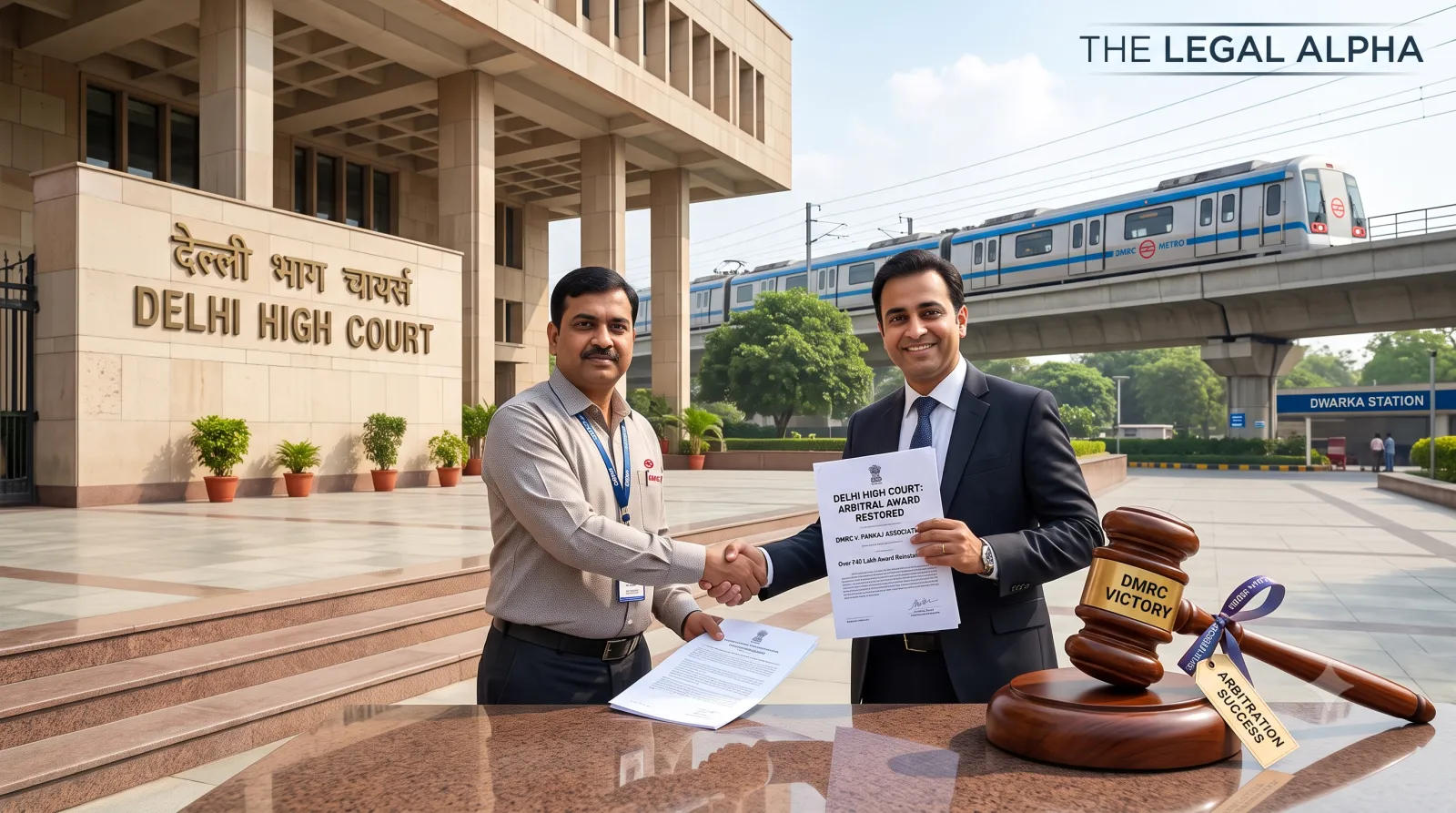
The Delhi High Court has reinstated an arbitral award exceeding ₹40 lakh along with interest in favour of the Delhi Metro Rail Corporation (DMRC), reversing a lower commercial court ruling that had invalidated the award on the grounds that it was delivered by a serving DMRC official.
A Division Bench comprising Justice Anil Kshetarpal and Justice Bharat Parashar held that statutory disqualifications introduced under the 2015 amendments to the arbitration law cannot be applied retrospectively to unseat an arbitrator whose appointment had already taken effect prior to the amendment's commencement.
The underlying controversy traces back to a commercial agreement where DMRC granted operating rights to a private entity, Pankaj Associates, to manage parking facilities across two metro stations in Dwarka. When contractual disputes arose, the matter was referred to arbitration in accordance with a clause authorising DMRC to nominate an arbitrator from within its organisation.
The designated sole arbitrator, a senior finance officer of DMRC, ultimately dismissed the contractor’s claims and awarded DMRC's counterclaim for approximately ₹40.15 lakh plus interest. Although a District Judge set aside the award in October 2024 citing statutory bias, the High Court concluded that the tribunal was legally constituted under the legal regime operating at the time of appointment.
Legal Topic
Area of Law: Arbitration Law / Commercial Litigation
Sub-topic: Arbitrator Ineligibility / Non-Retrospective Operation of Section 12(5)
Core Legal Issue
The primary question before the High Court was whether the statutory disqualifications governing an arbitrator’s relationship with a party—introduced under Section 12(5) and the Seventh Schedule through the 2015 Amendment Act—can retrospectively invalidate an arbitral tribunal validly constituted before October 23, 2015.
The Bench was also tasked with determining whether a contractual clause providing that proceedings would follow the Arbitration Act "as amended from time to time" constitutes an explicit agreement between parties to apply future statutory amendments to already-pending arbitrations under Section 26 of the 2015 Amendment Act.
What Did the Court Decide?
The High Court allowed DMRC’s appeal, set aside the District Judge’s October 2024 order, and fully restored the arbitral award rendered in favour of the public corporation.
The Division Bench ruled that the legality of an arbitrator’s appointment must be evaluated strictly against the statutory framework prevailing on the date the reference was made and the tribunal was formed. Because DMRC appointed its officer as sole arbitrator on March 24, 2015, the restrictive provisions of Section 12(5) could not reach back to extinguish the appointment.
Addressing the contractual language, the Court held that while the arbitration agreement referenced the Act "as amended from time to time", it concurrently tied procedural rules to the provisions "in force at the time the reference is made". Reading both stipulations together, the Bench clarified that the clause could not be construed as an unconditional agreement to import future statutory amendments into an ongoing arbitration.
The Court further held that a party does not waive its rights or implicitly agree to adopt subsequent statutory regimes merely by participating in the proceedings after an amendment enters into force.
Key Legal Points
-
Temporal Benchmark for Tribunal Validity: The legal competence and eligibility of an arbitral tribunal are assessed based on the statutory framework in effect on the date of appointment; subsequent statutory disqualifications do not operate retrospectively.
-
Scope of Section 26 Protection: Under Section 26 of the Arbitration and Conciliation (Amendment) Act, 2015, amendments do not apply to arbitral proceedings commenced before October 23, 2015, unless the contracting parties have expressly agreed otherwise.
-
Harmonious Reading of Reference Clauses: A clause referring to statutory amendments "from time to time" must be reconciled with clauses fixing the governing law to the date of reference, preventing unintended retrospective application of statutory bars.
-
No Implied Agreement by Conduct: Merely participating in or continuing with arbitral hearings after an amendment comes into force does not amount to an agreement under Section 26 to opt into the amended regime.
-
Pre-2015 Status of Employee Arbitrators: Prior to October 23, 2015, an employee of a contracting party was not statutorily barred from acting as an arbitrator if the arbitration agreement expressly sanctioned such an appointment.
Relevant Law
-
Section 12(5) of the Arbitration and Conciliation Act, 1996: Mandates that any person whose relationship with the parties or counsel falls within the Seventh Schedule is ineligible to act as an arbitrator, notwithstanding any prior agreement.
-
Seventh Schedule, Arbitration and Conciliation Act, 1996: Enlists categories of relationships—including existing employment—that create justifiable doubts as to independence and establish automatic disqualification.
-
Section 26 of the Arbitration and Conciliation (Amendment) Act, 2015: Transitional provision establishing that the 2015 amendments do not apply to arbitral proceedings commenced prior to October 23, 2015, absent an express agreement to the contrary.
-
Section 34 and Section 37 of the Arbitration and Conciliation Act, 1996: Governing applications for setting aside arbitral awards and subsequent appeals before appellate benches.
Arguments of the Parties
Appellant (Delhi Metro Rail Corporation)
-
The corporation contended that the arbitral proceedings were invoked in June 2014 and the sole arbitrator was appointed on March 24, 2015, well before the 2015 Amendment Act took effect on October 23, 2015.
-
DMRC submitted that Section 26 of the Amendment Act specifically insulates pre-amendment arbitral proceedings from newly introduced disqualification regimes.
-
It argued that the contractual agreement explicitly permitted the appointment of a DMRC employee, which was permissible and standard practice under the pre-amendment legal regime.
Respondent (Pankaj Associates)
-
The contractor argued that the award was fundamentally flawed because it was adjudicated by an active, serving senior officer of DMRC, creating an inherent conflict of interest.
-
Pankaj Associates maintained that Section 12(5) read with the Seventh Schedule rendered the employee arbitrator legally ineligible to pass an enforceable award.
-
It was further contended that the arbitration clause's phrase "as amended from time to time" meant the parties intended for ongoing proceedings to be governed by updated amendments as they entered the statute book.
Why Does It Matter?
This ruling provides important clarity on the temporal application of statutory arbitrator disqualifications, preventing legacy arbitral proceedings and awards from being vulnerable to collateral invalidation.
While Section 12(5) firmly prohibits serving employees from sitting as sole arbitrators in contemporary arbitrations, public sector undertakings historically relied on internal officers to resolve disputes under pre-2015 contracts. By confirming that Section 26 shields appointments made before October 23, 2015, the judgment preserves long-settled awards from being reopened purely on subsequent statutory grounds.
The decision also offers clear guidance on drafting and interpreting dispute resolution clauses. Standard phrases such as "as amended from time to time" will not be stretched into an open-ended waiver or retrospective opt-in where the contract concurrently links the dispute mechanism to the date of reference.
Legal Takeaway
An arbitrator's eligibility must be judged against the law in force when the appointment was made, meaning the statutory ineligibility rules under Section 12(5) do not apply retrospectively to pre-October 2015 appointments. Parties cannot displace the transitional safeguards of Section 26 through ambiguous contractual language or passive participation in ongoing proceedings.
Sources
Primary Source:
-
Judgment of the High Court of Delhi in Delhi Metro Rail Corporation Ltd. v. Pankaj, Division Bench of Justice Anil Kshetarpal and Justice Bharat Parashar (Decided on September 30, 2026).
Additional Sources:
-
Litigation report, Bar and Bench, published September 30, 2026.