Mumbai Metro Faces Fresh Insolvency Threat Over ₹1,745 Crore Offshore Debt as NCLT Flags Curable Defects in IIFCL UK Petition
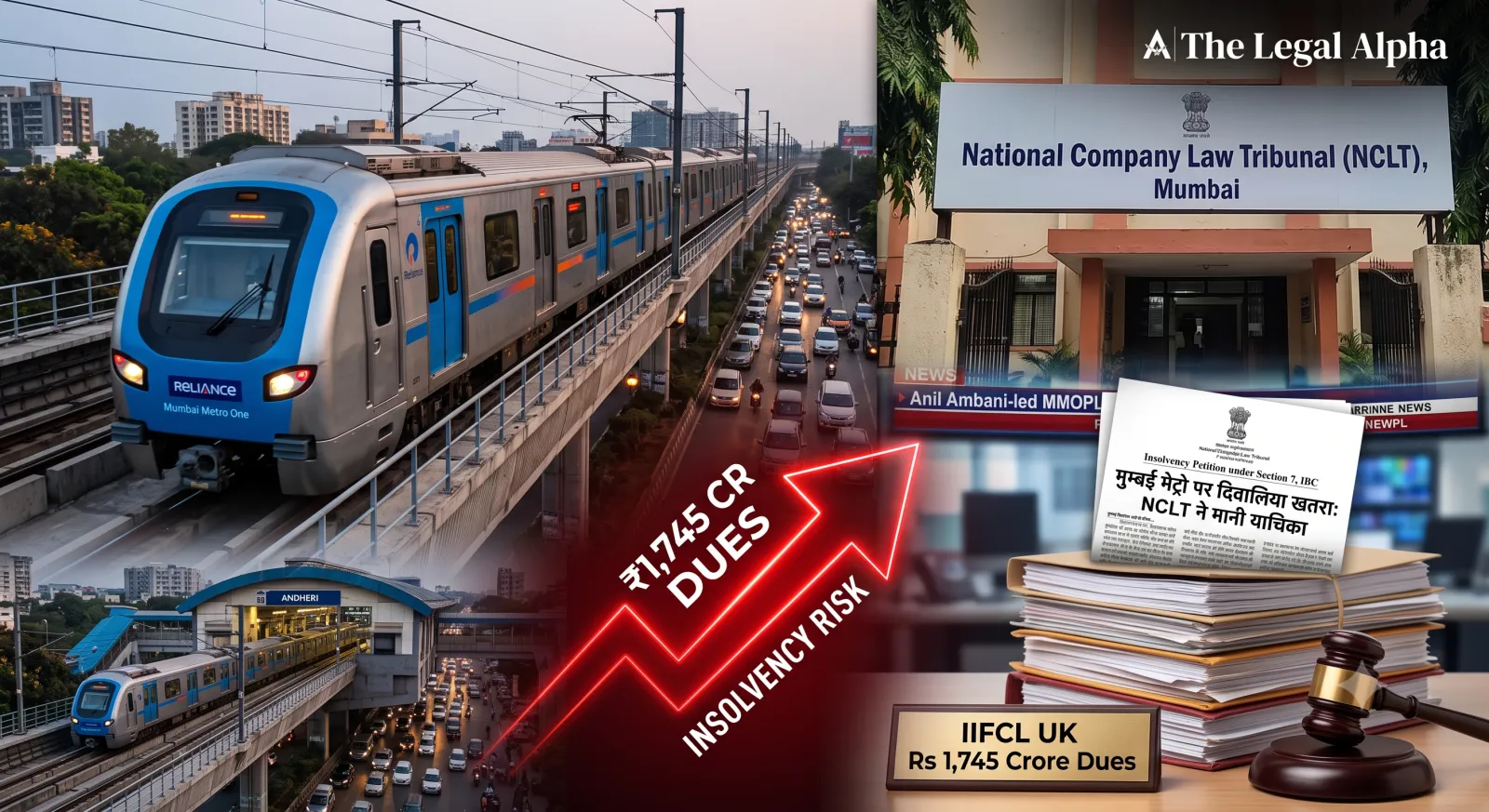
India Infrastructure Finance Company (UK) Limited (IIFCL UK), a state-owned British financing subsidiary of the Government of India, has initiated corporate insolvency proceedings against Mumbai Metro One Private Limited (MMOPL) before the National Company Law Tribunal (NCLT) in Mumbai. The offshore lender is seeking to recover external commercial borrowing (ECB) dues amounting to around $182 million, or approximately ₹1,745 crore.
MMOPL, a joint-venture concessionaire run by Anil Ambani’s Reliance Infrastructure in partnership with the Mumbai Metropolitan Region Development Authority (MMRDA), operates the 11.4-kilometre Versova-Andheri-Ghatkopar metro corridor.
At the initial hearing, the tribunal declined to issue immediate notice or admit the company into insolvency. Instead, the bench identified critical procedural omissions in the petition—including the failure to state the claim in Indian Rupees, the absence of an authenticated Record of Default from the Information Utility, and unaddressed questions surrounding limitation and pandemic-period protections. The tribunal gave the lender seven days to cure these defects before taking up the matter again.
Legal Topic
Area of Law: Insolvency and Bankruptcy Law / Corporate Finance Law
Sub-topic: Pre-Admission Scrutiny under Section 7 of the IBC / Cross-Border External Commercial Borrowings
Core Legal Issue
The primary question before the tribunal is whether an overseas financial creditor can maintain a Section 7 insolvency petition based entirely on foreign currency debt without converting the claim into Indian Rupees and without filing a certified Record of Default (Form D) from an Information Utility.
The matter also involves two threshold statutory barriers: whether the creditor’s claim is barred by the three-year period of limitation under the Limitation Act, and whether any portion of the claimed default accrued during the Section 10A statutory blackout window, which permanently bars insolvency actions for defaults arising between March 2020 and March 2021.
What Did the Court / Authority Decide?
The NCLT Mumbai Bench did not admit the petition or issue notice to the corporate debtor. Instead, it invoked the first proviso to Section 7(5) of the Insolvency and Bankruptcy Code (IBC), which obligates the adjudicating authority to grant an applicant an opportunity to cure rectifiable defects before deciding on admission or rejection.
The tribunal directed IIFCL UK to:
-
Amend its Form 1 application to convert and state the entire claim figure in Indian Rupees.
-
Clarify how the claim remains within the prescribed period of limitation.
-
Confirm that none of the claimed default amounts fall within the protected COVID-19 period under Section 10A.
-
Produce National E-Governance Services Limited (NeSL) Form D to formally establish default, noting that the lender had only annexed NeSL Form C.
The tribunal granted the lender seven days to remedy these deficiencies by filing an additional affidavit and an amended Form 1, adjourning the matter for further hearing to October 12, 2026.
Key Legal Points
-
Mandatory Statutory Curative Window: Under the first proviso to Section 7(5) of the IBC, the tribunal cannot reject a financial creditor's application on curable procedural grounds without first granting a mandatory seven-day window to rectify the defects.
-
NeSL Form D as the Evidentiary Benchmark: Filing an interim Information Utility acknowledgment (Form C) does not suffice; an authenticated Record of Default (Form D) is required to establish prima facie evidence of financial default.
-
Strict Construction of Section 10A: Even when defaults span multiple financial years, adjudicating authorities insist on an explicit carve-out showing that no debt falling within the non-actionable pandemic window is being used to trigger resolution.
-
Severability of Offshore Borrowings: The settlement or assignment of domestic consortium loans to an asset reconstruction company does not extinguish an overseas creditor’s independent statutory right to pursue insolvency under an ECB contract.
Relevant Law
-
Insolvency and Bankruptcy Code, 2016:
-
Section 7: Initiation of Corporate Insolvency Resolution Process by a financial creditor.
-
Section 7(5), First Proviso: Statutory notice directing financial creditors to rectify defects within seven days.
-
Section 10A: Prohibition against filing insolvency applications for defaults occurring during the pandemic period.
-
Section 215: Mandatory submission of financial information and default records to Information Utilities.
-
-
Insolvency and Bankruptcy (Application to Adjudicating Authority) Rules, 2016:
-
Rule 4 & Form 1: Statutory format and currency requirements for financial debt applications.
-
-
Limitation Act, 1963:
-
Article 137: General three-year limitation rule applicable to applications under Section 7 of the IBC.
-
Section 18 & Section 19: Effect of written acknowledgment of liability and part-payments in renewing the limitation clock.
-
Arguments of the Parties
Petitioner / Financial Creditor (IIFCL UK)
-
The lender submitted that MMOPL defaulted on external commercial borrowing facilities aggregating to approximately $182 million (about ₹1,745 crore).
-
Counsel argued that while domestic lenders (such as SBI and IDBI Bank) withdrew earlier insolvency pleas after assigning their debt to the National Asset Reconstruction Company Limited (NARCL), IIFCL UK’s facility remains separate and unresolved.
-
The lender noted that although it had granted in-principle consent to an earlier joint lenders’ forum debt recast, its board never granted final approval or executed the agreement.
-
Counsel pointed out that the debtor had paid roughly 10% of the dues in December 2022, but committed defaults on all subsequent repayment obligations.
-
IIFCL UK acknowledged that the claim was not converted into Indian Rupees in the original application and agreed to submit an amended Form 1.
Issues Raised by the Tribunal
-
The bench questioned whether the petition was initiated within the prescribed limitation period, seeking a clear account of how the claim remained legally enforceable from the date of initial default.
-
The tribunal inquired whether any portion of the defaulted sums fell between March 25, 2020, and March 25, 2021, which would attract a complete bar under Section 10A.
-
The bench observed that omitting the Rupee denomination and failing to produce a certified NeSL Record of Default (Form D) rendered the application defective as filed.
Why Does It Matter?
This development underscores the strict procedural threshold that the NCLT enforces before opening insolvency proceedings against crucial urban infrastructure projects.
Mumbai Metro Line 1 is a frontline public utility operated on a public-private partnership model. While the developer previously achieved breathing room when domestic consortium debt was transferred to NARCL, IIFCL UK’s standalone action demonstrates that bilateral offshore debt remains an active insolvency risk for Indian infrastructure operators.
The ruling serves as a reminder to corporate lenders that the NCLT will not dispense with essential statutory safeguards—such as Rupee-denominated pleadings, Information Utility certifications, and limitation checks—regardless of the quantum of debt or the government-backed status of the creditor.
Legal Takeaway
An overseas creditor initiating insolvency under Section 7 of the IBC must quantify its claim in Indian Rupees, substantiate default through a certified NeSL Form D, and affirmatively demonstrate that its claim is within limitation and free from Section 10A pandemic-era exclusions. Overlooking these statutory filing requirements will halt the proceedings at the pre-admission stage.
Sources
Primary Source:
National Company Law Tribunal, Mumbai Bench — Pre-admission proceedings in Section 7 application filed by India Infrastructure Finance Company (UK) Limited v. Mumbai Metro One Private Limited (Heard late September 2026; next listed October 12, 2026).
Additional Sources:
-
Insolvency and Bankruptcy Code, 2016 and related Adjudicating Authority Rules.
-
Regulatory disclosures by Reliance Infrastructure Limited.
-
Litigation reports published by Bar & Bench (September 30, 2026).