Kerala High Court Names Former Judge VG Arun to Supervise Sabarimala Chief Priest Selection
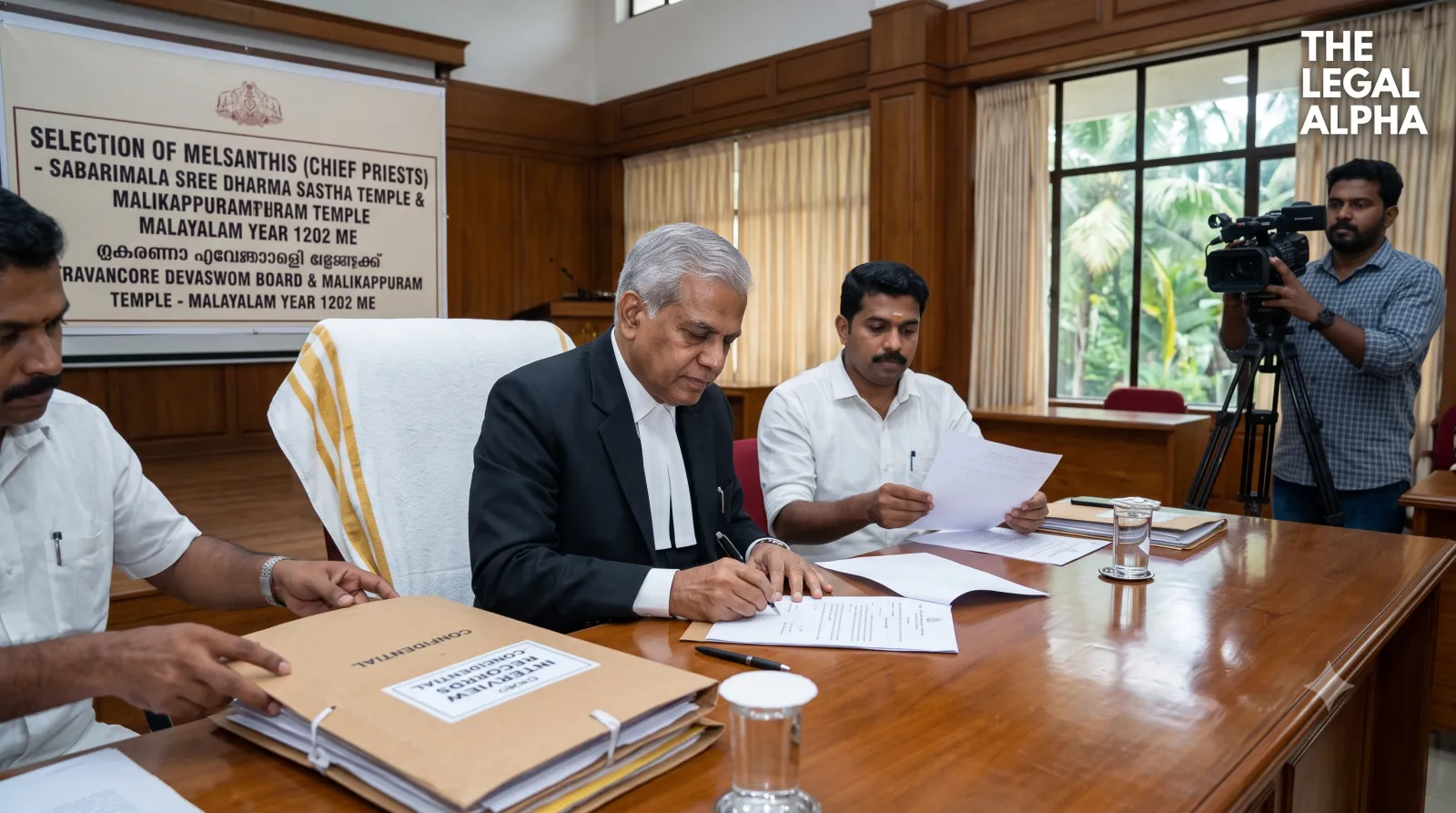
The Kerala High Court has intervened to ensure complete procedural integrity and transparency in appointing the Melsanthis (chief priests) at the prominent hill shrine of Sabarimala and the adjacent Malikappuram temple for the Malayalam year 1202 ME (2026–2027). A Division Bench comprising Justice Raja Vijayaraghavan V and Justice KV Jayakumar designated former High Court judge, Justice VG Arun, as an independent judicial observer to monitor the interview rounds and the subsequent ritualistic draw of lots.
The development stems from a suo motu petition initiated following recommendations submitted by the Sabarimala Special Commissioner. The High Court instituted stringent safeguards for the candidate evaluations scheduled at the Travancore Devaswom Board (TDB) headquarters in Thiruvananthapuram, mandating that the final selection via lot drawing cannot proceed without the court examining the interview records and granting express clearance.
3. Legal Topic
Area of Law: Administrative & Religious Endowments Law
Sub-topic: Temple Administration / Judicial Oversight of Public Trusts & Appointments
4. Core Legal Issue
The fundamental legal question before the Bench centers on the scope of judicial supervision required to safeguard fairness, non-arbitrariness, and institutional transparency in selection processes administered by statutory religious boards. Specifically, the court addressed how statutory selection norms and established guidelines for public religious offices (under the Travancore Devaswom Board) can be insulated against procedural manipulation while respecting long-standing customary practices.
5. What Did the Court Decide?
By its order dated September 29, 2026, the Division Bench passed a series of mandatory administrative and procedural directions:
-
Appointment of Independent Observer: Retired High Court judge Justice VG Arun was appointed as the official Observer to monitor interview proceedings at the TDB Head Office on October 5, 2026, and to remain present during the final draw of lots at the Sannidhanam.
-
Tamper-Proof Scoring & Documentation: Selection committee members must record candidate marks exclusively using ballpoint pens. The score sheets must be counter-attested by Justice Arun and placed under the secure custody of the Devaswom Commissioner.
-
Mandatory Videography: The entire interview evaluation must be video recorded.
-
Judicial Review Prior to Final Draw: The TDB has been directed to submit the video footage, original mark lists, and candidate shortlists in sealed covers to the High Court by October 15, 2026. The final draw of lots will remain stayed until the court reviews these records and issues further orders.
-
Customary Ritual Adherence: In line with traditional protocol, the court ordered that a young boy and girl nominated by the Pandalam Royal Family be present to draw the lots for the Sabarimala and Malikappuram sanctums, respectively.
-
Logistics: The TDB must provide all necessary travel and accommodation arrangements for the court-appointed Observer.
6. Key Legal Points
-
Proactive Suo Motu Jurisdiction: The High Court exercised its inherent supervisory and parens patriae jurisdiction over devaswom properties and public religious trusts to prevent administrative irregularities pre-emptively.
-
Safeguards Against Arbitrary Scoring: Strict documentation controls—such as requiring indelible ballpoint entries, independent judicial counter-signatures, and unbroken video records—serve as administrative safeguards under Article 14 standards of fairness.
-
Condition Precedent for Finality: The court delineated an interim checkpoint: shortlisted candidates do not acquire a vested right to enter the final draw until the High Court judicially verifies the procedural integrity of the interview phase.
-
Harmonising Custom with Rule of Law: The order preserves ancient religious customs (such as lot drawing by representatives of the Pandalam Palace) while embedding objective administrative and judicial scrutiny into the qualifying merit stages.
7. Relevant Law
-
Travancore-Cochin Hindu Religious Institutions Act, 1950: Governs the administration, governance, and appointment powers of the Travancore Devaswom Board across notified temples.
-
Constitution of India, Article 226: High Court's supervisory jurisdiction over statutory bodies and public boards administering religious trusts.
-
Judicial Precedents on Sabarimala Melshanthi Selection: Prior binding guidelines framed by the Supreme Court of India and Kerala High Court governing eligibility criteria, constitution of selection committees, mark allocations, and vigilance clearance.
8. Arguments of the Parties
-
The Sabarimala Special Commissioner: Pointed out the necessity for strict adherence to court-mandated selection guidelines and recommended independent oversight mechanisms to reinforce public confidence and procedural transparency.
-
Travancore Devaswom Board (TDB): Represented by Standing Counsel G. Biju, the Board placed before the Bench the initial scrutiny details—confirming that out of 78 total applications (48 for Sabarimala and 30 for Malikappuram), vigilance inquiries had cleared 5 candidates for Sabarimala and 3 for Malikappuram for the final interview phase.
9. Why Does It Matter?
The annual selection of the Sabarimala Melshanthi has historically attracted intense public interest and frequent legal disputes alleging subjective bias or arbitrariness in interview evaluations. By instituting an end-to-end audit mechanism—supervised by a former High Court judge and supported by sealed-cover judicial review before any name is drawn—the Kerala High Court reinforces the principle that statutory boards cannot operate with unguided discretion when filling pivotal public religious offices.
This mechanism offers a practical framework for other statutory religious endowment boards across India: procedural transparency can be achieved through non-intrusive judicial observation without displacing established ceremonial traditions.
10. Legal Takeaway
Statutory bodies managing public religious endowments must adhere to rigorous standards of procedural fairness and objectivity in key appointments. By conditioning the final selection on prior judicial scrutiny and an independent observer's certification, the High Court demonstrated how administrative discretion can be held accountable while preserving sacred temple custom.
Sources
-
Primary Source: High Court of Kerala, Order dated September 29, 2026, in Suo Motu v. State of Kerala & Ors. (Report of the Special Commissioner, Sabarimala).
-
Additional Sources: Travancore-Cochin Hindu Religious Institutions Act, 1950; Official submissions on behalf of the Travancore Devaswom Board.