India–Singapore Legal Partnership: CJI Surya Kant Calls for Stronger Arbitration Framework and Early Mediation
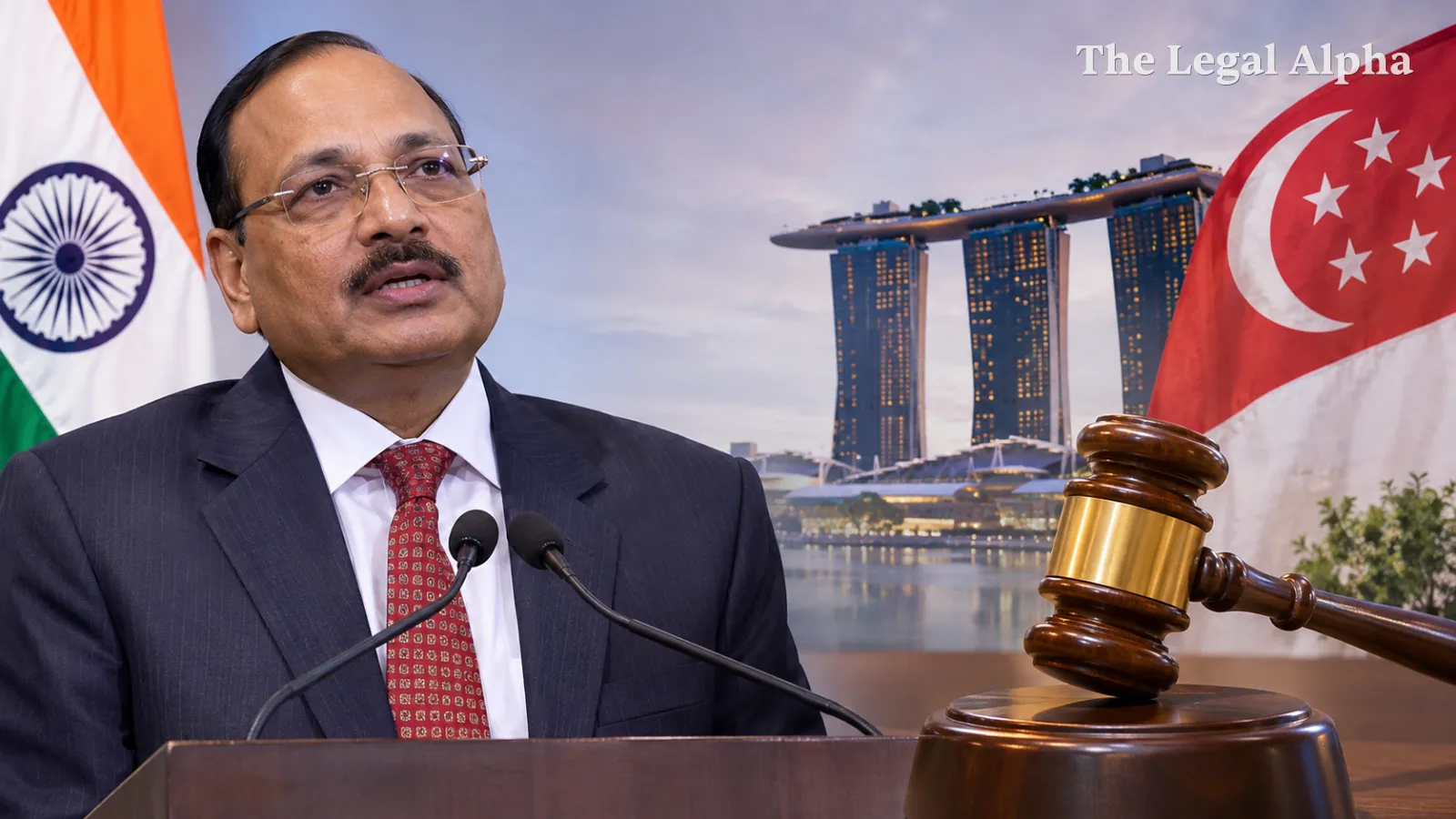
Chief Justice of India Justice Surya Kant has called for deeper cooperation between India and Singapore in strengthening international arbitration, improving professional standards and encouraging the early resolution of commercial disputes through mediation.
Addressing the Indian Council of Arbitration's (ICA) symposium titled India–Singapore: From Shared Legal Foundations to the Future through a video message on November 27, 2026, the CJI highlighted the importance of predictable dispute resolution in building investor confidence and supporting bilateral trade.
The symposium was organised at The Fullerton Hotel in Singapore to mark the 200th anniversary of Singapore's Second Charter of Justice, granted in 1826. It brought together senior legal professionals, government representatives and members of the business communities of both countries.
Justice Surya Kant emphasised that India and Singapore could benefit from exchanging institutional expertise, improving legal training and adopting technological advancements in dispute resolution.
Legal Topic
Area of Law: Arbitration and Alternative Dispute Resolution (ADR)
Sub-topic: International Commercial Arbitration, Institutional Cooperation and Mediation
Core Legal Issue
The central issue discussed at the symposium was how India and Singapore can strengthen their dispute resolution systems to address the growing complexity of cross-border commercial transactions.
A particular concern involves disputes arising from interconnected commercial agreements involving multiple parties. Such disputes can end up before different arbitral tribunals or forums, potentially resulting in inconsistent outcomes.
The discussion also highlighted the importance of balancing party autonomy in arbitration with the need for effective resolution of disputes involving multiple parties and contractual relationships.
What Did the Chief Justice of India Emphasise?
Justice Surya Kant called for cooperation between the two countries across several areas, including institutional design, professional standards, legal education, training and technology.
He also highlighted the growing role of mediation in India's dispute resolution framework and identified opportunities for cooperation through multi-tiered dispute resolution clauses.
The CJI referred to the establishment of the Mediation Council of India as an important development in India's mediation framework.
He further stressed that cooperation should operate on the principle of reciprocity. Neither country needs to reproduce the institutional framework of the other; instead, both should learn from their respective experiences and develop stronger professional and institutional relationships.
Singapore's Minister for Law and Second Minister for Home Affairs, Edwin Tong SC, also highlighted the importance of fair, transparent and predictable dispute resolution for international investors.
He noted that India was the third-largest foreign user jurisdiction of the Singapore International Arbitration Centre (SIAC), with 178 Indian parties participating in its arbitrations during the previous year.
Key Legal Points
-
International Arbitration Cooperation: India and Singapore have an opportunity to strengthen institutional relationships and exchange expertise in international commercial arbitration.
-
Early Mediation: Encouraging mediation at an early stage could help commercial parties resolve disputes without prolonged arbitration or litigation.
-
Party Autonomy: Arbitration depends on the consent of parties, but complex commercial transactions require effective approaches to resolving interconnected disputes.
-
Investor Confidence: Predictable and transparent dispute resolution mechanisms are important for attracting international trade and investment.
-
Professional Development: Cooperation in legal training, technology and professional standards can strengthen the arbitration ecosystem in both jurisdictions.
Relevant Law
The discussions at the symposium relate to the broader legal framework governing arbitration and mediation in India and Singapore.
Arbitration and Conciliation Act, 1996: Provides the principal statutory framework for arbitration in India, including domestic arbitration, international commercial arbitration and enforcement of foreign arbitral awards.
Mediation Act, 2023: Establishes a statutory framework for mediation in India and provides for institutional mechanisms, including the Mediation Council of India.
New York Convention, 1958: Provides the international framework for recognition and enforcement of foreign arbitral awards.
2024 India–Singapore Memorandum of Understanding on Cooperation in Law and Dispute Resolution: Provides a basis for bilateral cooperation in legal matters and dispute resolution.
India–Singapore Cooperation in Arbitration and Mediation
Justice Surya Kant referred to the 2024 Memorandum of Understanding on Cooperation in Law and Dispute Resolution, the first meeting of the India–Singapore Joint Consultative Committee in 2025 and the India–Singapore ADR Conclave organised by ICA in New Delhi on September 10, 2026.
The discussions reflected the growing importance of institutional cooperation between the two countries.
Singapore has emerged as a significant international arbitration destination, while India continues to strengthen its own alternative dispute resolution framework.
The symposium also highlighted the need to address disputes arising from complex, multi-contract commercial transactions, where separate proceedings may create difficulties for businesses and investors.
Why Does It Matter?
The growing commercial relationship between India and Singapore makes efficient dispute resolution increasingly important.
According to figures highlighted by Justice Surya Kant, bilateral trade increased from approximately US$6.7 billion in 2004–05 to US$34.3 billion in 2024–25. Singapore also accounted for approximately US$174.88 billion in cumulative foreign direct investment inflows into India between April 2000 and March 2025.
For businesses operating across international borders, uncertainty surrounding commercial disputes can affect investment decisions, contractual relationships and long-term business planning.
Greater cooperation in arbitration and mediation could help develop more efficient mechanisms for resolving cross-border disputes. Early mediation may also allow commercial relationships to continue instead of being disrupted by prolonged legal proceedings.
The discussions are particularly relevant for companies entering complex international transactions involving multiple agreements, jurisdictions and commercial partners.
However, the symposium represents a platform for policy discussion and institutional cooperation rather than a binding judicial or legislative decision.
Legal Takeaway
The India–Singapore symposium highlights the growing importance of international cooperation in commercial dispute resolution. Justice Surya Kant's emphasis on institutional development, professional standards, technology and early mediation reflects an approach focused not only on resolving disputes but also on maintaining commercial relationships and strengthening investor confidence.
Sources
Primary Source: Official information concerning the 2026 India–Singapore ICA Symposium and the statements delivered by the Chief Justice of India.
Additional Source: SCC Times, report dated November 27, 2026.


