Former CJI BR Gavai Questions Collegium's Accountability, Seeks Presidential Intervention Over Diversity in Judicial
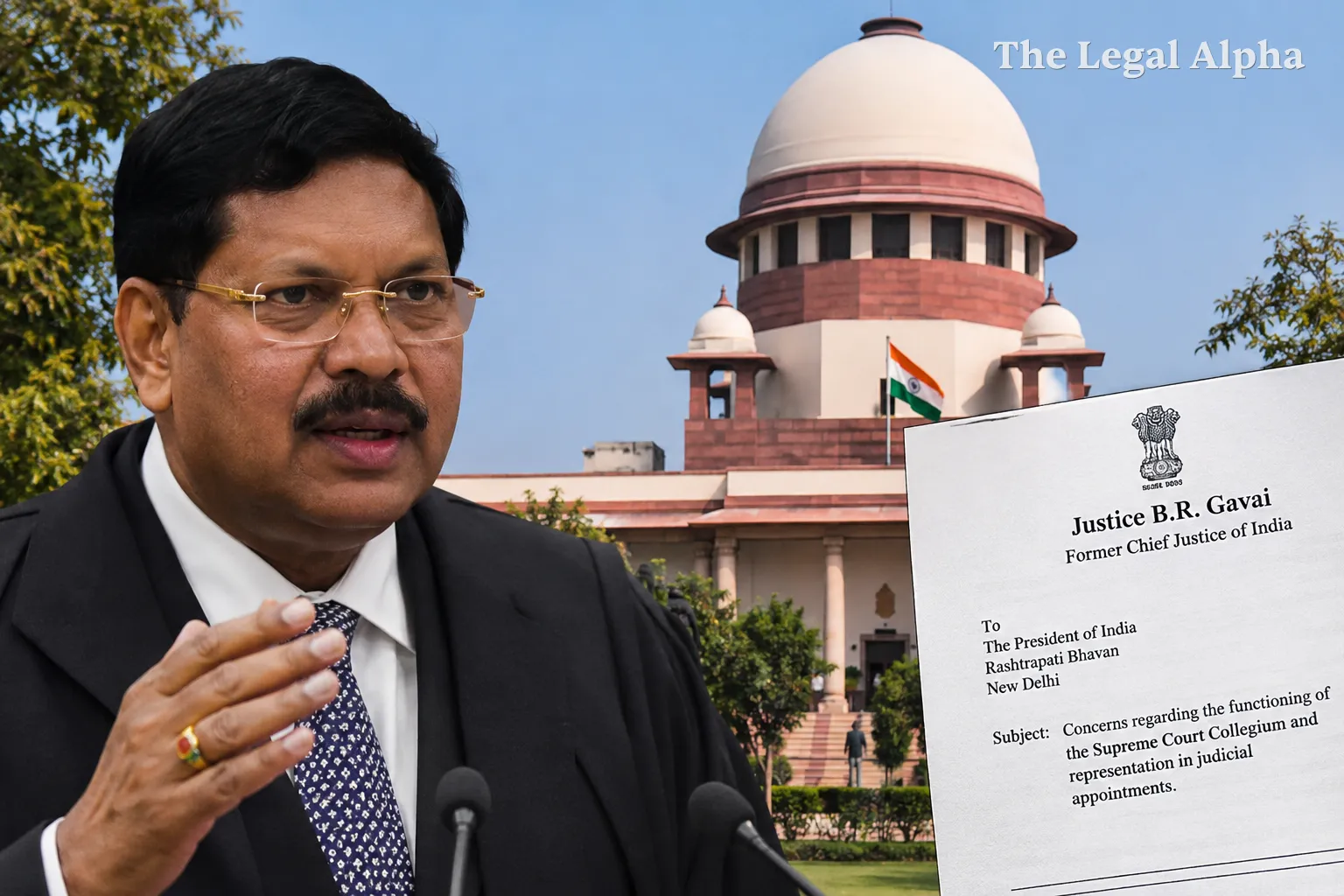
Former Chief Justice of India (CJI) Justice B.R. Gavai has written to President Droupadi Murmu expressing serious concerns over the functioning of the Supreme Court Collegium and the alleged lack of diversity in appointments to India's higher judiciary.
In a three-page letter dated November 27, 2026, Justice Gavai questioned the criteria being followed in recent judicial appointments and transfers. He alleged that candidates belonging to one particular community were increasingly receiving preference, while Scheduled Castes (SCs), Scheduled Tribes (STs), Other Backward Classes (OBCs), minorities and women were being inadequately represented.
The former CJI also questioned whether the Collegium's dominant position in judicial appointments had resulted in insufficient accountability. He urged the President to intervene and remind constitutional authorities of their responsibility to ensure fair representation in the judiciary.
The communication was also marked to Prime Minister Narendra Modi and Union Law Minister Arjun Ram Meghwal.
Legal Topic
Area of Law: Constitutional Law
Sub-topic: Judicial Appointments, Collegium System, Judicial Accountability and Social Representation
Core Legal Issue
The central constitutional question concerns the extent to which the Collegium must remain accountable while exercising its authority over appointments and transfers of judges to constitutional courts.
Article 124(2) of the Constitution provides for the appointment of Supreme Court judges by the President. However, judicial interpretations developed through the Second and Third Judges Cases established the Collegium system, giving the judiciary primacy in recommending appointments.
Justice Gavai's communication raises questions about whether this system adequately incorporates transparency, diversity and institutional accountability, particularly when candidates from different social backgrounds are considered for elevation.
Another important issue is the extent to which constitutional authorities should ensure that the composition of the higher judiciary reflects wider social representation without compromising merit and judicial independence.
What Did Justice Gavai Communicate to the President?
Justice Gavai expressed concern that recent recommendations for judicial appointments appeared to favour candidates belonging to one particular section of society.
He reportedly pointed out that a community constituting less than five per cent of India's population had secured more than 40 per cent representation in the Supreme Court in the recent past.
He also referred to parliamentary information concerning appointments to the High Courts. According to the figures cited in his letter, out of 715 judges appointed since 2018, only 22 belonged to Scheduled Castes, 16 to Scheduled Tribes, 89 to Other Backward Classes and 37 to minority communities.
The former CJI further highlighted the following concerns:
-
Unequal representation: He alleged that marginalised communities and women were not receiving adequate consideration in judicial elevations.
-
Concerns over merit: He questioned whether certain recommendations were influenced by considerations other than merit and inclusivity.
-
Judicial transfers: He raised concerns about transfers of High Court judges, suggesting that some decisions appeared inconsistent with merit-based considerations.
-
Collegium accountability: He maintained that the Collegium's primacy in appointments does not make its functioning immune from scrutiny.
-
Shared constitutional responsibility: He emphasised that the judiciary, executive and legislature all have a role in ensuring a balanced and representative higher judiciary.
Justice Gavai also referred to his own tenure as CJI, stating that he had attempted to maintain a balance between different sections of society while considering judicial appointments.
Importantly, he acknowledged that he had himself been part of the Collegium and shared responsibility for its functioning, but refrained from discussing the circumstances surrounding individual recommendations on grounds of propriety.
Relevant Constitutional Provisions and Legal Framework
Article 124(2) – Appointment of Supreme Court Judges
This provision deals with the appointment of Supreme Court judges by the President following the constitutionally prescribed consultation process. It forms the constitutional foundation of the debate concerning the respective roles of the President and the Collegium.
Article 217 – Appointment of High Court Judges
This provision governs the appointment of judges to High Courts and prescribes the constitutional consultation process.
Article 224 – Appointment of Additional and Acting Judges
This provision deals with the appointment of additional and acting judges of High Courts.
Second Judges Case (1993) and Third Judges Case (1998)
These landmark judicial decisions established and subsequently clarified the Collegium system, recognising the primacy of the Chief Justice of India and senior Supreme Court judges in judicial appointments.
NJAC Judgment (2015)
In Supreme Court Advocates-on-Record Association v. Union of India, the Supreme Court struck down the 99th Constitutional Amendment and the National Judicial Appointments Commission Act, restoring the Collegium-based appointment mechanism.
What Does the Government's Official Data Say?
The debate over representation in the higher judiciary has also been addressed in Parliament.
In its response to Lok Sabha Starred Question No. 411 on March 28, 2025, the Union Government stated that the Constitution does not provide for caste-based reservations in appointments to the Supreme Court and High Courts.
The Government further explained that social-background information had been collected from candidates recommended for High Court judgeships since 2018. It reported that, out of 540 judges appointed between 2018 and December 31, 2022, 15 belonged to Scheduled Castes, seven to Scheduled Tribes, 57 to OBCs and 27 to minority communities.
The Government also stated that it had requested High Court Chief Justices to give due consideration to suitable candidates from SC, ST, OBC and minority communities, as well as women, to improve social diversity in judicial appointments.
The official response is relevant because it establishes that social diversity has been recognised as an institutional concern, even though judicial appointments are not governed by a system of caste-based reservations.
Why Does It Matter?
The concerns raised by Justice Gavai bring renewed attention to the relationship between judicial independence and institutional accountability.
The Collegium system was developed to protect judicial appointments from excessive executive influence. However, questions about transparency, representation and the criteria used in recommending candidates remain important to public confidence in the judiciary.
A judiciary that draws its members from diverse professional and social backgrounds can contribute to broader institutional representation and public trust. At the same time, judicial appointments must remain grounded in constitutional requirements, professional competence and judicial independence.
The former CJI's communication also highlights that responsibility for improving representation cannot be attributed to a single constitutional institution. The executive, legislature and judiciary have distinct roles in the appointment process, making institutional cooperation important.
However, the allegations in the letter remain concerns expressed by Justice Gavai and should not be treated as judicial findings or an established determination of bias in individual appointments.
Legal Takeaway
Justice B.R. Gavai's letter has reopened an important constitutional debate about transparency, diversity and accountability in India's Collegium system. While judicial independence remains a fundamental consideration in appointments, the process must also inspire public confidence through fair consideration of merit and representation across different sections of society.
Sources
Primary Sources:
-
Constitution of India – Articles 124(2), 217 and 224.
-
Government of India, Ministry of Law and Justice – Lok Sabha Starred Question No. 411, March 28, 2025. Official Parliamentary Response.
-
Supreme Court of India – Collegium Resolutions and Appointment Records.
Additional Sources: