Electoral Rolls Are Not Frozen After Special Revision Drives, Clarifies Supreme Court
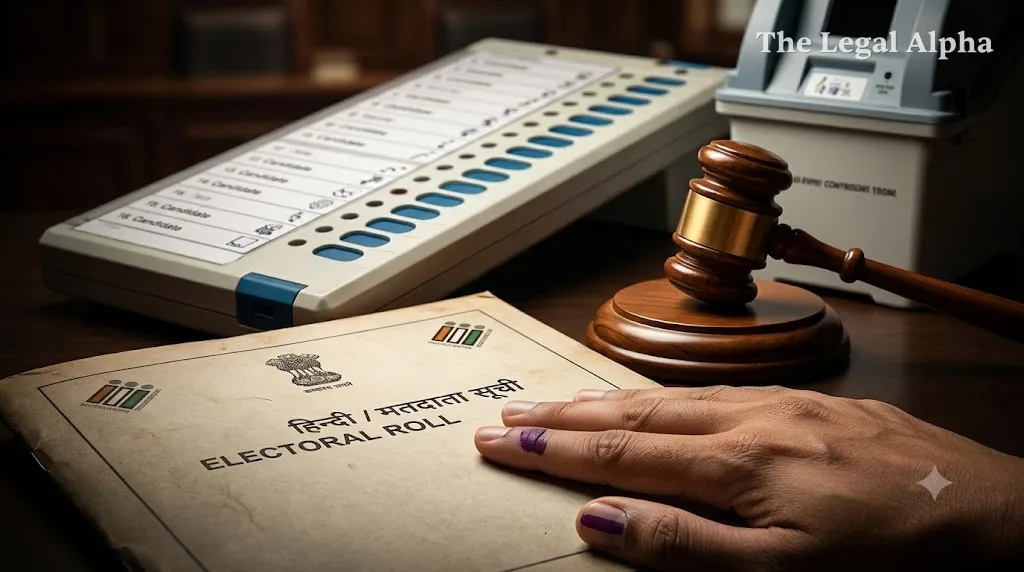
The Supreme Court of India clarified that completing a Special Intensive Revision (SIR) exercise does not result in the freezing or permanent closure of electoral rolls. A bench comprising Chief Justice of India Surya Kant, Justice Joymalya Bagchi, and Justice V. Mohana declined to extend the revision deadlines challenged in petitions arising out of Uttar Pradesh, Kerala, and Chhattisgarh. The court emphasized that voter registration and electoral roll updates remain an ongoing statutory mechanism, ensuring that eligible citizens who missed enumeration windows are not stripped of their right to vote.
Legal Topic
Area of Law: Election Law and Constitutional Law
Sub-topic: Electoral Roll Maintenance and Voter Enfranchisement
Core Legal Issue
The core issue was whether the conclusion of an intensive revision drive by the Election Commission of India permanently locks the voter rolls, thereby depriving omitted eligible individuals of their franchise unless the revision deadlines are formally extended by the judiciary.
The bench considered whether administrative closure of an intensive revision prevents eligible individuals from seeking registration through regular statutory procedures prior to election nominations.
What Did the Court Decide?
The Supreme Court refused to grant an extension of the SIR schedule, holding that no extension was required because voter addition is continuous. The bench addressed specific grievances across the respondent states:
-
The court permitted petitioners in Uttar Pradesh to submit specific instances of discrepancies directly to the Election Commission of India following acknowledged administrative lapses concerning bulk Form 7 filings.
-
In the Kerala petition, the bench directed the Communist Party of India (Marxist) to supply concrete details of individuals excluded due to time constraints, directing the election authority to scrutinize those cases and take appropriate corrective measures.
-
The court asked the Election Commission to respond to allegations of large-scale voter deletions raised through an additional note submitted by the petitioners.
The underlying legal proceedings and factual examinations remain pending before the court.
Key Legal Points
-
Electoral roll revision is legally recognized as a continuous administrative function under election statutes rather than a single frozen event.
-
The end of an intensive revision period does not extinguish the statutory right of an eligible voter to apply for enrolment.
-
The statutory scheme permits continuous updating, allowing eligible persons to submit inclusion claims right up to the last date of filing candidate nominations for an upcoming election.
-
While courts will not disrupt election administrative timelines without substantial cause, procedural lapses in processing deletion requests (Form 7) remain subject to regulatory correction and judicial oversight.
Relevant Law
-
Representation of the People Act, 1950: Section 21 (preparation and revision of electoral rolls), Section 22 (correction of entries), and Section 23 (inclusion of names in electoral rolls up to nomination filing).
-
Registration of Electors Rules, 1960: Form 6 (application for inclusion of name) and Form 7 (application for objecting inclusion or seeking deletion of name).
-
Constitution of India: Article 324 (superintendence, direction, and control of elections vested in the Election Commission) and Article 326 (elections based on adult suffrage).
Arguments of the Parties
Petitioners
The Communist Party of India (Marxist) and other petitioners contended that the intensive revision timeline was unduly compressed, leaving nearly 24 lakh eligible citizens excluded in Kerala alone due to insufficient time to submit forms. Senior counsel for other petitioners argued that large-scale voter deletions occurred during the Kerala drive and pressed for a detailed explanatory affidavit from the Election Commission. Petitioners in the Uttar Pradesh matter submitted that ground-level officials erroneously admitted bulk Form 7 objections aimed at removing names without following statutory verification procedures.
Respondent (Election Commission of India)
The Election Commission submitted that the Kerala revision process had concluded months earlier in February, serving as the basis on which recent assembly elections were conducted. Senior counsel appearing in the matter emphasized that the conclusion of a special revision does not preclude citizens from seeking inclusion, as continuous updation rules permit additions right until the candidate nomination stage. Addressing Uttar Pradesh, the commission acknowledged that local officials committed procedural lapses by accepting bulk Form 7 objections, but maintained that corrective measures were implemented and disciplinary actions were initiated against the errant officers.
Why Does It Matter?
The decision brings clarity to voter enfranchisement by untangling special revision campaigns from statutory enrolment rights. When election commissions undertake special drives, public confusion frequently arises over whether missed deadlines result in disenfranchisement. By affirming that continuous updation mechanisms remain operational until election nominations close, the top court prevented widespread disenfranchisement while refusing to derail election calendars. Simultaneously, the court's scrutiny over bulk Form 7 deletions reinforces safeguards against unauthorized voter purges without due verification.
Legal Takeaway
The formal closure of an intensive electoral revision does not permanently lock the voter register. Any eligible citizen omitted from draft or final rolls retains the statutory right to seek inclusion through standard continuous updation mechanisms right up to the last date for filing candidate nominations.
Sources
Primary Source
-
Supreme Court of India: Order dated October 30, 2026, passed by a three-judge bench comprising CJI Surya Kant, Justice Joymalya Bagchi, and Justice V. Mohana in the batch of petitions concerning Special Intensive Revision in Uttar Pradesh, Kerala, and Chhattisgarh.
Additional Sources
-
The Times of India / MSN News: Court report on the Special Intensive Revision hearing before the Supreme Court of India.