Election Commission Revises Honorarium for West Bengal Electoral Roll Tribunal Judges
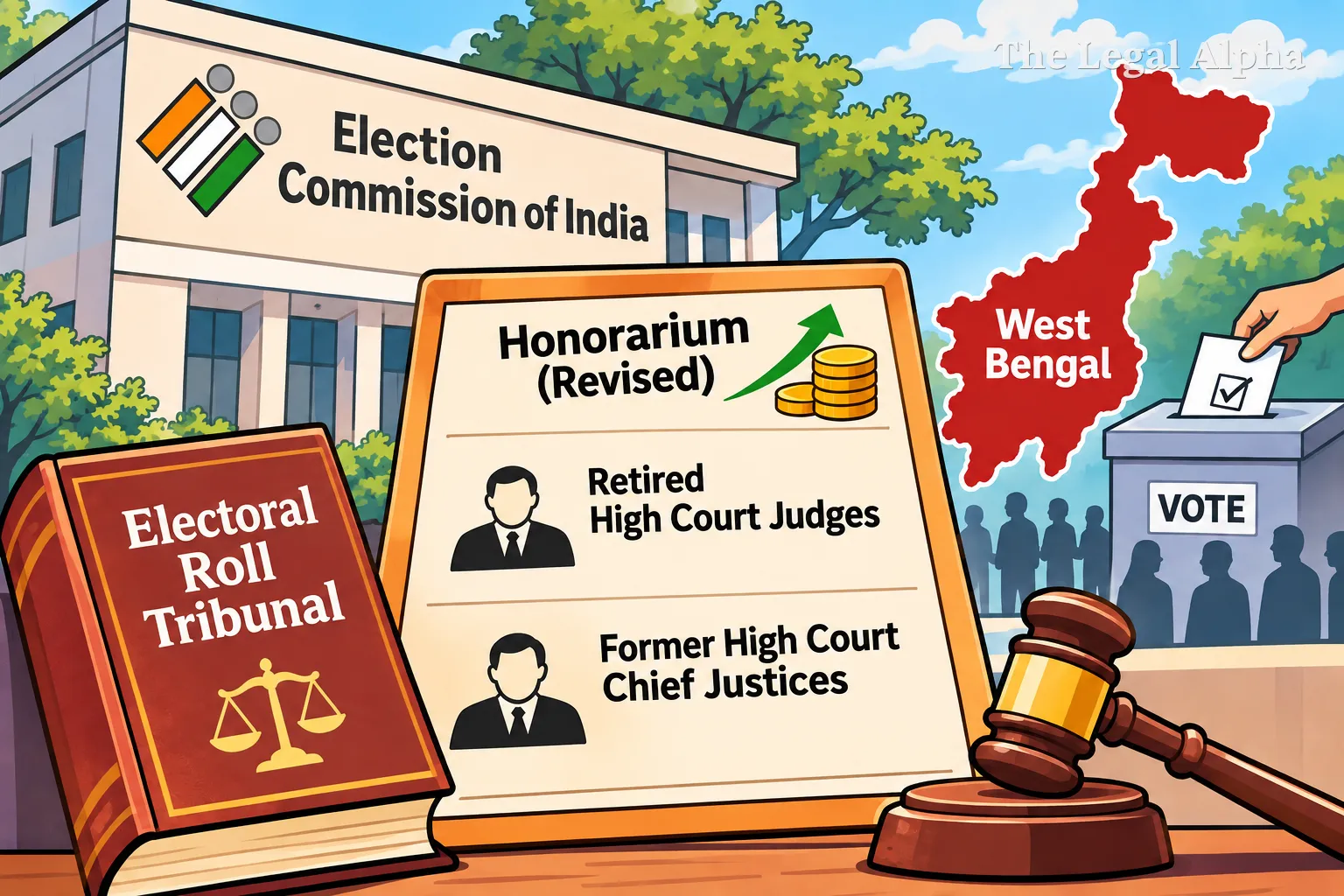
The Election Commission’s decision to increase the honorarium paid to judges serving on West Bengal’s Electoral Roll Tribunals brings attention to the administrative arrangements governing electoral-roll disputes. The revision concerns the remuneration of judicial officers entrusted with examining matters relating to voter-list entries and objections.
What Happened?
The revised payment structure provides:
-
Retired High Court Judges: ₹2.50 lakh per month.
-
Former High Court Chief Justices: ₹2.60 lakh per month.
The revised honorarium takes effect retrospectively from November 20, 2026.
Previously, the Election Commission's April 7 arrangement provided ₹1.50 lakh to retired High Court judges and ₹1.60 lakh to former Chief Justices for an initial two-week period, followed by ₹25,000 for every additional week.
The Commission has also directed the West Bengal Chief Electoral Officer to release the revised honorarium and other admissible expenses immediately.
Why Was the Honorarium Increased?
The revision followed concerns raised by tribunal judges regarding their remuneration and working arrangements.
During an August 11 meeting, the judges reportedly discussed the inadequacy of the existing payment structure. The Calcutta High Court's internal committee, headed by the Chief Justice, subsequently recommended an increase.
The Registrar General communicated the committee's decision to the Chief Election Commissioner on November 20, following which the Election Commission approved the revised rates.
Background of the West Bengal Electoral Roll Tribunals
The appellate tribunals were established following Supreme Court directions to examine appeals arising from the Special Intensive Revision (SIR) of electoral rolls in West Bengal.
The tribunals hear challenges to decisions taken by judicial officers concerning the eligibility of electors and the inclusion or deletion of names from electoral rolls.
According to figures reported by the Election Commission, judicial officers had deleted approximately 27.16 lakh voter names, while 22.21 lakh affected electors subsequently approached the 19 appellate tribunals.
The scale of pending appeals has placed considerable pressure on the tribunal system.
Supreme Court Directions on Expediting Appeals
On November 23, 2026, the Supreme Court directed the Election Commission to increase the number of appellate tribunals in consultation with the Chief Justice of the Calcutta High Court.
The Court also directed the tribunals to prioritise appeals filed by voters whose names had been deleted from electoral rolls, while temporarily deferring appeals challenging the inclusion of other voters.
Appeals involving voters from the Kolkata Municipal Corporation area were also directed to receive priority in view of the upcoming municipal elections.
What Are the Legal and Administrative Implications?
The revised honorarium addresses an important administrative aspect of the tribunal mechanism established to resolve electoral disputes.
Adequate remuneration and improved working arrangements may assist in attracting retired judicial officers to tribunal assignments and supporting the expansion of the appellate mechanism.
However, increasing remuneration alone does not resolve the substantial backlog. Timely disposal will also depend on tribunal capacity, administrative assistance, technological infrastructure and accessibility for affected voters.
What Happens Next?
The revised honorarium is effective from November 20, 2026, and the Election Commission has instructed the West Bengal Chief Electoral Officer to arrange immediate payment.
The tribunals will continue hearing appeals arising from the SIR exercise, with priority given to cases involving voters whose names were deleted from electoral rolls, in accordance with the Supreme Court's directions.
The Commission's decision is an administrative revision of remuneration; it does not determine the merits of individual electoral appeals.
Legal Takeaway
The Election Commission's decision highlights the importance of providing appropriate administrative and financial support to judicial bodies handling large-scale electoral disputes. The effectiveness of the West Bengal appellate tribunal mechanism will ultimately depend on its ability to ensure accessible hearings and timely decisions for affected electors.
Sources
Primary Source: Election Commission of India communication revising the honorarium (the complete November 27 remuneration order was not independently available for verification).
Additional Sources:


