Delhi Police Reports Sonia Gandhi's Name in 1980 Voter List Despite Citizenship Granted in 1983; Court Seeks Final Probe Report
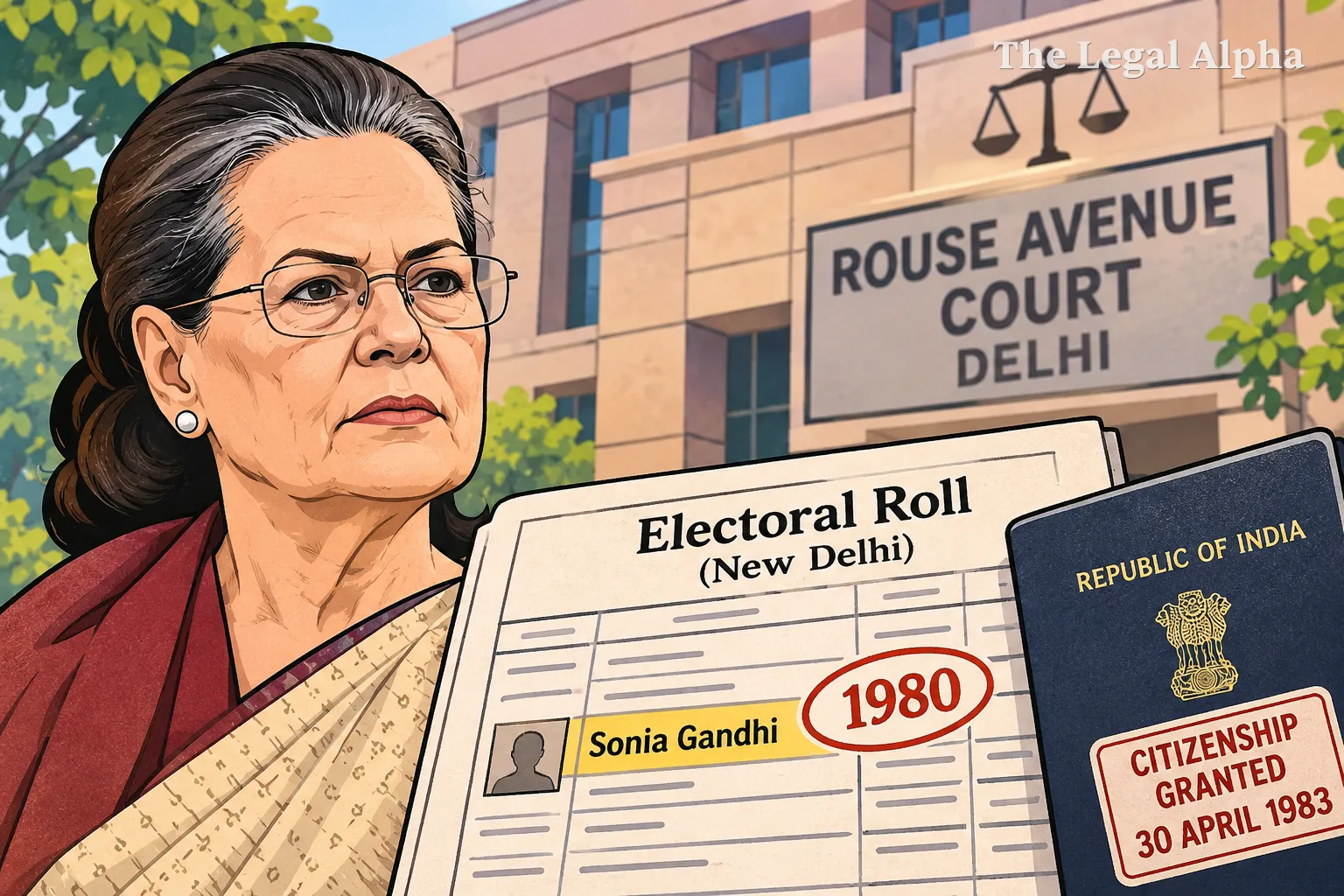
The Delhi Police has informed a court at Delhi's Rouse Avenue Courts that Congress leader Sonia Gandhi's name appeared in the electoral rolls in 1980, although she acquired Indian citizenship on April 30, 1983.
The submission was made during proceedings on a complaint filed by Vikas Tripathi, who has sought registration of an FIR over the alleged inclusion of Gandhi's name in the electoral rolls before she became an Indian citizen.
According to the police, the Electoral Registration Officer (ERO) of Assembly Constituency 40 confirmed through a communication dated November 25, 2026, that Gandhi's name appeared in the electoral rolls for 1980 and 1983. The police also obtained citizenship-related documents from the Ministry of Home Affairs.
However, the investigation is not yet complete. The police requested additional time to examine the remaining electoral records and determine whether the allegations disclose a cognisable offence.
Legal Topic
Area of Law: Constitutional Law and Criminal Law
Sub-topic: Electoral Rights, Voter Registration and Alleged Electoral Roll Irregularities
Core Legal Issue
The central legal question is whether the alleged inclusion of an individual's name in an electoral roll before acquiring Indian citizenship can attract criminal liability, particularly where the complaint raises allegations of false declarations or forged documents.
The matter also concerns the procedure a magistrate must follow when considering a complaint seeking police investigation and registration of an FIR.
What Did the Court Decide?
Judicial Magistrate First Class Vinod Joshi granted the Delhi Police additional time to complete its inquiry and submit a comprehensive report.
The court directed the police to clarify:
-
Whether the allegations disclose any cognisable offence.
-
Whether an FIR has been registered against the accused persons.
-
What action has been taken during the inquiry.
-
The present status of the investigation.
The police must submit its report by December 14, 2026. The court has also sought information about the progress of the investigation.
Importantly, the court has not held Sonia Gandhi guilty of any electoral or criminal offence. The proceedings remain at the inquiry stage.
Key Legal Points
-
Citizenship and voting rights: Indian citizenship is a fundamental eligibility requirement for registration as an elector under the applicable election laws.
-
Electoral roll irregularities: Alleged wrongful inclusion in an electoral roll may require examination of the relevant applications, declarations and official records.
-
Criminal liability: The existence of an entry in an electoral roll does not, by itself, establish forgery, cheating or another criminal offence.
-
Police inquiry: The investigating agency must examine the available documentary evidence before determining whether a cognisable offence is disclosed.
-
Magisterial supervision: The court can require the police to clarify the progress and outcome of an inquiry when considering a complaint seeking criminal investigation.
Relevant Law
Representation of the People Act, 1950
-
Section 16 – Disqualification for registration in an electoral roll, including where a person is not a citizen of India.
-
Section 19 – Conditions for registration in an electoral roll.
-
Section 31 – Making false declarations in connection with electoral rolls.
Constitution of India
- Article 326 – Elections to the Lok Sabha and State Legislative Assemblies on the basis of adult suffrage, subject to constitutional and statutory qualifications.
Bharatiya Nagarik Suraksha Sanhita, 2023
The provisions governing investigation and a magistrate's consideration of applications seeking police investigation are relevant to the procedural background of the complaint.
Arguments of the Parties
Complainant – Vikas Tripathi
The complainant alleged that Sonia Gandhi's name appeared in the New Delhi electoral roll in 1980, despite her acquiring Indian citizenship only on April 30, 1983.
He questioned how the electoral registration could have taken place before she became an Indian citizen and sought registration of an FIR to investigate the alleged irregularities.
Respondent – Sonia Gandhi
Sonia Gandhi has denied the allegations and described the complaint as misconceived, frivolous and politically motivated.
Her response maintains that the complaint relies on speculative assumptions and does not provide foundational documentary evidence establishing the alleged wrongdoing.
Why Does It Matter?
The proceedings raise important questions about the accuracy and integrity of electoral rolls in India.
The Representation of the People Act, 1950, makes Indian citizenship an essential qualification for registration as an elector. Allegations concerning registration before acquiring citizenship therefore require examination of the underlying electoral records and documents.
However, there is an important distinction between an irregular electoral entry and criminal misconduct. Establishing criminal liability requires evidence supporting the ingredients of a specific offence.
The inquiry will also test whether the available historical records are sufficient to establish how the disputed entry was originally made. The police must examine the relevant documents before reaching a conclusion.
Legal Takeaway
Indian citizenship is a statutory requirement for registration as an elector, but an allegedly incorrect electoral entry does not automatically establish criminal liability. The decisive question is whether evidence establishes a violation of election law or the ingredients of a criminal offence.
The matter remains under police inquiry, and the next significant development is expected when the police submit their report on December 14, 2026.
Sources
Primary Source:
- Rouse Avenue Court proceedings in Vikas Tripathi v. Sonia Gandhi, order dated November 28, 2026, as reported in the court proceedings.
Additional Sources: