Right to Agitate Cannot Mask Criminal Antecedents: Bombay High Court Demands Accountability on Detentions and Protest Venues
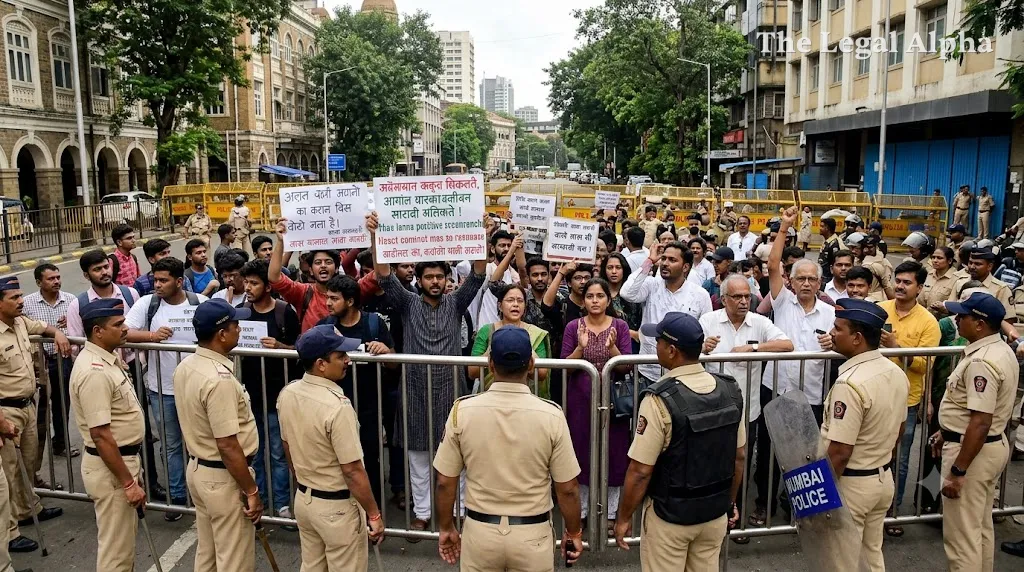
The Bombay High Court intervened in the ongoing controversy surrounding recent public demonstrations in Mumbai, balancing civil liberties against public order. While examining allegations of unlawful police detentions during demonstrations against the Chief Election Commissioner (CEC), a division bench stressed that while the right to assemble and protest is protected by the Constitution, authorities and courts must carefully examine the credentials and backgrounds of participants to ensure demonstrations are not hijacked by individuals with criminal records.
The court directed the Maharashtra government to file a formal reply regarding petitions alleging arbitrary house arrests and detention of agitators. Simultaneously, the bench took note of grievances raised by local residents regarding protests organized at Shivaji Park in violation of standing judicial restrictions.
Legal Topic
-
Area of Law: Constitutional Law / Criminal Procedure
-
Sub-topic: Fundamental Freedoms, Preventive Custody, and Public Assembly Regulation
Core Legal Issue
The central question before the High Court is whether executive and police authorities can use preventive detentions and house arrests against demonstrators without violating the constitutional guarantee of peaceful assembly, and conversely, whether the state has an affirmative duty to screen participant antecedents and restrict assembly venues to safeguard public order and protect local residents from severe disruption.
What Did the Court Decide?
The Bombay High Court declined to grant blanket relief at this stage and instead called for comprehensive accountability from all sides:
-
Directed the State of Maharashtra to submit a detailed response addressing allegations that protesters were held in custody for full days and subsequently placed under unauthorized house arrest.
-
Emphasized that peaceful demonstration is a constitutional guarantee, but warned that individuals with criminal records must not be allowed to participate under the cloak of ordinary citizenry.
-
ENTERTAINED interventions from residents of Shivaji Park and ordered both the petitioners and the state government to respond to claims that previous High Court orders banning protests in that zone were breached.
-
Scheduled the next hearing for November 19, 2026, leaving final determinations on the legality of the police actions pending.
Key Legal Points
-
Conditional Character of Article 19(1)(b): The freedom of assembly is inextricably tied to peaceable conduct; non-violence is an essential prerequisite, not an optional attribute.
-
Screening for Criminal Antecedents: The bench indicated that scrutinizing participants' credentials is a legitimate metric for assessing whether an assembly retains its civil character or poses an imminent threat to public safety.
-
Territorial Sanctions and Local Rights: The court recognized that protest rights cannot unilaterally override site-specific judicial bans or the civic rights of neighbourhood residents.
-
Scrutiny of Informal Detentions: Allegations of detaining individuals and restricting them to their residences without formal statutory booking require strict judicial examination.
Relevant Law
-
Constitution of India:
-
Article 19(1)(a) & 19(1)(b): Fundamental freedoms of speech, expression, and peaceful assembly without arms.
-
Article 19(2) & 19(3): Reasonable restrictions on fundamental freedoms in the interests of public order and the sovereignty and integrity of India.
-
Article 21: Protection of life and personal liberty, including safeguards against arbitrary detention.
-
-
Judicial Precedents:
-
Himat Lal K. Shah v. Commissioner of Police, Ahmedabad (1973): Established that the right to hold public meetings flows from Article 19, subject to non-arbitrary administrative regulations.
-
Anita Thakur v. State of J&K (2016): Affirmed peaceful assembly as a cornerstone of democracy, balanced against reasonable crowd-control protocols.
-
Arguments of the Parties
Petitioners
Senior Advocate Mihir Desai, appearing for the petitioners, submitted sworn affidavits detailing instances where individuals were picked up from their homes and kept in detention for entire days before being confined to their houses without lawful cause. Counsel argued that pre-emptive and extra-legal restraints by law enforcement suppress legitimate dissent and breach the personal liberty guaranteed under Articles 19 and 21 of the Constitution.
The State & Interveners
Law enforcement maintained that police forces operated with considerable restraint while managing volatile crowds and maintaining law and order in the city. Separately, counsel representing Shivaji Park residents submitted that protesters flouted existing judicial rulings explicitly designating the Shivaji Park precinct as a silence/restricted zone where political and public agitations are barred.
Why Does It Matter?
This development highlights the evolving judicial attitude toward modern mass protests. By bringing the "credentials" and criminal backgrounds of participants into the inquiry, the High Court introduces an added layer of administrative scrutiny that could influence future crowd-management protocols. If law enforcement is judicially permitted to evaluate participant backgrounds when setting assembly guidelines, it could redefine the line between preventive policing and disproportionate surveillance of political dissent.
Additionally, the case underscores the conflict between the spatial rights of urban residents and the democratic rights of political organizations. As designated protest spaces shrink across Indian metropolitan areas, judicial enforcement of venue restrictions (such as those at Shivaji Park) forces civil groups to reconcile their right to demonstrate with municipal and residential rights.
Legal Takeaway
While the High Court reaffirmed peaceful demonstration as a protected constitutional right, it clarified that this liberty does not grant blanket immunity or allow individuals with criminal records to shield themselves behind civil protests. For organizers, adherence to judicially cleared venues and maintaining a strictly peaceful, non-criminal demonstration remain critical prerequisites for constitutional protection.
Sources
-
Primary Source: Bombay High Court proceedings and oral observations in PILs concerning protest detentions and Shivaji Park venue restrictions (Hearing date: October 19, 2026).
-
Additional Sources: Reports by Press Trust of India (PTI), The Hindu, The Economic Times, and Business Standard (October 19, 2026).