Natural Justice in Slum Redevelopment: Mumbai SRA Mandates Prior Notice and Hearing for Private Landowners Before Section 3C Declarations
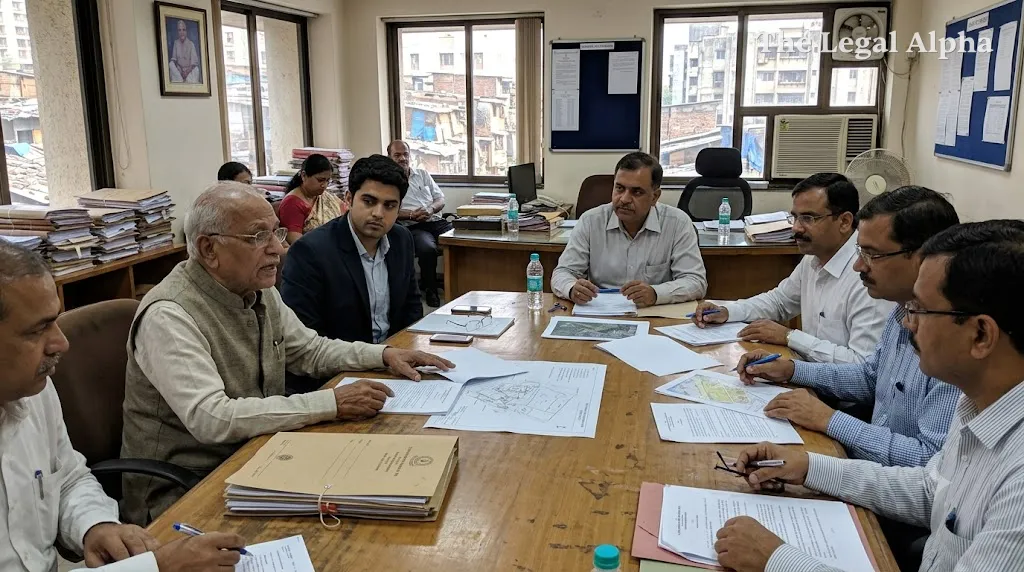
Mumbai’s Slum Rehabilitation Authority has introduced a procedural safeguard requiring prior notice and an opportunity of hearing for private landowners before their plots are officially notified as slum rehabilitation areas.
Under the revised framework, the authority will serve formal notices directly to title holders, granting them a 30-day window to submit objections and present their case. The move addresses long-standing grievances from property owners who previously found their plots declared as slums without prior individual intimation, directly affecting their constitutional property rights and statutory redevelopment priorities.
Legal Topic
Area of Law: Real Estate, Land Acquisition & Administrative Law
Sub-topic: Slum Rehabilitation / Natural Justice & Property Rights
Core Legal Issue
The core issue centres on the application of the principles of natural justice—specifically audi alteram partem (the right to be heard)—prior to statutory declarations under urban renewal laws.
When an authority designates private property as a slum rehabilitation area under Section 3C of the Maharashtra Slum Areas (Improvement, Clearance and Redevelopment) Act, 1971, it triggers statutory consequences, including rehabilitation obligations, potential acquisition under Section 14, and statutory time limits to submit redevelopment schemes. The central question is whether the statutory authority can issue such adverse declarations without affording prior notice and an individualized hearing to the recorded title owners.
What Did the Authority Decide?
The Slum Rehabilitation Authority formalized a standard operating procedure for notifications on private parcels:
-
Mandatory Intimation: The authority will issue formal notices directly to recorded private landowners before publishing a declaration.
-
30-Day Window for Objections: Landowners are provided 30 days from the receipt of notice to file objections or representations against the proposed slum status.
-
Personal Hearing: A structured hearing must be granted to the title holders to evaluate their claims before any final Section 3C notification is gazetted.
-
Rehabilitation Benchmarks Maintained: The procedural change does not alter statutory occupant cutoff dates; occupants residing in structures built prior to January 1, 2000, remain eligible for free rehabilitation, while eligible occupants from structures built between January 1, 2000, and January 1, 2011, remain subject to prescribed premiums.
Key Legal Points
-
Procedural Due Process: Reaffirms that administrative decisions encumbering private property rights under Article 300A must follow basic standards of procedural fairness.
-
Protection of First-Right Privileges: Protects the landowner’s preferential statutory right under Section 13(1) of the Slum Act to undertake in-situ redevelopment before the state initiates compulsory acquisition.
-
Pre-Emptive Dispute Mitigation: Minimizes prolonged writ litigation before the Bombay High Court concerning unilateral notifications and lack of natural justice.
-
Reconciliation of Competing Interests: Balances the welfare mandate of rehabilitating slum dwellers with the procedural rights of deed-holding landowners.
Relevant Law
-
Maharashtra Slum Areas (Improvement, Clearance and Redevelopment) Act, 1971:
-
Section 3C: Declaration of an area as a Slum Rehabilitation Area.
-
Section 13: Right and procedure for landowners/societies to execute redevelopment schemes.
-
Section 14: State power to acquire land declared under the Act for clearance and rehabilitation.
-
-
Constitution of India:
-
Article 14: Equality before the law and protection against arbitrary state action.
-
Article 300A: Right not to be deprived of property save by authority of law.
-
Arguments of the Parties
Landowners' Perspective
Landowners have consistently argued before administrative forums and the High Court that unilateral Section 3C declarations bypass the rule of fair play. They asserted that property owners often learn of slum tags only after schemes are sanctioned or acquisition notices are initiated, thereby depriving them of their statutory right under Section 13(1) to develop their own land or dispute improper slum boundaries and encroachment figures.
The Authority and Occupants' Position
The administration and occupant welfare representatives have maintained that swift slum declarations are critical to clearing hazardous dwellings and preventing endless title disputes from stalling public welfare schemes. The authority historically relied on general public gazette notifications, contending that requiring individual hearings across heavily encroached pockets could slow statutory redevelopment timelines.
Why Does It Matter?
This procedural mandate significantly impacts Mumbai's real estate ecosystem and urban land governance. By incorporating a mandatory 30-day notice and hearing stage, the Slum Rehabilitation Authority curbs bureaucratic arbitrariness and aligns administrative processes with settled constitutional benchmarks.
For developers and institutional landholders, this mechanism provides early visibility into potential slum rehabilitation schemes, reducing the risk of sudden encumbrances, title clouds, or surprise acquisitions under Section 14. For the judiciary, standardizing the right to a hearing before a notification is finalized should reduce repetitive Section 3C challenge petitions in the Bombay High Court, establishing cleaner administrative records before redevelopment projects begin.
Legal Takeaway
Administrative bodies cannot alter the legal status or development rights of private property by declaring it a slum without first affording the landowner prior notice and a reasonable opportunity to object. Ensuring audi alteram partem before issuing a Section 3C declaration protects both constitutional property safeguards and the validity of subsequent rehabilitation schemes.
Sources
Primary Source:
-
Circular / Standard Operating Procedure, Slum Rehabilitation Authority (SRA), Maharashtra, issued under the Maharashtra Slum Areas (Improvement, Clearance and Redevelopment) Act, 1971.
Additional Sources:
-
High Court of Judicature at Bombay, jurisprudence on Section 3C, Section 13(1), and Section 14 of the Maharashtra Slum Act, 1971.
-
Official communications and regulatory reports, Slum Rehabilitation Authority, Mumbai.