Modest Old-Age Pension Cannot Strip Parents of Medical Dependency Status, Rules Punjab and Haryana High Court
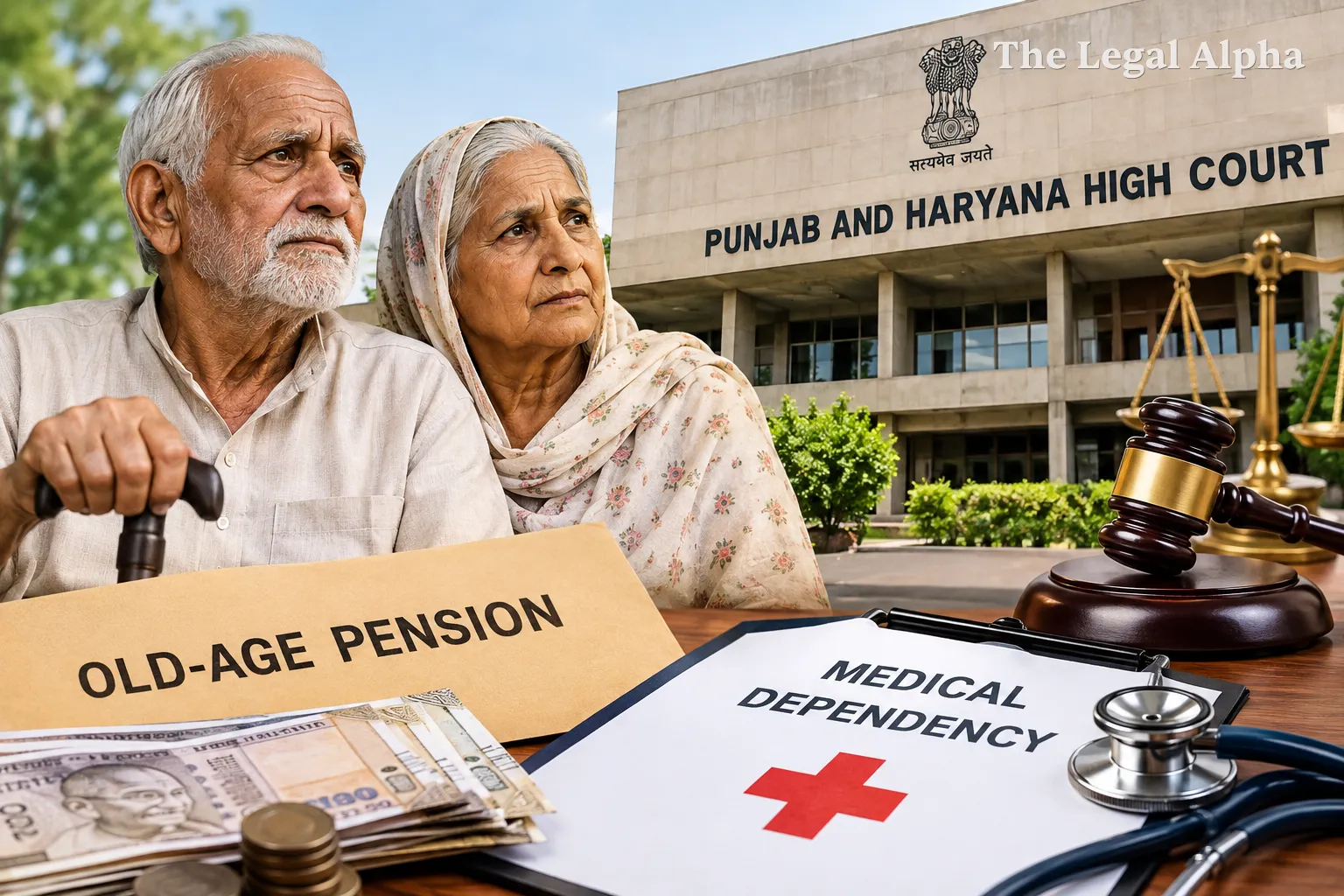
The Punjab and Haryana High Court quashed orders issued by Haryana authorities denying medical reimbursement claims to government employees on the sole ground that their elderly parents were receiving a monthly social security allowance or had minor incomes slightly exceeding administrative ceilings.
Several government employees had approached the High Court after their claims for legitimate, undisputed medical treatments of their parents or parents-in-law were rejected. State officials had based the disqualifications on a mechanical income-ceiling test, asserting that drawing the ₹3,000 monthly Old Age Samman Allowance rendered the parents financially independent. Finding this stance contrary to the purpose of welfare rules, the High Court directed the State to clear and disburse all admissible reimbursement claims within two months.
Legal Topic
Area of Law: Service Law / Administrative Law
Sub-topic: Medical Reimbursement / Definition of "Dependency" for Welfare Entitlements
Core Legal Issue
The primary question before the court was whether an elderly parent receiving a modest social security benefit—such as Haryana's ₹3,000 per month Old Age Samman Allowance—or minor earnings marginally beyond administrative financial limits automatically loses their legal status as a "dependent" for the purpose of government medical reimbursement policies.
Connected to this was whether executive instructions imposing rigid monetary caps can restrict the wider definition of family dependency envisaged under statutory service rules and constitutional guarantees of the right to health under Article 21.
What Did the Court Decide?
Justice Kuldeep Tiwari / Justice Harpreet Singh Brar's bench held that receiving a small old-age pension or social assistance cannot, by itself, negate an elderly parent's dependency on an employed son or daughter.
The court emphasized that:
-
The genuine nature of the illnesses, treatments, and hospital bills was never contested by the State.
-
Administrative circulars or executive guidelines cannot be applied so rigidly as to defeat substantive statutory entitlement and welfare protections.
-
In cases involving female employees claiming reimbursement for their parents-in-law, denial on rigid patriarchal definitions was impermissible under the applicable policy framework.
-
The impugned rejection orders were quashed, and the respondent authorities were directed to process, sanction, and disburse the admissible medical reimbursements within two months of receiving the certified order.
Key Legal Points
-
Holistic Concept of Dependency: Legal dependency in old age is not confined to basic caloric or nominal financial survival; it encompasses physical vulnerability, geriatric care, and emotional supervision, particularly when severe health complications arise.
-
Statutory Rules Prevail Over Administrative Instructions: Executive guidelines establishing low income ceilings cannot nullify or arbitrarily curtail rights grounded in statutory service conditions and government welfare rules.
-
Social Security is Not Medical Self-Sufficiency: A modest monthly welfare allowance intended for dignified living cannot be equated with an independent capacity to bear catastrophic medical and hospitalization costs.
-
Rejection on Pure Technicalities Disallowed: When hospital bills, diagnostic proofs, and the necessity of treatment are undisputed, the State cannot deny relief purely on technical grounds.
Relevant Law
-
Article 21 of the Constitution of India: Right to life, which judicially encompasses the right to health, timely medical treatment, and state assistance in welfare matters.
-
Haryana Civil Services (Medical Attendance) Rules: Statutory rules governing medical care and reimbursement entitlements for State employees and their dependent family members.
-
Supreme Court Precedent (Shiva Kant Jha v. Union of India): Principle establishing that procedural bottlenecks, administrative ceilings, or non-empanelment cannot defeat genuine claims for medical reimbursement in a welfare state.
Arguments of the Parties
Petitioners
The employees argued that their parents were advanced in age, lived with them, and were entirely reliant upon them for day-to-day care and extensive medical requirements. They contended that the Old Age Samman Allowance of ₹3,000 per month is a welfare grant from the state that nowhere covers commercial hospital treatment, surgery, or medication. They further submitted that technical executive ceilings cannot be leveraged to defeat the beneficial intent of medical reimbursement rules.
Respondent State
The State authorities contended that government guidelines clearly define the financial threshold for dependency, prescribing an income cap (such as ₹3,500 per month). They maintained that once a parent draws regular pension income or social benefits, their independent income exceeds the permissible administrative limit, disqualifying them from being categorized as a dependent under the prevailing instructions.
Why Does It Matter?
This ruling offers substantial relief to thousands of public sector employees who face rising geriatric healthcare expenses for their aging parents. Administrative departments frequently use nominal pension incomes or welfare hand-outs as an exit route to reject medical bills.
By defining dependency as an umbrella concept covering physical and medical vulnerability—rather than just an arithmetic calculation—the High Court has curbed the practice of mechanical rejections by government accounts branches. It also sets a persuasive precedent across states where administrative limits on dependent allowances have failed to keep pace with contemporary inflation and hospital costs.
Legal Takeaway
A modest social welfare pension does not make an elderly parent financially capable of funding medical crises, nor does it strip them of dependent status under service rules. Government bodies must evaluate dependency through the reality of care and actual medical need rather than relying on hyper-technical income caps to deny reimbursement.
Sources
Primary Source:
-
Sunil Kumar & connected matters v. State of Haryana and Others, Punjab and Haryana High Court.
Additional Sources:
-
High Court reporting and analysis by The Tribune and Livemint.
-
Shiva Kant Jha v. Union of India, (2018) 16 SCC 187.